

What Does Burger King Do With Leftover Food?
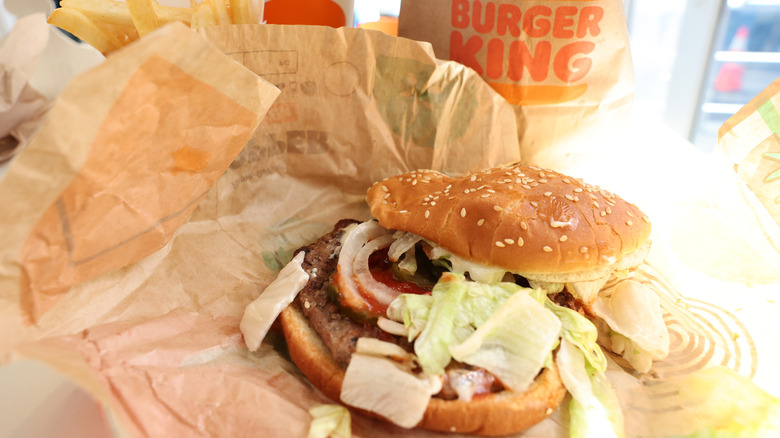
Millions of Whoppers get flame-broiled every day, stacked with lettuce, tomato, and that signature flame-grilled taste that Burger King has spent decades marketing. Most of them get eaten. Some don't. In all those cases — from a patty coming off the grill and never getting ordered, to batch of fries becoming stale under the heat lamp — someone in the back has to decide what happens next. Even though Burger King has been recycling its used fryer oil into biofuel for years, the actual food itself is a question that needs extra investigation.
Burger King is a participant in the Too Good to Go program, alongside Tim Hortons and Popeyes, by their parent company, Restaurant Brands International. This app allows people to buy "surprise bags" of unsold food at a steep discount. Across the three brands, RBI reported that there were 3,100 locations offering surplus food this way in 2025 (though it gave no breakdown showing how many belong to Burger King). Since the program began in 2023, it's saved more than 2.7 million meals in total, including 1.2 million in 2025 alone, across Canada, the U.S., U.K., Italy, France, and Spain.
Who runs the restaurant decides what happens to the food
Whether any given Whopper that doesn't sell ends up on a discount app or in a dumpster depends less on Burger King as a company and more on who owns the restaurant. The vast majority of Burger King's roughly 7,000 U.S. locations are franchised, and RBI's own reporting frames the company's role as supporting those owners with "tools, training, and best practices," rather than dictating the details of how things like food waste are managed on-site.
There's no concrete information that participating in the program is mandatory or chain-wide, so what happens to unsold food may be a decision made independently at thousands of restaurants. That variation shows up in conversations among staff members online, working in different locations, some of whom report throwing away onion and tomato slices after every breakfast shift, while others say their waste was donated to farms instead.
Look past Burger King or any single restaurant, though, and the broader picture isn't encouraging. Restaurants and food service businesses generated 12.5 million tons of surplus food in the U.S. in 2024, and more than 85% of it was landfilled or incinerated, according to ReFED. Prepared restaurant food is harder to transport, store, and hand off intact than the packaged goods a grocery store throws out, which ReFED points to as a reason why less than 1% of restaurant and foodservice surplus nationwide was donated. Between the app that sells the extra Whoppers and the dumpster behind the store that doesn't, most of the industry's unsold food still ends up in the latter. With thousands of independently run Burger King locations, there's simply no easy way to know how many belong to each side.