

Do Caramelized Onions Really Take An Hour To Cook?
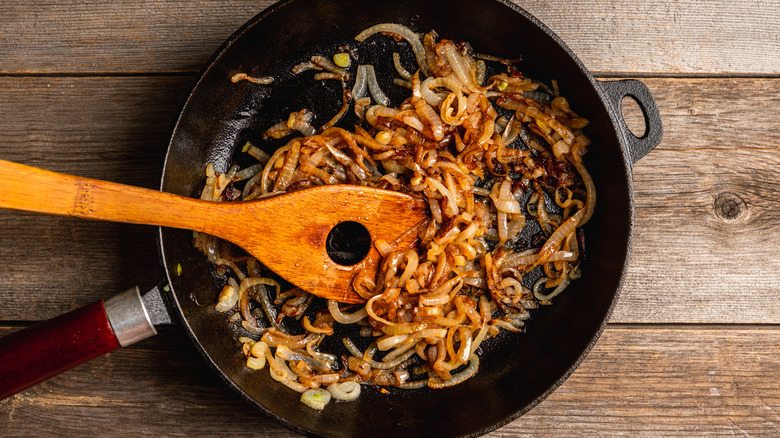
Does it really take four years to paint something like the Sistine Chapel? Does it actually take an hour to caramelize onions? You technically could get the job done faster, but would the results be the same? While we'll never really know if tutorial videos could have sped up Michelangelo's productivity, we do know that rushing caramelized onions usually doesn't pan out as well as taking your time.
There are tricks to speed up the process of caramelizing onions, but it seems that you still ultimately get out what you put in. You can turn onions brown in 10 minutes, but you can't truly caramelize them. One hour is a good rule-of-thumb cook time to make sure the sugars caramelize, and the onions brown nicely while developing more complexity — so long as you keep the temperature low so you don't burn them.
When we caramelize onions, we're using heat to transform the sugars, causing them to brown and release the compounds that make foods like caramelized onions so rich, sweet, and complex. This is not the same as the Maillard reaction, which is a separate (yet equally delicious) chemical process that turns the surface of the onions brown after sugars and amino acids interact when heated. One of the common mistakes everyone makes when caramelizing onions is cooking too hot and fast. This can result in just the surface of the onions burning before there's been enough time for caramelization to occur.
You can't rush the art of caramelization, but there are ways to make it more efficient
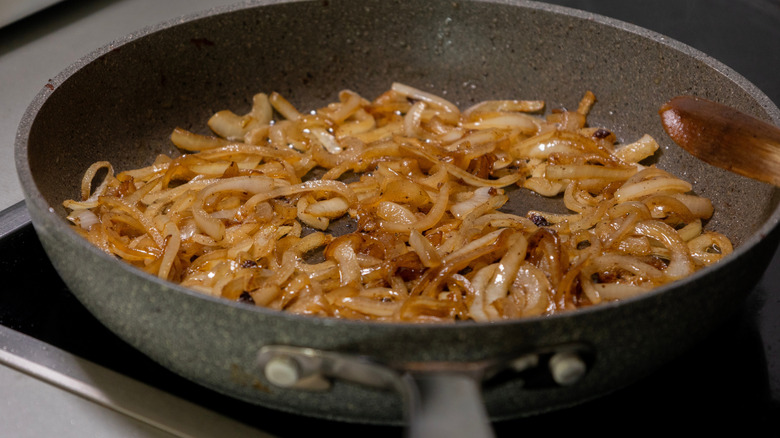
Sulfenic acids are compounds that give onions their pungency, and they take steady cooking time over low heat to break down and let sweetness take over. Squeeze an hour's worth of cooking into 20 minutes on too-high a heat, and the result can be burnt, bitter onions.
Onions are also deceptively loaded with sugar. According to the USDA, 1 cup of sliced onion contains the equivalent of just over a teaspoon of granulated sugar by weight. While it may seem logical to add sugar to speed up the transformation into a caramelized counterpart, there is already plenty of sugar there.
So, caramelization can't be rushed. However, you can employ a few tricks to avail the sugars faster so caramelization can begin. Preparing these sugars to caramelize means turning the complex carbohydrates into simpler fructose and glucose that offer more perceptible sweetness. Cooking onions initially on medium-high heat with water creates steam, which in turn cooks them more evenly, and breaks cells down faster to work out the sulfenic acid while preventing burning. Once the onions are fully softened in the steam, you can let it evaporate and cook the onions slowly over a low heat until the sugars have caramelized fully. For similar results, some have claimed that putting sliced onions in the microwave for ten minutes achieved the same initial gentle cooking process that readies them to be caramelized.