

Strawberries, Blueberries, Or Raspberries: Which Fruit Has The Least Sugar?
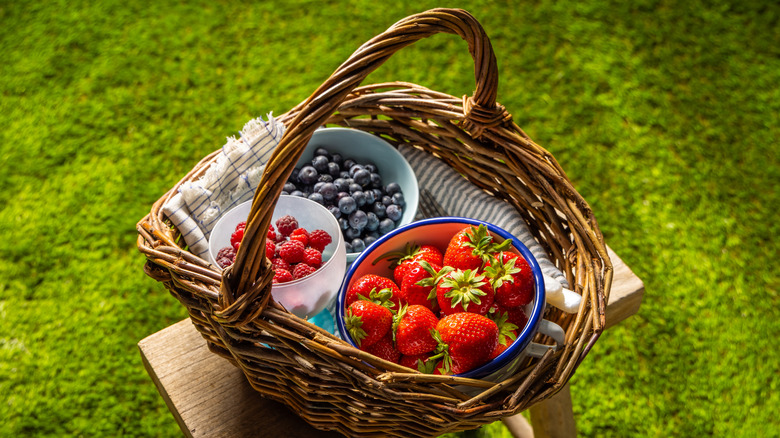
It's only too common to pick up a container of strawberries, raspberries, or blueberries in the afternoon for them to then mysteriously vanish before the end of the day ... and why not? They're natural, so they should be healthy, right? Whether for personal dieting, blood sugar management for diabetes, or general health goals, sugar content in all kinds of food goes under a discerning lens, and berries are no different.
In fact, the amount of sugar in these types of berries might actually be higher than you think. Blueberries are the most sugar-loaded by a fair margin, with 9.4 grams of sugar per 100 grams, according to the USDA. Strawberries have only about half as much sugar, 4.9 grams, while the berry with the least sugar is raspberries, with 4.4 grams. Fear not, as with most fruit, the healthy aspects of these naturally sweet treats, like fiber, vitamins, and cardiovascular and anti-inflammatory benefits, come along with the sugar content.
Looking at berries volumetrically, a cup of raspberries (123 grams) contains the equivalent of around 1.3 teaspoons worth of granulated sugar, while a cup of sliced strawberries (168 grams) contains 2 teaspoons. Meanwhile, a cup of blueberries (148 grams) contains roughly 3.3 teaspoons worth of sugar. Bear in mind that volumetrically speaking, the smaller size of blueberries means more fit in a cup than bigger berries like strawberries, which can be tricker to measure.
The type of sugar is just as important as the amount

The sugars found in these three types of berry are mainly fructose and glucose, with smaller amounts of sucrose. It may surprise you that a cup of raspberries has as similar amount of sugar to a regular marshmallow, which has around 4 grams. However, there is a big difference in how our bodies absorb sugars from natural sources like fruit, versus refined sugars.
One aspect that makes a major difference is the presence of fiber in fruit, which balances out the negatives of sugar in a few ways. Firstly, it slows the absorption of sugar into our blood, helping berries to not spike blood sugar levels. This absorption rate is known as the glycemic index, or GI. Berries have low GI, which means that even if fruit contains similar levels of sugar to candy on paper, we don't absorb it in the same way. Fiber also makes food more satiating, making you more full so you eat less, while some fibers such as those in berries are prebiotic, supporting the gut microbiome.
Berries also provide antioxidants and vitamin C, and can quell inflammation and lower cholesterol. You can take advantage of raspberry's lowest-sugar status by combining it with chia seeds to make a healthy snack that doubles down on beneficial fiber. You could even jump on the "food bowl" trend and add any of these berries to yoghurt and granola to build a berry bowl that's crunchy and satiating.