

What Does Hy-Vee Do With Unsold Food? Here's How The Chain Prevents Waste
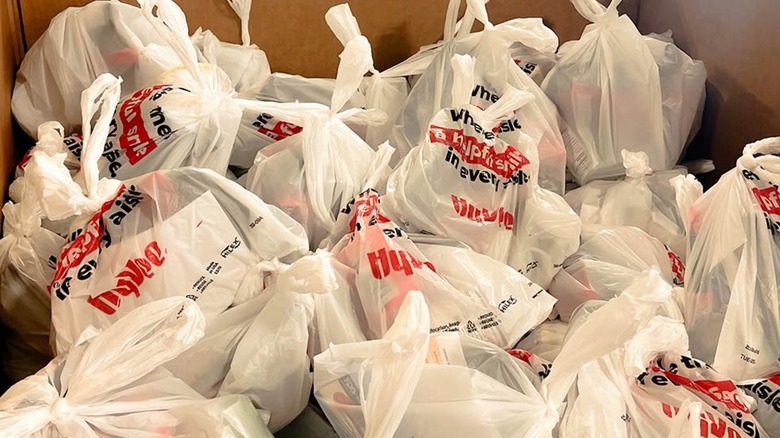
According to a report published by ReFED, nearly 114 billion meals' worth of food goes to waste each year — for scale, if you eat three meals a day, that's 1,095 meals per year, meaning it would take you more than 100 million years to consume that much food. That figure includes produce that never makes it from the shelf to your plate, and grocery stores bear major responsibility in closing that food waste gap. One grocery chain that proudly does its part in preventing food waste from unsold items is Hy-Vee, which in 2015 launched a food waste diversion program.
While it's unclear if this program is still explicitly implemented across all of its locations, it's clear that its goals and approaches are as active as ever. Hy-vee claims to divert between 15 and 20 million pounds of food waste every year, and it does this in a few key ways. For example, the grocery chain donates to hunger relief partners, uses proactive inventory management, implements composting initiatives, and it has even partnered with produce clearance apps in the past.
Hy-Vee claims that its distribution centers have earned TRUE Zero Waste certification, for stopping waste from being incinerated, going to the landfill, or ending up the environment. In 2022, one of Hy-Vee's distribution centers even received a WasteWise Award for maintaining an incredible 98.4% diversion rate during the coronavirus pandemic. It's unclear today exactly how much of Hy-Vee's unsold food makes up its total food waste, but it stands to reason that it comprises a significant part of the millions of pounds diverted yearly.
Hy-Vee tackles food waste at every stage
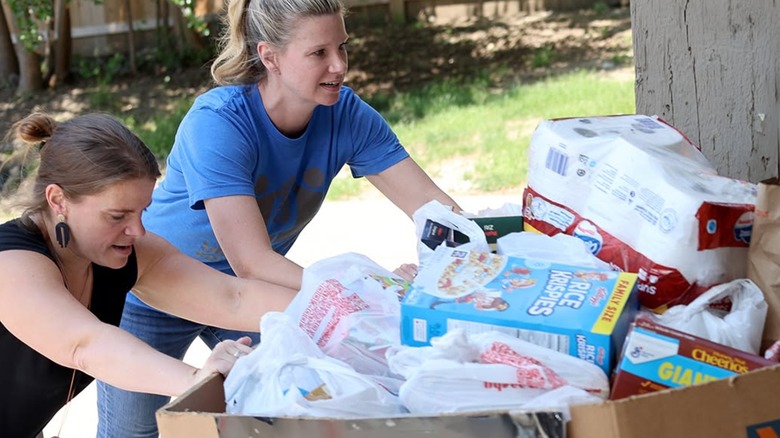
Even before stock arrives, proactive inventory management means that surplus levels of stock are minimized, preventing unsold food at the earliest opportunity. Then, stock that's past its recommended consumption date (or is deemed unsellable) has a well-established path to hunger relief organizations like Feeding America and other regional food banks with whom Hy-Vee has maintained strong relationships. Food that can't be sold or isn't fit for consumption has historically gotten another opportunity to dodge the landfill through Hy-Vee's composting partnerships, turning unwanted items into useable compost.
While coverage of Hy-Vee over the last few years has shone more light on the large-scale food collection and fundraising campaigns it achieves with the likes of Feeding America, these food waste management efforts seem to collectively and quietly contribute to the millions of pounds of food waste that Hy-Vee claims to divert every year. These campaigns may also be a large channel for Hy-Vee's unsold food, although it's not publicized to what degree. For example, Hy-Vee collected and donated 100 million meals worth of food to Feeding America and 19 partner food banks over a 20-month campaign in 2025, although it's not disclosed how much of that was unsold food. Like some other grocery chains that regularly donate food, there are also apps such as Too Good To Go, which Circle K uses, and Flashfood, which Kroger uses, to sell unsold food at a discount. Hy-Vee piloted Flashfood in 2019, but seemingly stopped sometime in the last few years.