

The Healthy-Sounding Breakfast Staple Hiding More Sugar Than You'd Expect

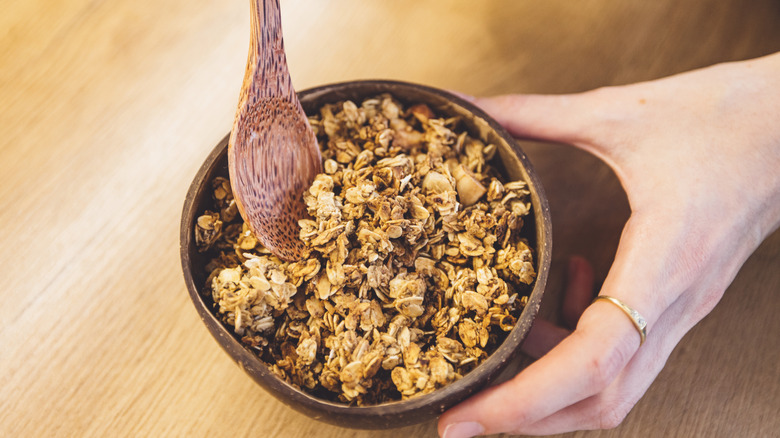
Crunchy, wholesome, and outdoorsy, granola has a healthy reputation. It's the go-to breakfast of hikers and food co-op members, equally at home in a mason jar as layered in a yogurt parfait. Made up of oats, seeds, and nuts, granola supplies fiber, healthy fats, minerals, and slow-digesting carbohydrates. But when buying granola, it's important to scrutinize the nutrition facts panel on the back of the package because it often tells a pretty different story than the health halo on the front. Among the superfoods, like goji berries, flax seeds, and chia seeds found in granolas, many contain a hefty helping of added sugars as well.
The added sugar serves an important culinary purpose. It helps loose oats and seeds stick together into those crunchy clusters that differentiate granola from nutrient-packed muesli, which is also comprised of oats, dried fruits, and nuts. As the granola bakes, the sugars caramelize, imparting a deeper color and flavor, which tempers the slight bitterness of the whole grains. The crystallized sugar also adds crunch and staves off staleness. Granola-makers may use different sweeteners, like cane, maple, agave or brown rice syrups, coconut sugar, or even fruit juice concentrates. None of those ingredients are inherently "bad," but it's worth recognizing how they affect the rest of your day.
Labels like "organic," "high protein," or "ancient grains" are appealing, but they don't tell you how much sugar you're getting. Both regular-degular and premium brands of granola often exceed 10 grams of sugar per serving, which is, any way you slice it, a lot of sugar to start your day. If you love granola, it doesn't have to disappear from your morning routine, but it's empowering to understand what it is and isn't contributing to your diet.
The most important meal of the day
Although many brands land in a similar range, sugar content still varies enough that it's worth comparing labels before tossing a bag into your shopping cart. Some varieties, like Purely Elizabeth, keep added sugar relatively restrained, while others, like Quaker's simply granola, climb into the double digits in a serving that's often much smaller than many people actually pour into a bowl. Those extra grams add up quick, increasing the glycemic load of a virtuous-looking breakfast considerably more than many people realize or intend.
When they hit your digestive system, both added sugars and carbohydrates become glucose, one of the body's favorite fuel sources. Glucose then enters the bloodstream, where insulin helps move it into cells to be used for energy or stored. That's normal, healthy physiology. Protein naturally slows gastric emptying — the rate food physically leaves the stomach — while soluble fiber attracts water and forms a gel-like matrix, which also slows digestion. Together, they slow nutrient absorption, which helps you feel full longer but also gives your body more time to respond, instead of receiving a large influx of glucose all at once.
This is why your breakfast of sweetened granola and milk might lead to more and more cups of coffee or rummaging around in the snack cabinet mid-morning. The granola's sugar and carbohydrates digest quickly, blood glucose rises fast, insulin responds, and you're hungry before lunch. But granola doesn't have to exist in a vacuum; fruit, fresh or dried, is an impressively fibrous pairing and you can easily combine it with protein-rich accompaniments like Greek yogurt, cottage cheese, or even eggs on the side. That way, you still get a sweet, crunchy bite, plus enough protein and fiber to sustain you.