

Why Some Of Cookware's Biggest Names Took Caraway To Court
We may receive a commission on purchases made from links.
The Caraway cookware brand was introduced in 2019 as an alternative to Teflon pots and pans. Its founder, Jordan Nathan, said that he was inspired to design healthy nonstick cookware after leaving a PTFE pan on the burner too long and developing symptoms associated with Teflon flu, a temporary respiratory condition caused by inhaling toxic polymer chemicals typically used in nonstick products. Ceramic Caraway products were marketed as a health-conscious, non-toxic alternative to traditional nonstick cookware, which the company claimed contained dangerous forever chemicals that could pose health risks. These claims are now the subject of a federal lawsuit.
The lawsuit against Caraway was filed in February 2026 by two cookware companies: Groupe SEB and Meyer Corporation, the manufacturers of some of the best cookware brands on the market, including All-Clad, Anolon, Circulon, Farberware, Hestan, and T-fal. According to Fortune, it alleges that Caraway's advertising unfairly maligns the reputation of nonstick manufacturers by stating that its products are toxic and harmful. As a result, the suit claims that company aims to increase its sales by sparking fear in consumers through false advertising, and that it's hurting competitors' bottom line.
PTFE, the nonstick chemical coating that many know for its use in Teflon-brand products, can contain PFOA and other PFAS. Teflon is not necessarily dangerous or toxic when pans are used and maintained properly. However, consumers may not realize when they're misusing pots and pans. When cookware is heated to temperatures over 570 degrees Fahrenheit, it may begin to degrade and release dangerous fumes. Repeated or prolonged exposure can cause Teflon flu.
Caraway was warned about making false claims against competitors in 2025

The allegations in the lawsuit shouldn't come as a surprise to Caraway. In 2025, the Cookware Sustainability Alliance (CSA) asked the National Advertising Division, an independent subset of the Better Business Bureau, to investigate claims made by Caraway. The mission of the CSA, which is a non-profit association that represents cookware designers, manufacturers, and retailers, is to advocate for the safety of cookware. The specific claims that the CSA objected in Caraway's advertising, as reported by the BBB Natural Programs, included that cases of Teflon flu are rising and that competitors' nonstick pans weren't worth buying because they were harmful or toxic.
To determine whether the company was making false and harmful claims in its marketing materials, the NAD investigated a range of advertisements and evaluated Caraway's overt and implied messaging. Caraway also submitted third-party laboratory reports and studies to the organization in support of its claims. The NAD found that these claims were not backed up by the reports that the company submitted as evidence, and determined that Caraway did not have any factual or legal basis for stating that its competitors' nonstick cookware was toxic. The organization advised the company to stop making these allegations and change its marketing materials. Caraway responded that it disagreed with the organization's assessment, but would make the changes recommended.
According to the 2026 lawsuit, Caraway's misleading and false advertising claims persisted, and the company even released a spate of new marketing campaigns making the same points that were previously warned against by the NAD.
Caraway has leveraged the lawsuit into a marketing opportunity
Positioning itself as the underdog in a fight against powerful cookware manufacturers with deep pockets, Caraway has successfully leveraged the lawsuit into a marketing opportunity. In an open letter on its website, Caraway founder Jordan Nathan writes that Big Cookware is trying to take down and "silence" the small business. A Change.org petition started by the company in May 2026, three months after the lawsuit was filed, asks consumers to take a stand against forever chemicals. It currently has over 55,000 signatures. On its website, Caraway states that its signature ceramic coating has undergone rigorous, independent laboratory testing that has confirmed it is free from toxins like PFAS, fluorine, and heavy metals.
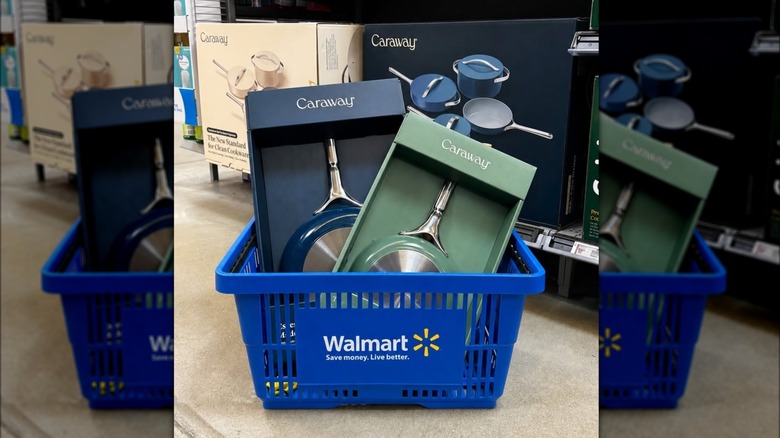
Caraway's attorneys have filed a motion to dismiss the lawsuit, stating that the plaintiff corporations use many of the same tactics in their own advertising. The company, which recently expanded retail sales of its nonstick cookware and expensive ceramic bakeware sets to Walmart on July 13, 2026, also paid to advertise on a billboard near Groupe SEB's New Jersey headquarters, telling the company to "pick on someone your own size" (via Inc.) Ultimately, attorneys for Groupe SEB and Meyer Corporation will need to prove to a jury that Caraway's advertising claims are indeed false, and that these misleading messages caused harm to the plaintiffs' sales and/or reputation. In the interim, however, news of the lawsuit has already inspired action from consumers, as a class-action lawsuit was filed against Caraway by a California resident alleging false and misleading advertising.