

How Milk Cartons Became An Unlikely Tool For Finding Missing Kids (And Why This Stopped)
We may receive a commission on purchases made from links.
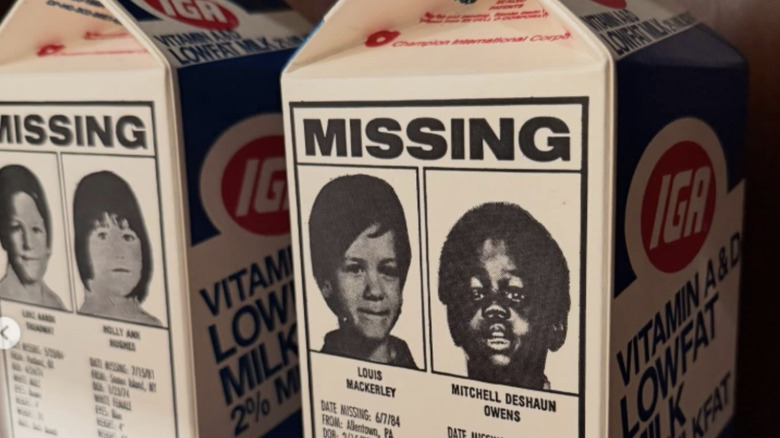
In the 1980s and early 1990s in the United States, families were faced with a macabre start to the day: Images of missing children from across the country printed on the side of milk cartons. The hope was that everyone who ate breakfast in the '80s would be alert and keep an eye out for the missing children while in their communities.
At the time, public concern about missing children was at an all-time high, thanks to grassroots efforts made by their parents. With the creation of the National Center for Missing & Exploited Children, recovery efforts for missing children became a nationwide campaign. The idea of putting photos of missing children on milk cartons started in 1984 when a 13-year-old paperboy named Eugene Martin disappeared while delivering the Des Moines Register. His disappearance came two years after another paperboy from the same newspaper, 12-year-old Johnny Gosch, was kidnapped in the same area. When Martin disappeared, a relative working at the Anderson & Erickson Dairy persuaded the owners of the company to print images of Eugene and Johnny on its milk cartons. Within weeks, word of the missing boys had quickly spread.
Soon after, with the help of the National Child Safety Council, over 700 independent dairy companies across the country began printing missing kids' photos as well as details like height, weight, eye and hair color, and birthdates on name brand and generic milk cartons. During the years the campaign was active, an estimated 5 billion milk cartons were printed with the details of missing children. However, the campaign had its issues and was short-lived.
What led to the milk carton campaign's downfall
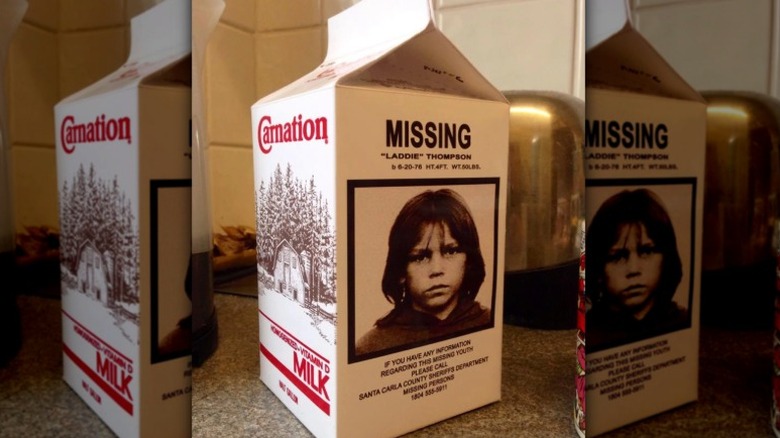
Explaining "milk carton kids" to young people today might result in them thinking it was a bizarre vintage campaign that seems more like something from a movie, such as the milk carton prop shown above from "The Lost Boys." But during this time, missing children appeared regularly on pizza boxes, grocery bags, bus ads, and even mailers.
Critics argued that the milk carton campaign disproportionately featured white children, even though many abducted children were not white. They also pointed out that the process of getting a child's photo onto a milk carton often took too long to be effective. Even renowned pediatricians criticized the program, saying it traumatized children by making them fear abduction — a message that helped fuel the era's growing "stranger danger" mentality.
As national databases became more coordinated and sophisticated, technology led to the campaign being phased out in the late 1980s. AMBER Alerts launched in 1996, quickly distributing information about missing children through radio and TV broadcasts. Over time, the system expanded to include cell phones, highway signs, and other digital alerts. Social media has also become an important tool. NCMEC now uses digital billboards and QR codes in places like airports to help locate missing children.
Though short-lived, the campaign had a lasting impact, changing how missing children are brought to the public's attention. Today, the milk carton has also become a symbol of the era, with shows like "Stranger Things" using it as a nostalgic visual cue for the 1980s.