

Made In's Stainless Clad Cookware Gets This Chef's Seal Of Approval
While it is true that being a good chef requires skill, experience, and some creativity, any cook worth their salt (amateur or professional) knows that the cookware you use matters. Some pans are simply superior to others, and, as a general rule, stainless clad is revered for its durability, reliability, and versatility. That said, you can spend a pretty penny on a quality stainless frying pan, so it is important to do some homework before you bite the bullet and invest in a full set of cookware.
When I was approached to take Made In Stainless Clad cookware on a test cook, I jumped at the chance. As a professional chef with 18 years of experience, I have a lot of opinions about cookware. I have spent a lot of money on cookware designed for the home and for the professional kitchen with mixed results. What I am seeking is even heat distribution, a pan that can create a beautiful sear on a piece of meat, one that cleans easily, and one that isn't susceptible to wear and tear.
Made In introduced its first stainless frying pan in 2017 and has been going strong ever since. Its Stainless Clad line is designed with 5-ply construction (which helps with heat retention), has a proprietary Stay Cool handle, and has a lightweight aluminum core that helps transfer heat evenly across the pan. But how do these pans actually fare when they are put to the test?
Some recommendations are based on firsthand impressions of promotional materials and products provided by the manufacturer.
Methodology
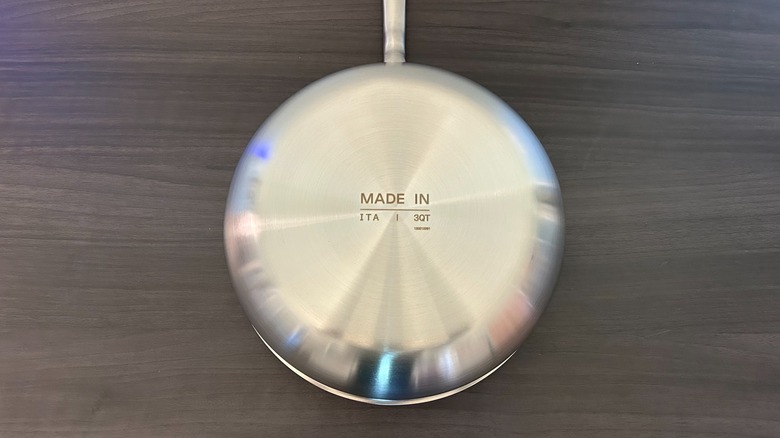
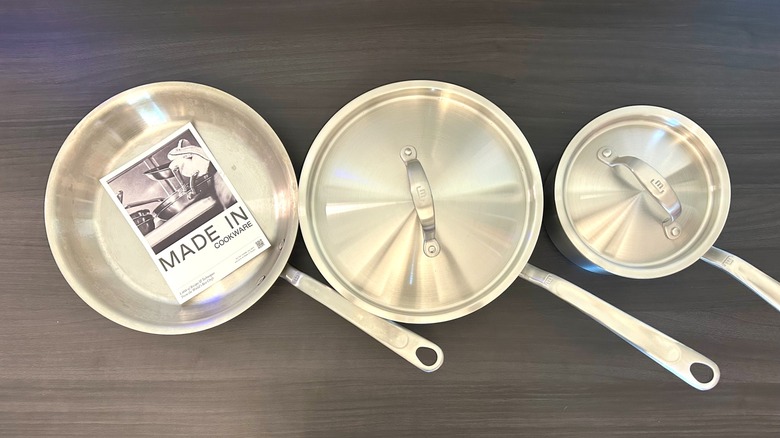
Made In sent me three Stainless Clad pans to test out from its collection: a 3-quart saucier, a 10-inch frying pan, and a 2-quart saucepan. To test out these pans, I wanted to make sure I prepared as many recipes using various techniques as I could, ranging from pan searing to stewing. As such, I made a classic crème brûlée, a pan-seared salmon filet, a butter-basted steak, and a simple one-pan chicken tagine recipe.
My primary criteria for testing the pans were to see how well they performed with each cooking method, particularly where heat retention was concerned, as well as how easy they were to clean. The best way to clean stainless steel in general is to wipe away any remaining food particles and to clean it in hot water to avoid thermal shock, which can cause the pan to warp. These pans are no different. While they are oven safe up to 800 degrees Fahrenheit, they should not be subjected to cold water, nor are they dishwasher safe. It is also wise to avoid abrasive scouring pads, which can damage the surface of the pans.
Putting Made In Stainless Clad Cookware to the ultimate cook test
The initial recipe I made was the crème brûlée, which requires heating the heavy cream until it just begins to simmer, but doesn't scald. This can be challenging with standard pans that don't heat evenly. Not only was this not a problem with this pan, but I also found pouring the cream from the saucepan easy and mess-free owing to the Stay Cool handle.
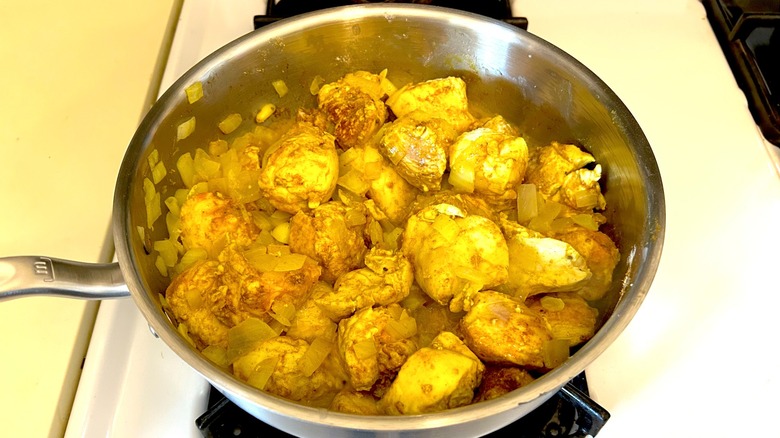
The next recipe I made was the chicken tagine, which is a stew. I prepared this in the saucier. My primary focus when making a stew is that the meat browns evenly, but doesn't burn, and that when I deglaze the pan, the browned bits scrape up easily and thoroughly, forming a sauce that is rich in flavor. This was exactly what happened. In fact, short of using an actual earthenware tagine (which infuses the meat with flavor itself over time), this is the most deeply layered, flavorful Moroccan stew I have made of recent memory.
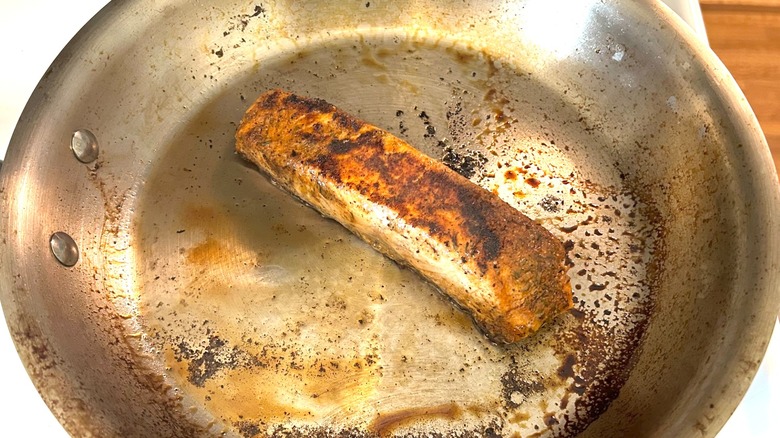
The last thing I did with the frying pan was pan-sear a salmon filet and butter-baste a steak. Both of these require a pan that can handle higher temps that hold heat and doesn't have hot or cold spots, which can result in uneven browning. The frying pan heated up rapidly and remained consistently hot. The salmon skin crisped up beautifully without burning, while the steak developed a delightful crust and retained a juicy center.
Are Made In Stainless Clad pans worth the cost?
Made In's 10-inch Stainless Clad frying pan retails for $139. The 3-quart Stainless Clad saucier sells for $179. And, the brand's 2-quart Stainless Clad saucepan can be obtained for $149. Each of these can also be purchased in various bundles featuring different assemblages of pan styles, offered at a significant discount. While these prices may seem steep for a single pan, you generally pay for what you get when it comes to quality cookware. For example, Misen's 10-inch stainless frying pan, which is also 5-ply, runs $119, while All-Clad's 3-ply stainless steel, 10-inch frying pan costs $149.99. Made In is right in line with these cost-wise.
With this in mind, I feel confident in saying these pans are well worth the investment. They perform superiorly in every way, from even heat to ease of cleaning. The Stay Cool handle is a huge bonus, and the ability to seamlessly transition these pans from stovetop to oven is also very appealing. If you are concerned about some of the pitfalls often encountered with stainless steel, like it not being nonstick, there are a number of tips you can follow to minimize these issues.
Overall, I cannot say enough about these pans. They may not be especially budget-friendly, but if you are outfitting a kitchen for a food lover who wants pans that will last, Made In has you covered.