

4 Steaks To Buy At Walmart And 4 To Avoid
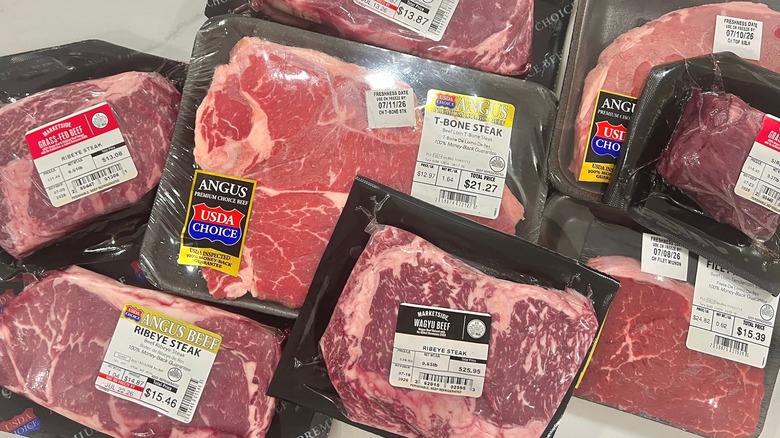
Steak dinners are now a certified luxury. There's no denying that. The cost of beef has been skyrocketing for years, and steaks lead the category, reaching an average price of $12.80 per pound in May 2026. That's not a number that's predicted to go down anytime soon, either, at the time of this writing. But even at astounding costs, Americans remain hungry for a good, hearty steak. Steakhouse parking lots are far from empty, and customers continue to fill their grocery store baskets with the cuts of their choice.
The demand is certainly still there. But that doesn't mean consumers aren't looking for ways to trim the fat and stretch their dollar a little further in this category. When we're talking about record prices, value starts to become just as important as quality. And where better to go when you're seeking value than Walmart? As a big-box retailer, Walmart can provide us with more deals and affordable everyday cuts than we're likely to find at a butcher counter or specialty grocer. The store sets us up with a decent variety, as well, offering everything from strips and filets to T-bones and even wagyu.
The only question that remains is whether a product from Walmart can still satisfy that steak craving. Or if a competitive price translates to a less-than-competitive taste and texture. To answer that question, I picked up eight different Walmart steaks. After cooking and trying them for myself, I separated the must-buys from the ones you should avoid throwing away money on.
Skip: USDA Choice Angus Beef Top Sirloin Steak
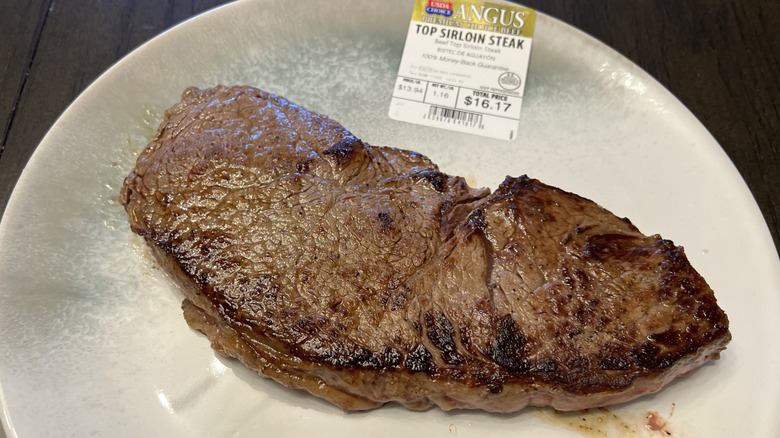
You know what you're signing up for when you throw on a sirloin steak. With its lean stature, it's the no-frills workhorse of cuts. It doesn't claim to be anything fancy, and as such, it often comes at the most modest of prices. That makes it mighty tempting. But the hard reality is that a budget steak purchased from a budget grocer doesn't exactly yield the highest-quality results.
Walmart's USDA Choice Angus top sirloin steak is big. I'll give it that. It was the second-largest steak I tried, behind only the T-Bone, and all 18 ounces of it rang up at just over $16. So, you're getting a lot of steak for your buck, but that means nothing when the flavor is lacking. The first warning sign was the cut's greyish tone that holds steady from raw to cooked. It wasn't spoiled, but that muted appearance seemed to carry over into the flavor. It was dull with a faint gaminess and a slightly tangy note that didn't sit right with me. It also refused to be helped by the light char and layer of salt and pepper around the edges.
The taste alone earned it a thumbs down from me. But the most disappointing part was that the texture wasn't half bad. Cooked to a solid medium, it was thick and fibrous with only a mild chewiness. The potential was there, if only the natural flavor could sort itself out.
Buy: USDA Choice Angus Beef New York Strip Steak
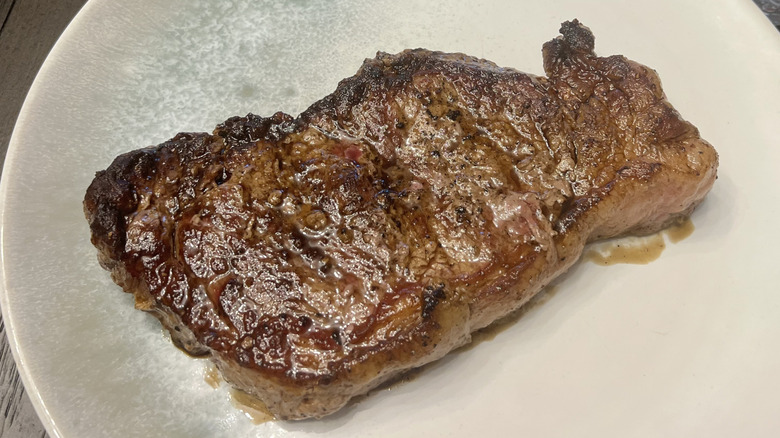
Ditch the top sirloin and go with the New York strip instead. You may be surprised to learn that these two steaks were priced almost identically (I know I was). The cost per pound was only a few cents higher for the strip, and since it was slightly smaller, I actually paid less than I did for the sirloin — a total of $13.87.
The look was promising from the start, showing off a reddish-purple hue and the kind of fat cap along one side that defines a New York strip. The fat actually extended into the majority of one end, but it was easy enough to trim away while still being left with plenty of meat. It seared nicely with the simple seasoning blend of salt and pepper, and slicing into it to get that first bite was an easy task. A respectable amount of internal marbling made it tender and just juicy enough, while the outside developed a flavorful crust from the cast iron. As for the flavor, it was noticeably bolder than the sirloin. The savory Angus beef could be enjoyed without any funky undertones.
The entire steak was solid from end to end, extra fat and all. It was an obvious pick over the top sirloin and even turned out to be one of my top choices. I'd buy it again in a New York minute.
Skip: Marketside Grass-Fed Beef Sirloin Steak
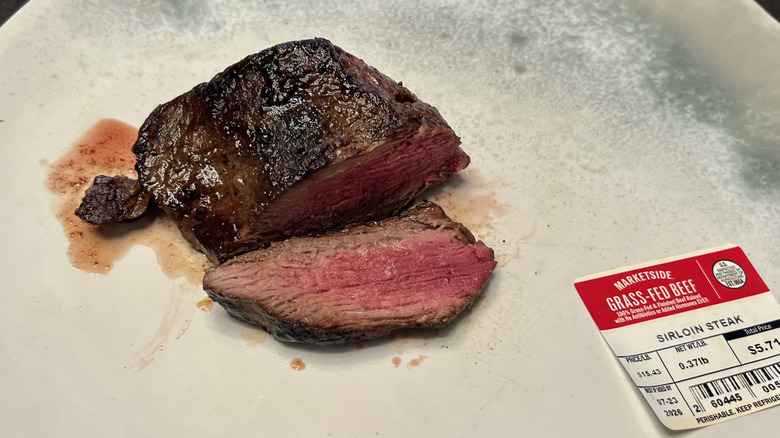
Walmart has its normal USDA Choice Angus beef cuts. Then, it has even more steak options from its Marketside line. The store's in-house brand usually focuses on foods in the deli, bakery, and produce sections, but it has evidently expanded into meats, as well. The steaks I picked up with this label specify that they contain beef raised with no antibiotics or added hormones. In the case of this sirloin, the packaging also highlights that it's grass-fed.
Compared to the earlier top sirloin, this looked like a completely different kind of steak. It wasn't wide and flat but instead had a squat, chunky shape. This meant it took longer to cook through, even though it was significantly smaller, at just 0.37 pounds (or just around six ounces). The coloring was also wildly different. In the packaging, this grass-fed steak leaned far more purple, and on the skillet, it developed a rosy-pink hue at the center with a blackened crust around the outside. The taste was another noticeable improvement. It was much closer to that mild, umami-rich beefiness you would expect from a sirloin. However, I still wasn't completely sold on it. Many bites passed the line of firm, becoming downright tough, and juiciness was also lacking.
I actually wavered back and forth on this one for a while, because it feels like a steal at a sub-$6 price tag. But I ultimately decided there's far more flavor and value to be had elsewhere in Walmart's meat department.
Buy: Marketside Grass-Fed Beef Ribeye Steak
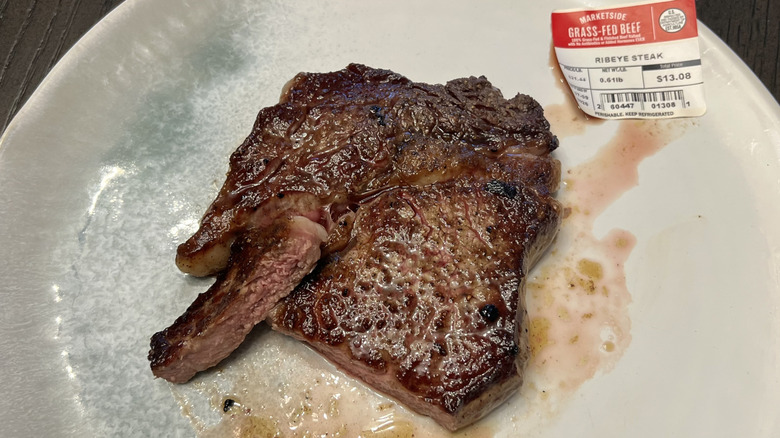
This steak shares many of the same qualities as the Marketside sirloin. 100% grass-fed beef? Check. No antibiotics? Check. No added hormones? Check. I even cooked them the exact same way, with a simple blend of salt and pepper in a hot cast-iron skillet. However, it's a different cut from a completely different part of the cow, and that creates a completely different kind of eating experience.
Ribeye trumps sirloin nearly every time in my mind, and Marketside does an admirable job with its own offering. A thick strip of fat runs right through the center of the steak, complemented by beautiful marbling throughout the rest of the meat. On the plate, that translated to a glistening, extra-juicy cut. On the palate, I was immediately met with a significantly deeper, richer flavor than I found in any of the other previous offerings. One side did lean more tender than the other, but I chalked that up to uneven cooking rather than an issue with quality.
As is to be expected, you will pay more of a premium for the ribeye. Marketside's grass-fed cut was priced at $21.44 per pound, making my 0.61-pound (or around 10-ounce) steak just over $13. But in my opinion, it's worth it. I'm always willing to dish out a little more for the crown jewel of steak — even at Walmart.
Buy: USDA Choice Angus Beef Ribeye Steak
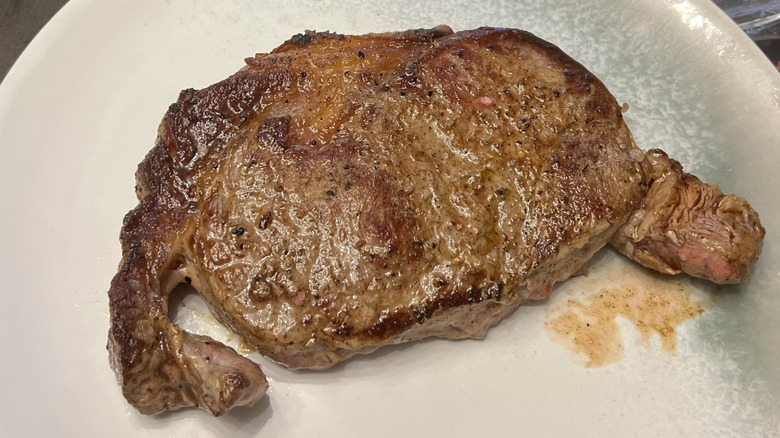
If you're looking for a ribeye at a more competitive price, this pick is at your service. It's a more straightforward Walmart offering, and beyond the USDA Choice Angus designation, it doesn't come with any premium labels or marketing claims. But in terms of taste, it gets the job done all the same.
It stands out against Marketside's ribeye thanks to its bigger size (both thicker and wider). In terms of weight, it's about 70% heavier and only cost me about $2 more. It also comes with noticeably less marbling throughout. That's the main tradeoff you're making here: size for fat content. It cooks to a less appealing grey-ish color on the outside, with minimal searing that's mostly sequestered to the edges, where the main ribbons of fat are located. You may have to chew it for a little longer, and the rich flavor is perhaps a small step down from the grass-fed beef. But none of that stopped me from going in to saw off a second bite, and then a third. It's still hearty and full of moisture. The perfect cut for a meat-and-potatoes kind of dinner.
Without the comparison game against the Marketside ribeye, I would have simply labeled this as a solid steak. It was actually up there with the New York strip as one of my preferred options.
Skip: USDA Choice Angus Beef Filet Mignon
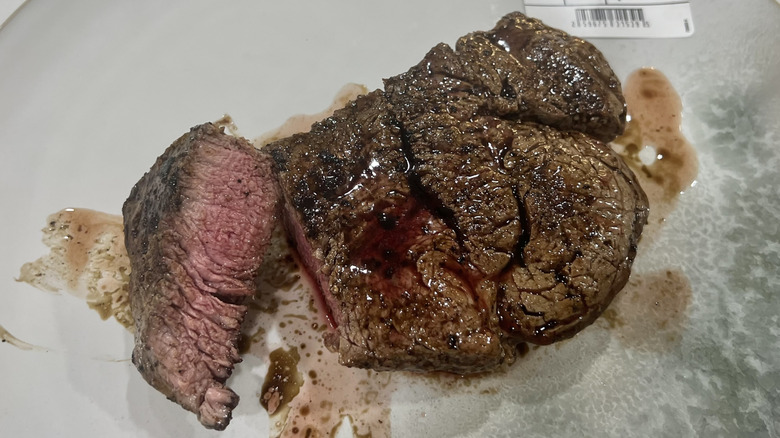
I don't know about you, but when I picture a filet mignon, I picture a stout steak medallion that's nearly as tall as it is wide. That is the filet in its most standard format, and it's what usually lands on diners' plates when the cut is ordered at restaurants. So, I was surprised to see this Walmart filet completely breaking that mold. It's far more elongated and just an inch or so thick. I almost overlooked it entirely, thinking it was yet another sirloin.
In the skillet, it held on decently well to some char, and the juiciness was evident as it touched down on the plate. But as I cut into it for the first time, I knew it wasn't going to live up to my expectations. It's a far cry from the cut-like-butter filets I've enjoyed in the past. Rather than being fine and compact, the meat inside was more stringy. That meant the ends were especially chewy, and it didn't let up until I made my way well into the center of the cut. Here, I found at least a few quality bites of tender beef.
The other issue was the flavor. It fell flat. My husband even likened it to the simple taste of ground beef, and I certainly agreed that it was in desperate need of additional seasonings to give it some life. So, facing problems with both texture and taste, I found it hard to justify the $24.82 per pound price tag.
Buy: Marketside Wagyu Beef Ribeye Steak
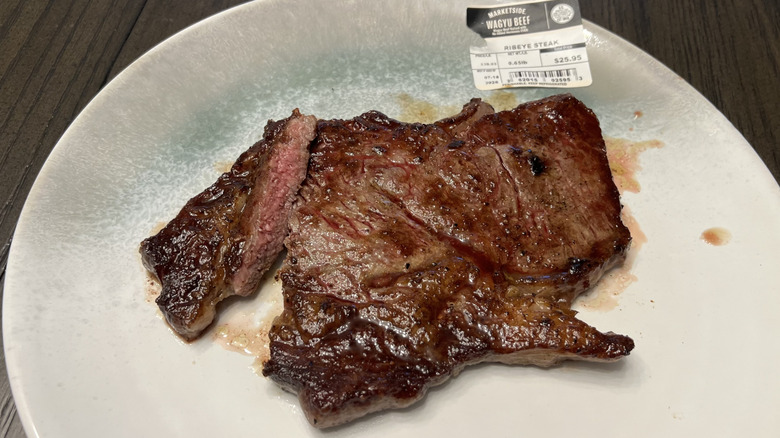
Wagyu is always bound to come with some sticker shock. Yes, even the wagyu from Walmart. The Marketside wagyu beef ribeye steak specifically is marked at a whopping $40 per pound, making it the most expensive cut I tried ... by far. That alone made it a little intimidating. I saved it for last on the skillet, worried that I may overcook it, sending $26 straight down the drain. Thankfully, everything went as smoothly as possible, including the moment that I finally sliced into it.
It's 100% worth the splurge. If this had been a blind taste test, I would have picked this one out immediately as the wagyu. It immediately hits you with that burst of savory, buttery flavor. I wouldn't quite describe it as "melt-in-your-mouth" texture-wise, but it comes pretty close. That deep web of intramuscular fat was really working overtime. Since it comes from the Marketside brand, you also know you're getting a cleaner cut. There are no added hormones or artificial ingredients.
The wagyu ribeye is a must-try, and I'm not the only one who thinks so. Walmart shoppers have also marveled at the flavor, calling it "absolutely delectable". I will note that it does lean to the thinner side. When it was raw, it weighed in at 0.6 pounds, and it naturally shrank as it cooked. But that one caveat wasn't enough to make me change my positive opinion.
Skip: USDA Choice Angus Beef T-Bone Steak
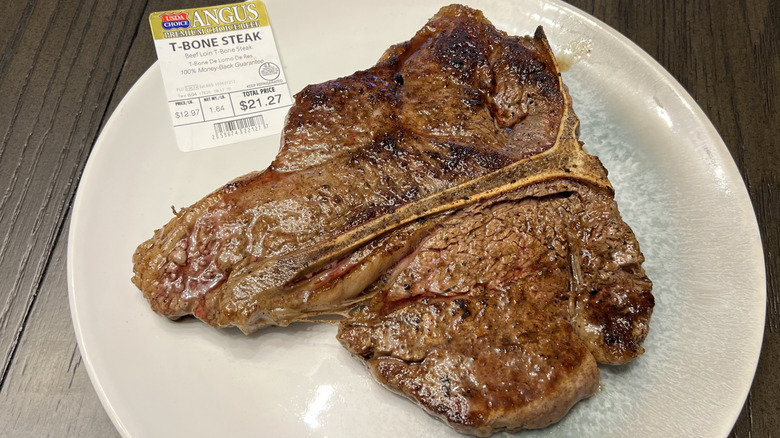
Last up is the almighty T-Bone — the only bone-in steak of the bunch, and subsequently, the largest and heaviest, sitting at 1.64 pounds (or about 26 ounces). Purely because of its size, it was also one of the most expensive. I paid $21.27 for this behemoth of a steak.
I understand why T-bones are enticing. As soon as I laid eyes on this one, I was ready to sink my teeth into it. It's also famous for its two-for-the-price-of-one appeal. With each T-bone, you get a New York strip on one side of the bone and a tenderloin (or filet mignon) on the other. When done well, it's the great compromise of steaks. But Walmart's cut just ended up being double the disappointment. I wasn't overly impressed by either side. While I appreciated the surprisingly large portion of tenderloin, the tenderness was not at the level I would have liked. Unfortunately, the strip side was even tougher, despite the cap of fat and a lot of attention given to not letting it overcook. Everything was governed by a rugged kind of taste that was more robust than some of the other picks. But the toothsome flavor wasn't enough to make up for the lackluster texture.
T-bones are always a bit of a gamble, since you have to deal with uneven cooking thanks to the bone. In this case, I don't think it's worth the headache, especially when you're already working at the deficit of Walmart-quality beef.
Methodology
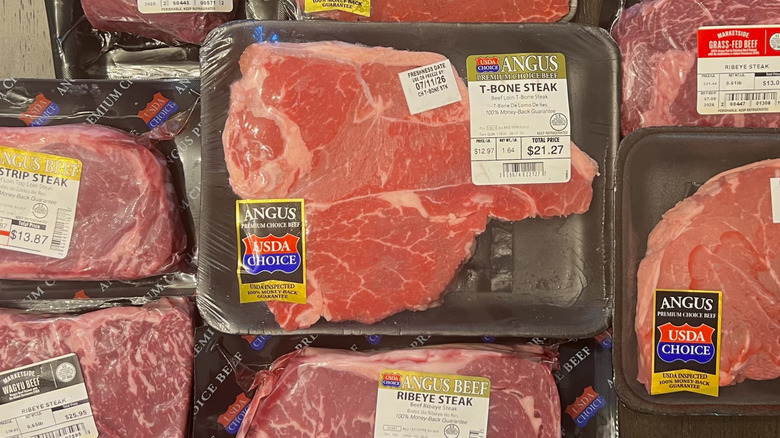
Staring down Walmart's meat selection, my goal was to pick up a hearty variety of different steaks. I peppered in several different cuts, included a few Marketside offerings with extra accolades, and even picked up a steak made from wagyu beef (I had to). I selected the best-looking steak of each kind, though there weren't always a ton of options to pick from. Once I was satisfied with my haul of eight total steaks, I brought them all home to cook.
I opted for a cast-iron skillet cooking method for every single steak, cooking them two or, in some cases, just one at a time. Before laying them in the pan, I gave them each a simple seasoning of salt and pepper, and then used olive oil as my cooking fat. A medium to medium-rare temperature was my aim for each cut, and I was successful ... for the most part.
As I tasted, I used several criteria to determine if it was a steak worth buying. Essentially, I was looking for the best balance of both quality and value. I evaluated each cut to see if it had the appropriate texture, juiciness, and flavor that it should. Some steaks impressed with their marbling or bold flavors, while others were much closer to what you would expect from a budget cut. The results prove that you don't always have to pay top dollar for a decent steak. But at the same time, there are some steak cuts aren't even worth their lower price tag.