

Why There Are Gaps Between Your Fridge And The Counters
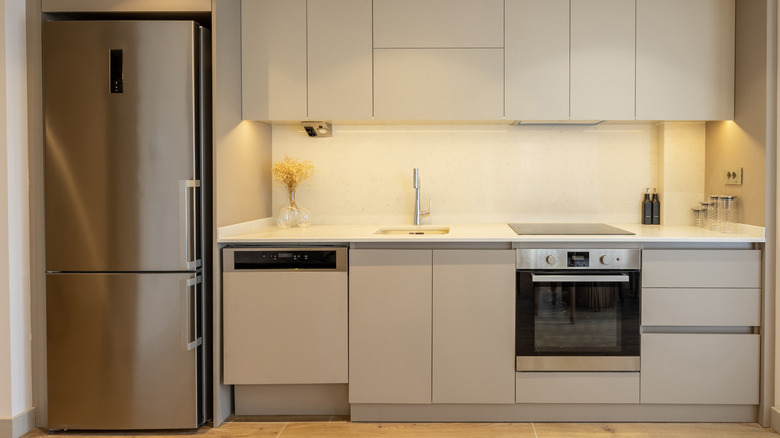
If you're bothered by gaps on each side of your fridge and wondering if you can maximize your space by moving everything closer together, we understand the impulse. Unfortunately, when it comes to most refrigerators, maintaining this space clearance is non-negotiable. That's because your fridge needs at least a ½ inch of space on the left and right sides and a full inch between the back and your wall for proper airflow as part of the cooling process. You should also try to save ½ to 1 inch of space from the top of the fridge to a cabinet above.
When a fridge's coils don't have enough airflow, this can cause the appliance to overheat and malfunction. Even if you can avoid this worst-case scenario, poor proximity and minimal airflow can force your fridge to work harder than necessary, leading to higher energy bills. This is why fridge placement is so imperative to consider in your kitchen's overall design.
Of course, in a small kitchen, layout is everything. While most fridge coils were once along the back of the appliance, creating distance from the wall, many manufacturers have moved them to the base in recent years to increase energy efficiency. If you're in the market for a new fridge, you can look for models that are marked as "zero-clearance." With these designs, the airflow systems are not as reliant on side clearance, so you can plan for a tighter fit, but you'll still need to make sure there is adequate space behind and above the fridge.
How to determine the best spot for your fridge
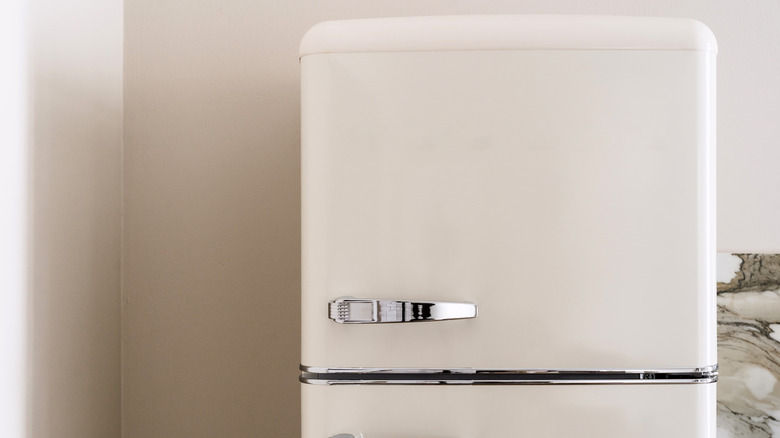
If your goal is to design a kitchen that won't look dated down the road and meets your current needs, the floor plan and layout of this room are everything. A refrigerator's location can majorly affect the flow when you're prepping and cooking meals. While some designers are advocates of the "golden triangle" rule because it guarantees the perfect access points between the stove, sink, and fridge, a design is rarely a one-size-fits-all solution.
Given its space requirements, the corner of your kitchen is often a great place for a fridge, ideally alongside a workspace or countertop. In this location, you can allow for space on the side of the appliance without drawing attention to the gaps.
Of course, the most obvious factor to consider is that you need the fridge to be near an outlet, because you never want to use an extension cord to plug in your large appliances. Avoid placing your fridge near an oven, radiator, or other heat source as well to prevent overheating. Experts recommend saving at least a foot or two of space between a fridge and other heat-producing appliances, and to make sure direct sunlight from nearby windows won't provide another source of heat.