

The Best Grilling Method Depends On How Thick Your Burger Is
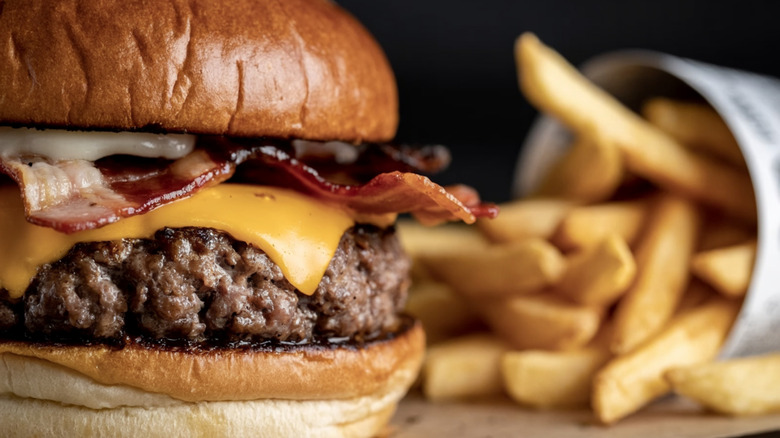
The perfect burger patty is meaty and juicy, with a nice, caramelized crust, and a rich, beefy center. While there are many common mistakes people make with homemade burgers, from the type of meat you buy to how you shape the patty, the biggest ones usually relate to the grilling process. The reason for this is that there's no one-style-fits-all solution. You need to match the patty size to the grilling method. Tasting Table spoke to Scott Thomas, owner of The Grillin' Fools, to break down the cooking process needed for different styles of burgers.
As with most things to do with cooking, we're playing with two key variables: heat and time. With a smash burger, the focus is on getting your cooking surface really hot. Although there's a long list of tips for making the ultimate smash burgers, Thomas zeroes in on temperature as the most important factor. "For smash burgers, we generally go with a super-hot, single-zone grill. We want to serve the smash patties as soon as they get done," Thomas said.
Once you've smashed your patty on the hot surface, wait for it to get brown and crispy around the edges. "Scrape it off the griddle with a flat-edge scraper and flip over, add a slice of cheese, and put a melting lid or cloche over the top," he added. "When the cheese is melted, the burger has those crispy edges and is still super juicy," Thomas explains. Because these patties are thin, there's a small window to keep them succulent, which is exactly why he suggests serving them straight away.
How to grill a regular burger patty
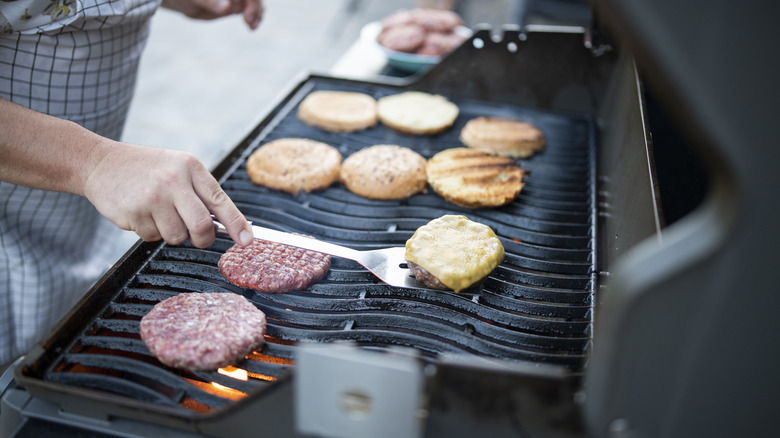
If you're not a fan of smash burgers and prefer them the old-school way, the grilling technique is completely different. For starters, flipping the burger just once isn't enough. "See, we could burn the burger before the inside is cooked through with a thicker burger. So we get some browning, flip over, get some browning, flip over, and get some more browning," Thomas explained. "Rinse and repeat until that burger hits your desired doneness."
The other option is to create two separate temperature zones — one to sear the patty on the outside and the other to cook it through. "Thicker patties need more than just sear, flip, sear, and serve like a smash burger. After searing it, they need to bake, indirect on an upper rack or on the side of the grill with no hot or direct heat," he said. If your grill has an upper rack, this is the perfect time to use that. "Brown both sides, place on the upper rack, and close the lid," Thomas advises. The two-zone grilling setup is the best method for the juiciest burgers with a crispy crust (and even stuffed burgers) since it allows the inside of the patty to cook through without risk of the crust burning.
If your grill does not have an upper rack, you need to create two separate heat zones. If it's a coal grill, this can be done by placing coal on one side and keeping the other side empty so it only gets residual heat. If you're using a gas grill, Thomas recommends keeping one side of the burner on and the other side off. "When the burger hits 155 degrees Fahrenheit (medium), slap on a slice of cheese and close the lid again," he said. "When the cheese is melted, the burger will be close to 160 degrees Fahrenheit."