

The Best Grilling Method For The Juiciest Cheeseburger With A Crispy Crust
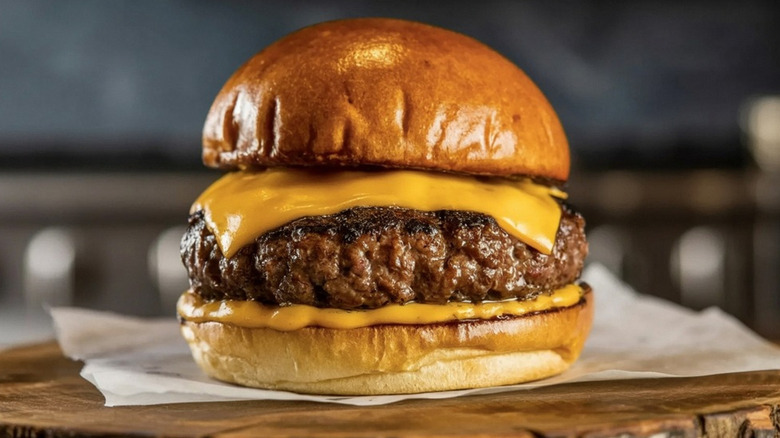
It's not uncommon for people to think of barbecuing at home as simple cooking, merely whacking your burgers onto the grill, flipping, slapping some cheese on top and letting the smoke and flames work their magic. However, approaching your grill with just a little more nuance will lead to substantially better results, particularly in terms of building a crust while still maintaining a juicy interior.
The method to achieve this is a two-zone grilling setup: Effectively transforming your single-function barbecue into a mini dual-function cooker. By setting up high heat and low heat grill sections, you allow your cheeseburgers to get a quick crust from ripping heat, but to retain their internal moisture thanks to the gentler indirect heat of a cooler grill zone. Simply put, it's the best of both worlds. It's the same principle as searing a piece of meat in a pan on a high heat, before letting it finish slowly in an oven on a lower heat.
A two-zone grill setup also makes it much easier to get that cheese melt just right. Best of all, it's really no harder to prepare a two-zone grill than a typical grill.
Setting up your two grill zones
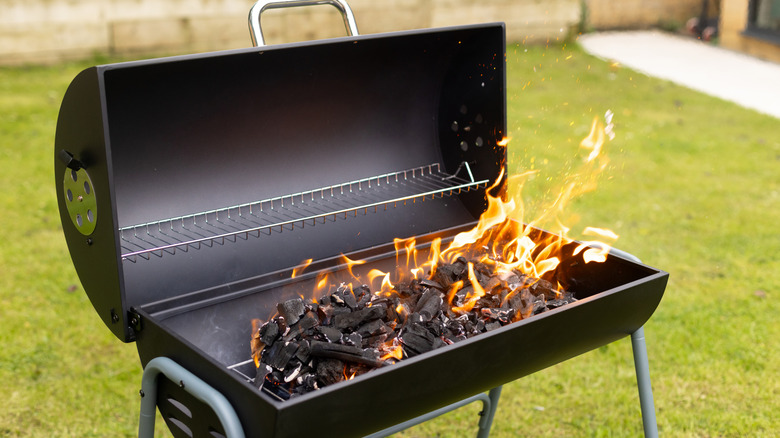
How you create your grill zones depends on what type of grill you have. For coal or wood fire grills, once you're got a hot pile of embers, push the majority to one side to create the hot zone. For gas grills, depending on its design it may be trickier to create a clear zone distinction, but ideally you'll be able to light the burners on just one side.
On the "direct heat" side, you're looking for somewhere between 450 and 550 degrees Fahrenheit. This will be hot enough to give your burgers a nice sear. If you have one, use a thermometer to get an accurate reading. The cool zone is relying mostly on the radiating heat from the hot zone, much like how an oven works. When your indirect heat zone is maintaining a temperature range around 275 to 300 degrees Fahrenheit, you're ready to start thoroughly cooking those juicy cheeseburgers.
Cooking on a two-zone grill
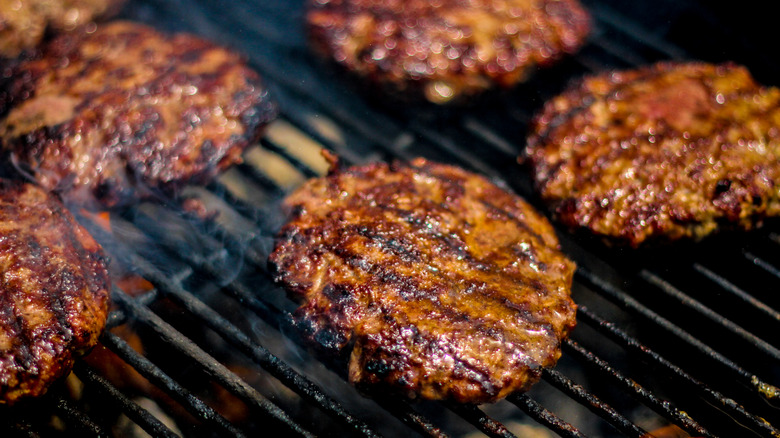
First, your patties are going to get a baptism of fire on the high heat zone. You want to give each side time to build color and an enviable crust, but not so much that it burns — two minutes per side is usually about right.
Once the Maillard reaction has formed a brown crust on both sides, transfer your patties to the low heat zone. They should stay here until the internal temperature reaches 160 degrees Fahrenheit, indicating a medium doneness. You might prefer a less cooked patty, but do so at your own risk: Grinding beef spreads bacteria from the meat's surface throughout the patty, making it riskier to eat when undercooked.
When they're almost ready, add cheese to your patties, close the grill lid to allow it to melt for about a minute. If your grill doesn't have a lid, putting a tinfoil cap on each patty will achieve the same result. Finally, let your patties rest two to three minutes to allow the juices to redistribute, before serving in a bun with sauces and pickle — or however you like to serve your patties!