

Would You Eat An AI-Designed Fast Food Burger? Researchers Say You Might Not Know The Difference
Generative AI continues to be applied in new fields as research keeps emerging that frames the technology as increasingly necessary or inevitable. If you thought AI wasn't going to break into the culinary world, researchers at Stanford are ready to set you straight. A new AI tool, appropriately called BurgerAI, has been developed to create the perfect, tailor-made burger recipe based on an individual's age, nutritional requirements, and tastes. The recipes can even meet your sustainability goals.
According to a 2026 study published in npj Science of Food, BurgerAI was able to successfully recreate the recipe for a Big Mac, even though the Big Mac wasn't one of the recipes it had been trained on. The program went on to create two novel burgers that were rated by testers against McDonald's Big Mac. One was nearly identical in terms of ingredients, while the other included additions such as a remoulade and thyme. In both cases, the AI burger scored higher for flavor.
BurgerAI also created a mushroom burger designed to reduce environmental impact and a nutritious vegetarian bean burger. All of these things sound promising, not just for diners but for sustainability and people's overall health. After all, who wouldn't want a delicious burger that is better for them than fast food and also better for the environment?
How an AI burger falls short
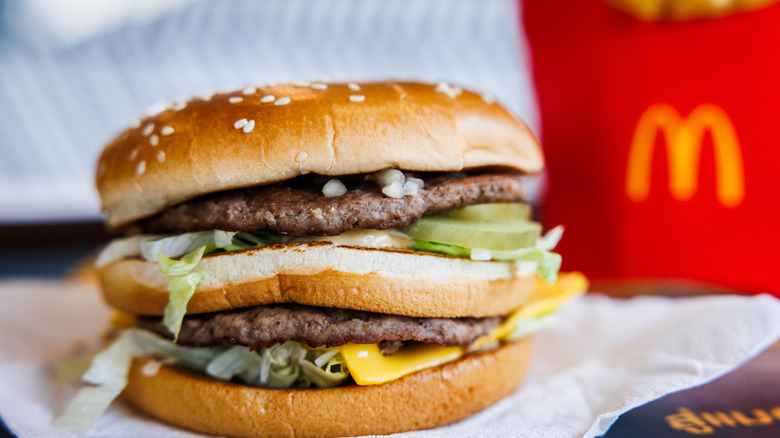
While BurgerAI sounds promising, there are several potential flaws in how it was evaluated. For instance, the claim that taste testers preferred its burgers may be true, but the comparison was only made against a Big Mac. That claim also only accounts for two of the five burgers. Two mushroom burgers ranked below the Big Mac, and the bean burger fared even worse. According to a 2026 YouGov poll cited by Food & Wine, McDonald's ranked fifth for burgers among America's favorites, garnering only 8.7% of the vote.
Tasting Table picked the Whopper over a Big Mac in a taste test, as did several other outlets. Choosing a Big Mac as a baseline burger may have stacked the deck in BurgerAI's favor. In one of the matchups, the AI-created burger ranked higher than the Big Mac for smokiness. However, the Big Mac is not a smoky burger, which makes the comparison questionable. The sample size was also just 101 people. That's a fairly small group to use when arguing that the burgers have broad appeal.
Stanford said BurgerAI represents a leap forward. "We wanted AI to invent what should exist next," explained Stanford researcher Ellen Kuhl. But is that what it did? The AI was trained on 2,216 burger recipes from Food.com. Much like an AI system trained on all of Shakespeare's works and asked to write a "new" Shakespeare poem, it can break down existing material and recombine it into something that appears new. In practice, it is arguably a Frankensteined version of bits and pieces of those existing ideas. We've previously addressed the shortcomings of AI trying to write recipes, and this is very similar.
AI burger beefs
Stanford researchers chose hamburgers because they estimated there are 10^43 potential burger recipes. That made hamburgers a strong proof-of-concept test for their AI. If the AI can create delicious, new hamburgers, it suggests another AI could develop new pharmaceuticals, materials, or various complex systems that humans have not yet considered.
The number 10^43 is 10 septillion and no human could ever try so many recipes, so clearly AI has an edge. But you also have to wonder how many of those recipes are meaningful. There is no world in which 10 septillion tasty burgers exist; only a far narrower subset makes culinary sense. Just because AI could imagine a beef/kangaroo/chocolate burger doesn't mean it should exist. All of the silly ideas have to be discounted, creating a much smaller practical field that would be less impressive sounding and more manageable.
According to TIME, by 2030, AI could be using as much water as 1.3 billion people. Studies have shown AI chatbots are wrong about half of the time, per Wired. As Stanford admitted with BurgerAI's training set, AI is also often trained on data taken from other sources, representing the hard work of humans. Those 2,216 burger recipes were written by people, and BurgerAI would not be able to generate even a single recipe without them to help it "understand" what a hamburger is and how flavors work together. All of these things make trusting AI, even with something as simple as crafting a burger, questionable. Is the future of burgers AI? Maybe. But here are 15 hamburger recipes you can adapt into something new to suit your tastes without relying on AI.