

This Seafood Order Sounds Upscale, But It's Never Worth It
Flip through enough seafood menus, and eventually you'll come across shark — either listed outright or tucked under something more obscure. Shark fin soup. Mako steaks. It sounds exciting. Adventurous. Like ordering the (arguably) main character of "Jaws" for dinner. And sure, it's legal to eat in the U.S., but there are a few good reasons to leave it alone.
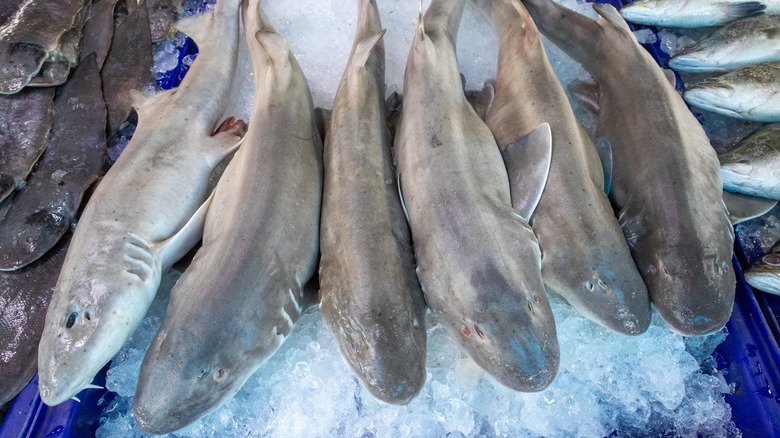
The biggest one is mercury. Shark meat sits near the very top of the FDA's mercury rankings, averaging 0.979 parts per million — a figure nearly equal to swordfish, itself a fish the agency warns consumers to limit. Sharks accumulate mercury because they're at the end of a long food chain, eating fish that have already eaten fish, with no biological mechanism to clear the metal from their bodies. And mercury isn't the only issue. A dead shark's urea converts to ammonia fairly quickly, leaving behind an odor that skilled prep work can reduce but rarely eliminates entirely (via the Food and Agriculture Organization).
To make things even murkier: Shark meat is sometimes sold under different names, including flake, dogfish, grayfish, or simply whitefish — and it occasionally turns up in fish and chips or imitation crab. So if you're eating unspecified "white fish" at a seafood shack, there's a chance you've already had it. Nothing you can do about it there, but if you've got the choice? It'll be safer (as well as cheaper) to skip it for something like tuna.
Even celeb chefs who ate everything drew the line at sharks
The culinary world has two very vocal voices who are staunchly against eating sharks. Anthony Bourdain tried hákarl, Iceland's fermented Greenland shark, during a 2005 episode of No Reservations, and called it "unspeakably nasty" (via YouTube). The fermented variety has to be cured for months to neutralize the shark's naturally toxic flesh. What's left smells heavily of ammonia and tastes about as bad as it sounds. Gordon Ramsay, who also tried hákarl, nearly brought it back up after a single bite.
Ramsay didn't stop at hákarl. In 2011, he fronted an entire documentary — "Gordon Ramsay: Shark Bait" — investigating shark fin soup across Taiwan and Costa Rica. To say it was drama-filled would be an understatement: someone poured gasoline on his head during filming, prompting him to say, "Let's get out of here before we get shot" (via YouTube). After all that, he sat down to a £90 bowl at a Taiwanese restaurant and found the fins essentially flavorless, with the broth doing all the work. His public summary was that it "actually tastes of nothing" (via YouTube).
The fins themselves are cartilage — little taste, just texture. The same broth over chicken or pork would be better. But the real reckoning is in the brutality of shark finning, where fishermen strip fins from live sharks and dump the bodies — killing an estimated 100 million annually (via Science). It's why it made his list of "never-try-again" foods, and probably should make yours too.