

The Cheap Wisconsin Beer You Haven't Sipped Since The Early '70s
Ask a Midwestener: The region's beer culture runs deep. In the 1970s, there were just certain beers that everyone drank. But, for discerning imbibers in the Midwest specifically, there's probably a good chance that the fridge was stocked with a few cans of Chief Oshkosh. The brew borrows its name from Oshkosh, Wisconsin, the city in which it was produced.
This clean, smooth, mild, pale gold lager featured a straightforward formula of six-row barley, flaked corn, and hops. Perhaps even more appealing than its taste, an eight-pack of stubby 12-ounce glass bottles of Chief Oshkosh ran for just $1.25 in 1963 (about 16¢ per brewski). It was discontinued in 1972. But for 44 years, Chief Oshkosh beer was accessible, inoffensive, and ideal for sipping while standing in the garage, polishing the hood of a Pontiac Trans Am (there's a reason "That '70s Show" is set in the Wisconsin suburbs, after all).
The brew's story begins in 1928 during the Prohibition era. Chief Oshkosh first hit the market as a non-alcoholic beer, with the alcohol removed via a vacuum-seal process instead of traditional boiling. However, Wisconsin's home brewing culture caused the beer's fanbase to grow slowly at first. Fast-forward to March 1933, and the Cullen-Harrison Act allowed commercial brewers to sell beers with a 4% ABV. Enter: Chief Oshkosh, alc-style. Prohibition officially ended that December, and the Chief kicked up to the slightly stronger 4.5% ABV, where it stayed.
Chief Oshkosh was an affordable Everyman lager for Midwesterners of the disco decade
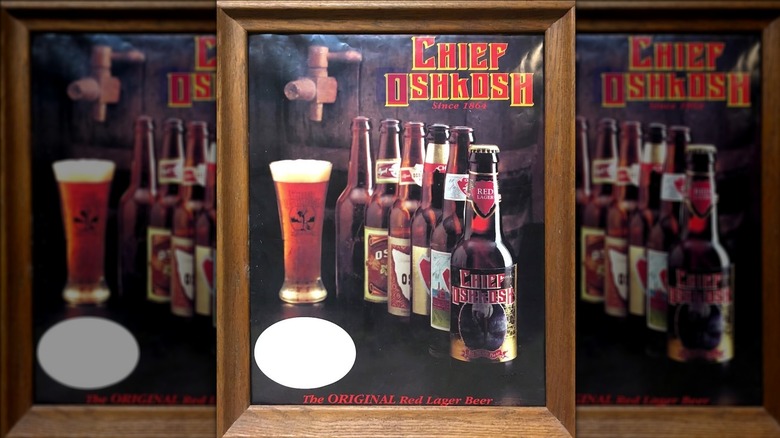
Until 1950, the recipe remained unchanged. However, the original Chief Oshkosh brew of the early-1900s leaned a tad hoppier, darker, and fuller-bodied than the American lagers that were becoming more popular – and remain the unofficial industry standard today. To meet changing consumer preferences, Chief Oshkosh beer received a revamped formula, resulting in a lighter, less robust lager. Apparently, it worked. In 1900, Oshkosh Brewing Co. (Chief Oshkosh's maker) was producing roughly 50,000 barrels of beer each year. By 1953, the brewery was cranking out over 60,000 annual barrels of its Chief brand alone.
Then, in 1961, Chief Oshkosh received yet another recipe update, this time for the worse. The brewers added hop extracts and swapped corn syrup for corn grits, ostensibly cost-cutting moves. Unlike the well-received reformulation a decade earlier, this unpopular change marked the beginning of the end. Sales dropped, and Oshkosh Brewing Co. closed its doors for good in October 1971. As for Chief Oshkosh beer, Wisconsin neighbor Peoples Brewing Co. bought the brand and sold it for one more year before also closing its doors in 1972 – the year the Watergate scandal began, and Todd Rundgren released "Something/Anything?" The old brick OBC building was demolished in 1986.
Chief Oshkosh beer hasn't been made since 1972, but fans still remember it
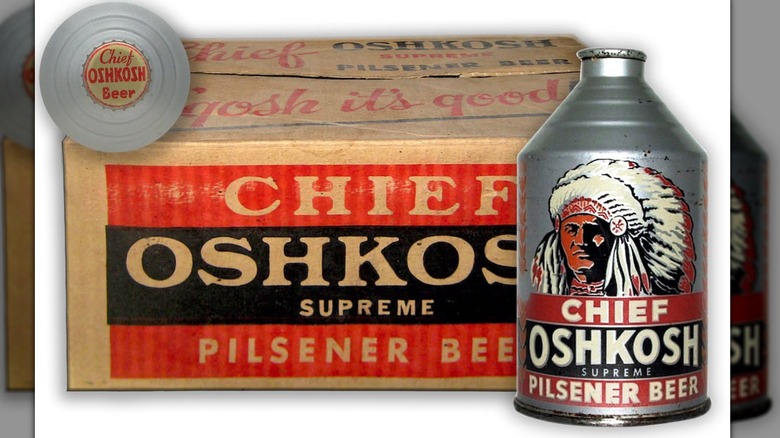
Nowadays, what remains of Chief Oshkosh beer is a trove of vintage memorabilia on eBay. Fellow Midwestern beer giant Schlitz announced its closure this year, too. Over the course of its four-decade lifespan, Chief Oshkosh emerged as the top-selling beer to ever come from the city. Even the Oshkosh Brewing Company itself is a symbol of the Midwest region's history.
OBC was founded in 1894 as a merger of three Oshkosh breweries: Brooklyn Brewery, Union Brewery, and the Gambrinus Brewery. The joining of forces was an attempt to keep up with industry competition from Milwaukee, as Pabst Brewing Company and Joseph Schlitz Brewing Company broke onto the scene with gusto. Around 1900, OBC made the face of Chief Oshkosh of the Menominee tribe — for whom the Wisconsin city was named — its official logo.
The beer may have been gone for over 50 years, but diehard fans of the region's beer tradition are still carrying the torch with pride. Last year, a single 1950s Chief Oshkosh "crowntainer" fetched a whopping $111,150 at Morean Auctions, setting a new company record for collectible beer bottles. The winning bidder was a Wisconsin native. "It was both thrilling and validating to see the price surpass $100,000," shared Morean Auctions' founder, Dan Morean, in a press release. "These old beer cans were never meant to be collectibles. They were designed to be disposed of, which makes them incredibly rare. Collectors have had a deep passion for them since the 1970s, and it's gratifying to see them gain the recognition they truly deserve."