

Why Grocery Store Bread Doesn't Taste Like Bakery Bread

As simple as it might sound, heading to the store for bread isn't actually a cut-and-dry sort of task. Say your partner texts you at work and asks you to pick up a loaf on the way home. Do they mean a loaf of soft, sliced whole wheat bread to make sandwiches, or are they looking for a crusty boule that can be served with soup? Looking at those breads side by side, they barely seem like the same food. To understand exactly why bagged grocery store bread looks and tastes so different from bakery bread, we spoke with Kantha Shelke, PhD, a certified food scientist who is the founder of food science and research firm Corvus Blue LLC and a senior lecturer on food safety regulations for Johns Hopkins University.
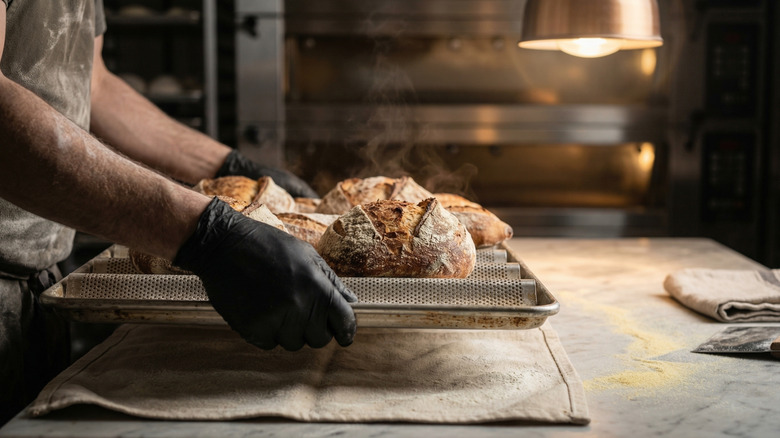
"While it may seem logical to assume it all comes down to one ingredient, the bigger story is really about time and freshness," she explains. Artisan bakery loaves are made much the same way bread has been made for centuries. The dough is allowed to slowly ferment and rise for many hours, producing, as Shelke explains, "a range of compounds including organic acids and aromatic compounds with that wheat/popcorn-like aroma with a faintly tangy complexity."
The situation for bagged sandwich bread is very different. "Industrial bread operations strive for speed," Shelke explains. "Some baking lines go from flour to finished loaf in a couple of hours." Using specialized techniques and ingredients like dough conditioners, manufacturers can quickly produce large quantities of bread. The tradeoff? The bread doesn't have time to develop the wonderful flavors and textures you expect from a nice bakery loaf.
Time affects bread at every stage of production
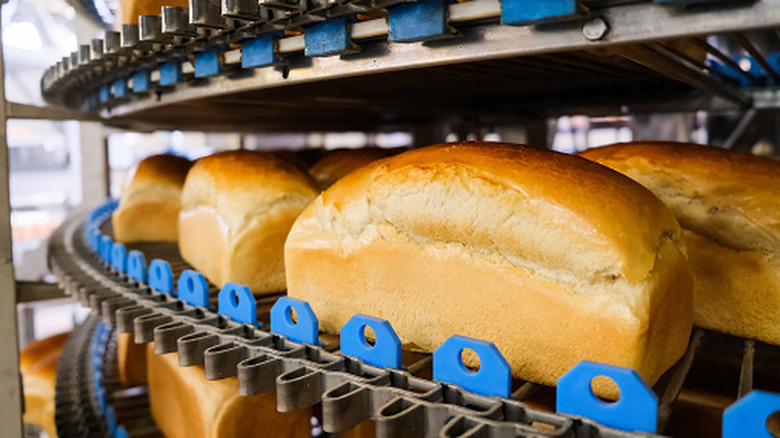
Fermentation isn't the only stage where time matters. It also plays a role during the baking process. "A crusty bakery loaf bakes hot and browns deeply through the Maillard reaction, which develops toasty, nutty aromas," Shelke says. Meanwhile, "soft sandwich bread is baked in a pan to stay pale and tender."
While those production method tweaks deliver an industrial bread that is great for the shelf, they also result in a milder flavor. When you buy a loaf of bread from the bakery, it was almost certainly baked that day, likely just a few hours before you went to pick it up. Those bagged sliced loaves, on the other hand, may be days out of the oven by the time they hit the grocery shelf. "Bread's signature aroma is volatile and starts fading within hours of baking," Shelke explains. After several days on the shelf, "all the aroma and flavor compounds have dissipated and become muted." The shelf life of bakery bread may be shorter, but that's another reason that it tends to be a more flavorful choice.
The extra ingredients don't really change industrial bread's flavor
While many consumers assume preservatives would have a significant effect on the flavor of store-bought bread, Shelke says that is just not the case. "Preservatives play such a small role in the flavor of bread that most people are surprised and find it hard to accept." she says. "Calcium propionate is most often used as a mold inhibitor in bread," Shelke reveals, adding that it's "tasteless."
Adjuncts like dough conditioners, crumb softeners, and emulsifiers are all key elements of producing a soft sandwich bread that can sit in a bag for a week before being eaten. As Shelke explains it, these ingredients are added "to strengthen the dough, to produce a taller and more uniform loaf," and, perhaps most importantly, "for shelf-life extension by slowing stalling and keeping the crumb soft longer." The effects on texture and shelf life are huge, but flavor? Not so much.
There is, however, one ingredient often found in industrial breads that does have a notable impact on flavor: sweeteners. "Sugar or corn syrup is often added to sandwich breads," Shelke says, "but not in lean bakery baguette which is just flour, water, salt, and yeast." The sugar in industrial breads is about more than just added sweetness, though. It also helps the dough rise more quickly and the crust to brown up without hardening.