

7 Myths About Self-Checkout Shoppers Keep Believing
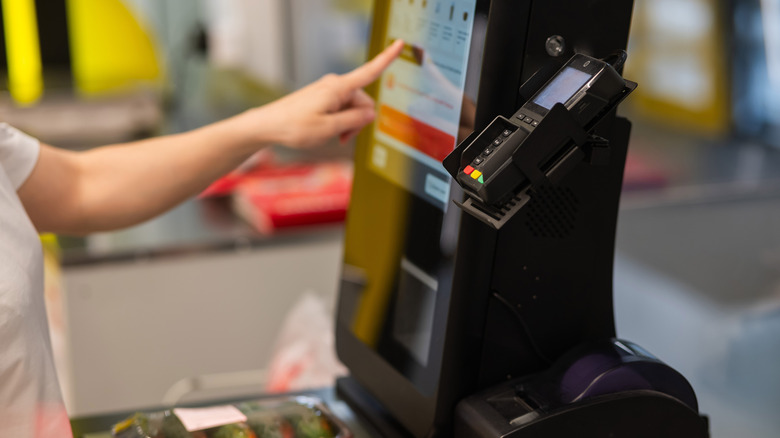
You're at the grocery store, and it's time to check out. At many grocery stores — with notable exceptions like Trader Joe's (which some customers find annoying) — you'll have two options: go through the traditional checkout line or opt for self-checkout. There are pros and cons to both choices, but if you don't have many items (or you'd just rather not have a conversation with someone), going through the self-checkout line may be your best bet. Sometimes, this can seem like the quicker option, and some people love self-checkout for its convenience and ease of use. And since you don't have to wait for a cashier to become available, you might not have to stand in line for quite as long as you otherwise might.
Whether you use self-checkout often or not, there are some prevalent myths about it that you might believe. Learning the truth behind these myths might just change the way you use self-checkout in the future, or may make you question why you ever used it in the first place. Either way, it pays to have a bit more clarity when you're checking out at the grocery store.
Most customers love self-checkout
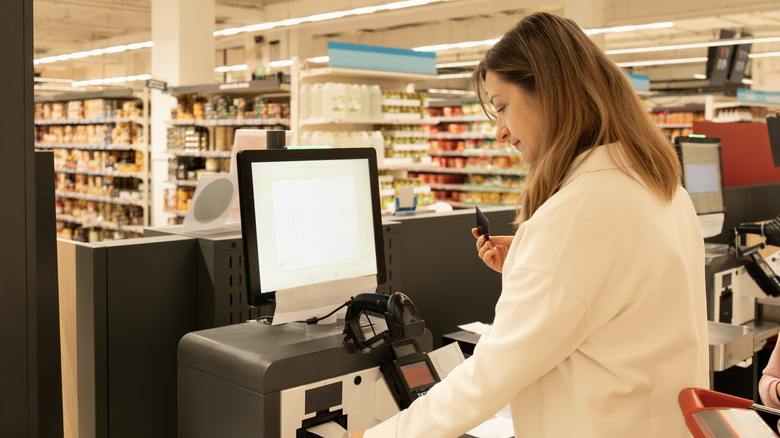
Self-checkout is seemingly everywhere these days. You'll notice it at your neighborhood grocery store, but you can also find self-checkout lanes at warehouse clubs like Costco. They've even moved beyond the grocery space and can be found in retail settings — Uniqlo is one example. Because of the current ubiquity of self-checkout, you might understandably assume that customers love this method of checking out. But these days, that's just not the reality.
Studies have shown that customers largely prefer checking out with cashiers. Part of this preference comes down to the fact that customers don't want to have to do the work of scanning and bagging all of the items. However, they also perceive that the customer service is better when they get to interact with a real cashier. This makes sense, considering that self-checkout was widely adopted partly so businesses could cut labor costs, not exactly because it made customers' shopping experiences better. Businesses that employ real cashiers tend to have greater brand loyalty than those that prioritize self-checkout.
In some ways, self-checkout is the grocery and retail space's symbol of "enshittification," the idea that companies have been incentivized to make their offerings worse in an effort to expand their profits, all at the expense of the consumer. So, don't believe the myth that most people are on board with the ubiquity of self-checkout; there's a reason it's widely disliked. At least some companies are taking the hint and cutting back on self-checkout.
It's faster than going to a real cashier
So, what's the real draw of self-checkout for those who choose to use it? In a lot of cases, it simply comes down to time. Customers generally don't want to spend more time in the grocery store than they have to, and they think self-checkout is going to get them out the door faster. In fact, according to NCR Voyix, 77% of shoppers who claim to prefer self-checkout say they choose it because it's faster, and they don't want to have to wait in line for as long as they might if they were to go to a staffed cash register.
However, on average, self-checkout actually takes longer than a standard checkout. People might perceive self-checkout as faster because they're not waiting in line as long. But after they scan all of the items themselves, wait for an employee to come enter a code when the computer freezes, and follow all the prompts to pay properly, self-checkout can take longer than it seems.
You don't need an ID for age-restricted items at self-checkout
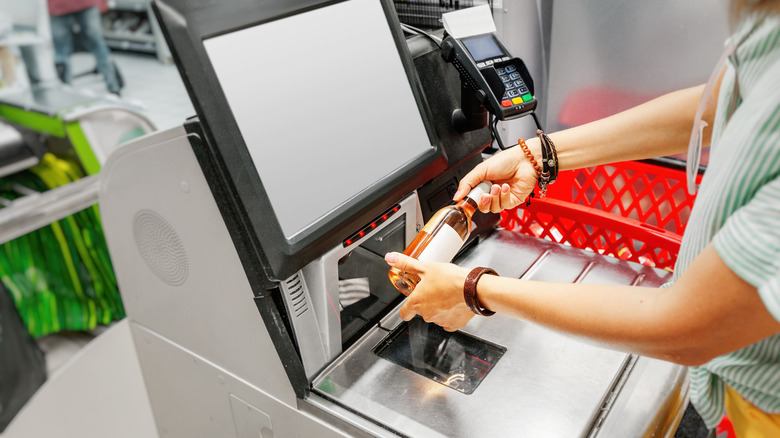
If you're at a grocery store that sells alcohol, you might assume that you can simply take your bottle of wine or six-pack of beer to self-checkout, ring it up, and be on your way. You might think the same is true for other types of restricted products, like certain medications. Ultimately, though, this is a myth. Just like a staff member has to check your ID when you're buying alcohol at a normal checkout, the same will have to happen when you're at self-checkout. When you ring up an age-restricted item, it will alert a staff member to come over to your checkout station, where they're supposed to take a look at your ID.
Some question whether it's even appropriate to use self-checkout for age-restricted items, since you'll be slowing down the line considerably while you wait for someone to type in the information to let you make your purchase. If you are going to use self-checkout for alcohol or other age-restricted items, make sure you have your ID on you and ready. It might make more sense for you to go through a standard checkout, though, since you'll still have to wait for a store employee to help you anyway.
It's the most efficient way to shop and check out
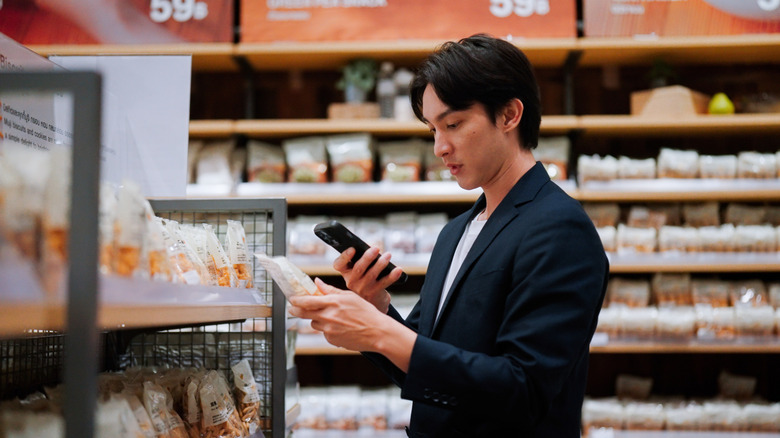
Some seem to have the idea that self-checkout is a more efficient way of doing your grocery shopping, although we've seen that it's often not a quicker way to check out at all. Still, though, it seems that the myth persists. But it's not just a standard checkout experience that's arguably more efficient than using a self-checkout station — there are new types of shopping technology that may negate the need for a checkout area altogether.
Retailers are considering the pros and cons of rolling out scan-and-go shopping. With new technology, customers can actually scan items on their phones while they're putting them in their carts. Once they're ready to leave the store, they can just pay on their phone, with no need for a specific area or equipment to check out. This kind of technology is available at select locations of chains like Hy-Vee, Giant, and even Walmart.
But others are pulling back on the idea of scan-and-go shopping. Wegmans, for example, claimed that it was ending the initiative in its stores because of significant losses. Whether you like the idea of scan-and-go shopping or not, it's hard to deny that it's a more efficient way of shopping than taking all of your purchases to a specific place and scanning them one by one, which means that self-checkout certainly isn't the most efficient checkout option out there.
You can't use coupons at self-checkout
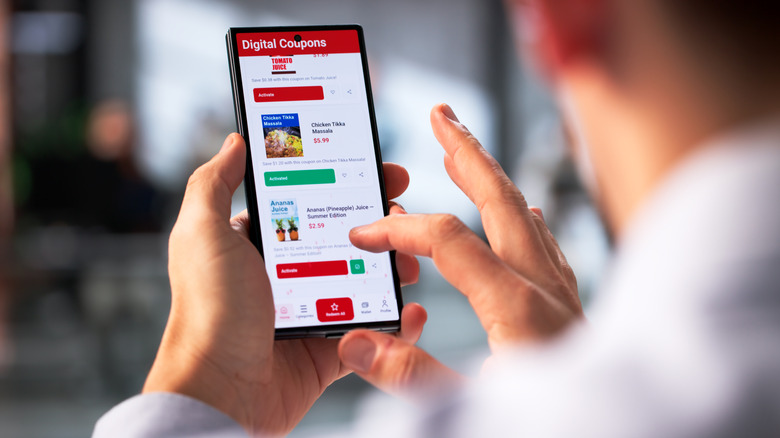
These days, as grocery prices are on the rise, more and more shoppers are looking for ways to save money at the grocery store. Arguably, one of the most underrated ways of doing so is by using coupons. Sometimes, grocery stores will send you coupons directly, and other times, you can seek them out online when you're really trying to maximize your savings. But because you may have had the experience of handing all of your coupons to a cashier who had to sort through them one by one, you could be under the incorrect assumption that you can only take advantage of coupons at a standard checkout station.
But good news for couponers everywhere: You actually can use coupons at self-checkout. Generally, you can "clip" coupons from grocery stores' apps and apply them at checkout through your phone. Even if you're using physical coupons, though, you can just scan them like you would with items you're ringing up. If you have an issue with one, you can call a staff member over to help you. Therefore, you shouldn't skip out on the coupons just because you plan on using the self-checkout — use them to take advantage of those savings.
Shoppers rarely make errors while using self-checkout stations
Checking yourself out at the grocery store doesn't seem like too tricky a task. After all, you just have to scan in all of your items, pay, and bag them. But the idea that shoppers rarely make mistakes while using self-checkout stations is, in reality, a complete myth. In fact, the more items that are in a shopper's cart, the more likely they are to make a mistake while they're checking out. There's a whopping 90% chance (per ECR Retail Loss) that a shopper who has 100 items in their cart is going to scan something incorrectly or neglect to scan certain items at all.
And then there are the purposeful non-scans. Let's be honest: It's pretty easy for people to simply take items out of the store that they didn't actually pay for when using self-checkout. According to one survey, via Lending Tree, 27% of people admitted to having taken an item without scanning it on purpose. And 36% of people said that they've accidentally left the store without paying for an item, and most don't return those unscanned items once they discover the mistake.
This is why employing self-checkout can result in larger losses for stores, losses that aren't seen on the same level at stores without self-checkout stations. You might want to double-check to make sure you've scanned everything in correctly the next time you're at the grocery store, but if you do make a mistake (or get sticky fingers) at self-checkout, you're reportedly not alone.
There aren't really any unspoken rules about self-checkout etiquette
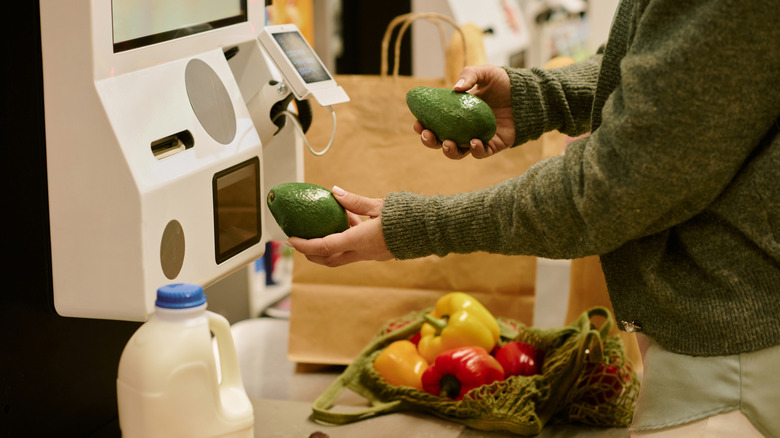
The self-checkout station at your local grocery store isn't the Wild West, and just because you're not working with a cashier doesn't mean that everything goes. It's a myth that there aren't etiquette rules that you're supposed to follow when you're using self-checkout. Some of these are obvious: You won't want to bring too many items to a self-checkout station, particularly if there are a lot of people waiting in line to check out. Also, you shouldn't just leave things that you intended to buy but no longer want at the self-checkout, as it crowds the space for the next customer and unnecessarily makes a staff member do more work.
But there are a few other etiquette considerations that you might not immediately think of until you find yourself in a certain position. For example, it's usually not a good idea to start scanning your items while others are still bagging up their groceries at the same station — you'll be getting in their personal space, and might make them feel rushed. You should also put your basket or cart back where you got it from before you leave, so as not to create more work for staff members.