

The Reason Cool Whip Is Sold Frozen Might Make You Leave It On The Shelf
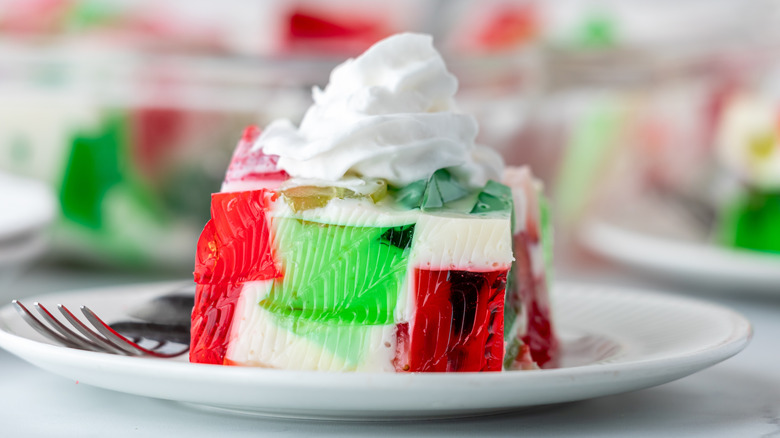
If you've ever taken the time to make whipped cream from scratch, you probably know that Cool Whip, the fluffy manufactured topping often found in vintage salads, is an engineered creation. Unlike traditional whipped cream, which is just heavy cream often mixed with confectioners' sugar, Cool Whip is an amalgamation of oils, sweeteners, emulsifiers, and stabilizers. Those ingredients are blended into an inherently fragile foam that has to be sold in the freezer aisle, rather than the dairy case.
If the product warms too quickly or sits out for an extended period of time, the whole structure begins to break down. And it doesn't just melt the way ice cream does. When you learn that Cool Whip was manufactured by a chemist at General Mills in 1966, it makes a little more sense. The chemist, William A. Mitchell, is the man behind some of our most magical foods; he also created Tang, quick-set Jell-O, and Pop Rocks. Mitchell wanted to create a convenient whipped cream replacement that could be shipped, frozen, and used when needed. Incredibly, his recipe at that time was totally dairy-free.
Fresh whipped cream gets its texture by trapping air bubbles inside milk fat, while Cool Whip is engineered as stabilized foam. Freezing helps preserve the airy structure during shipping and storage, and when thawed properly in the fridge, it returns to its characteristic fluffy consistency. Cool Whip's success was thanks to 1960s cooking trends like frozen convenience foods, which were a huge time-saver for newly working moms at the time.
Cool Whip is a product born of mid-century convenience
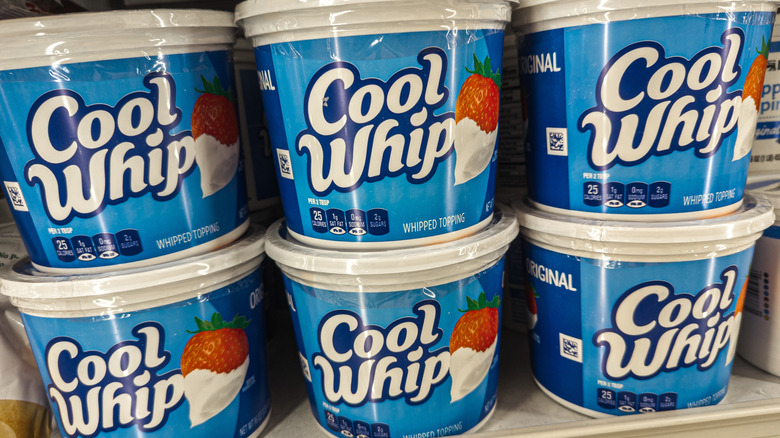
Cool Whip quickly became a staple ingredient in recipes found in community cookbooks, ladies' magazines, and the classic Watergate salad. For many Americans, this engineered fluff is associated with holidays, pies, and potlucks, along with plenty of nostalgia. But for slow food enthusiasts and chefs, it can be viewed as the polar opposite of what they value in cooking and eating. The biggest criticism is that Cool Whip is the furthest thing from actual whipped cream. The first four ingredients are water, corn syrup, high fructose corn syrup, and hydrogenated vegetable oil — three of those are on many dietitians' lists of key ingredients to avoid.
For people who prioritize simple, recognizable ingredients, Cool Whip is an industrially formulated product that seems unnecessary. And if you value traditional food preparation, well, this product is pretty darn disconnected from the agricultural origins of its ingredients. The texture can also throw some people as well. Fans appreciate the Whip's stability and fluffy consistency, but naysayers describe it as overly airy synthetic slop. It also lacks the clean, fresh dairy taste of homemade whipped cream.
Now, this doesn't mean everyone who appreciates good food is a hater of Cool Whip. Some desserts, particularly the kitschy mid-century candy bar "salads" that we love to reminisce about, were developed specifically around Cool Whip's unique properties. We think there's enough room in the fridge (or freezer) for both real whipped cream and its chemical counterparts.