

Why You Don't Often See 5-Pound Bags Of Sugar Sold In Grocery Stores Anymore
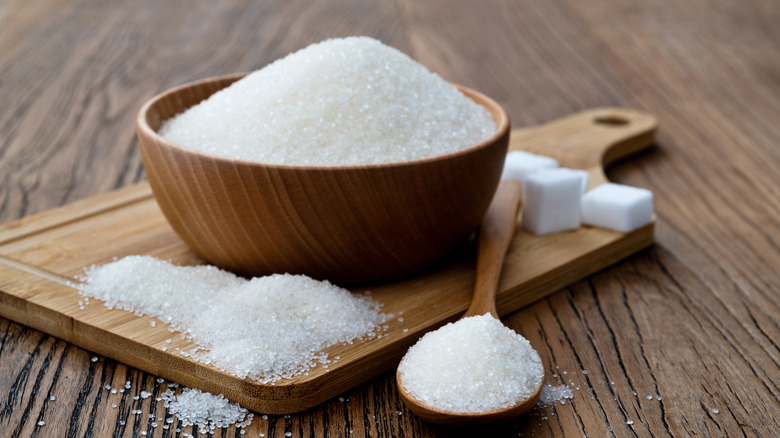
For years, you could head to your local grocery store and pick up a bag of sugar for a couple of dollars. In 2008, sugar in Indiana might cost you $1.99, or roughly 40 cents per pound, while it was only about 30 cents per pound in Minnesota. In 2000, a Minyard ad from Dallas (via Facebook) showed sugar at about 25 cents per pound. In 2026, a bag of sugar at Walmart costs around 78 cents per pound. The cost of sugar keeps going up.
Prices aren't the only thing changing. Close to 20 years ago, 5-pound bags started vanishing from shelves, replaced by 4-pound bags. Shrinkflation is the reason; manufacturers changed package sizes to combat rising costs. According to Marketplace, the price of sugar saw serious fluctuations in 2008 that intensified over the following few years. Government policies in sugar-producing parts of the world, including India, resulted in lower production volumes. As supply was reduced, demand remained the same, so prices went up.
From 1980 until August 2009, the price of sugar as a commodity never rose above 20 cents per pound (via Macrotrends). In 2010, it nearly doubled, reaching almost 40 cents. Weather and supply chain issues drove prices up, and manufacturers responded by downsizing package sizes. Transportation costs, various fees, and tariffs in the American market also increase prices for consumers, and lead to decisions like shrinking packaging. The driving force behind shrinkflation is to save money while essentially tricking customers into thinking they're still getting a nearly identical product, even though you're really getting less. Sugar is just one of many products that fell victim to shrinkflation.
When sugar isn't so sweet
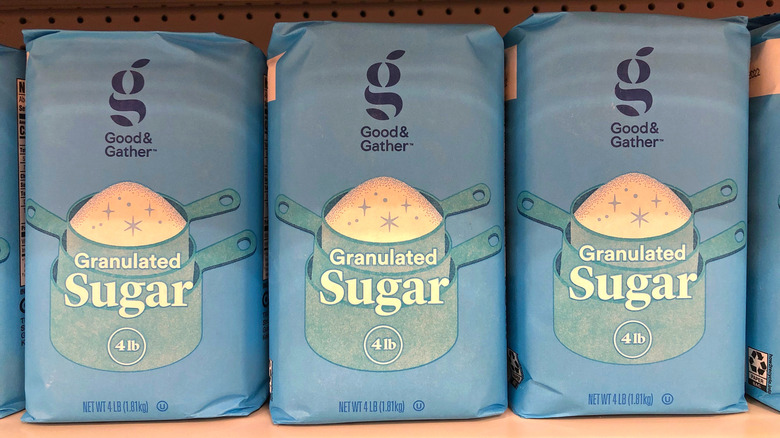
Some consumers notice shrinkflation right away — not just at grocery stores, but even at fast food restaurants such as In-N-Out. Not everyone does, though, and not right away. That's why it works. "If manufacturers simply charged more per unit to compensate for those higher prices, it would scare off customers," commodities and futures analyst Judy Ganes told Marketplace. So, prices stay relatively steady, or rise slightly while the package size decreases. C&H Sugar explained on Facebook in 2011 that it had to raise prices in an effort to lower its own costs: "The reduction in size, however, is not enough to offset the cost increase in the remaining four pounds of the product. That's why you're seeing the price go up and the size go down at the same time."
One poster on Facebook in 2021 was shocked to discover a 5-pound bag of sugar was only 4 pounds, prompting another commenter to note they had been 4-pound bags "for at least 10 years." Another commenter on a Washington Post article from 2022 about shrinkflation said, "A pound of coffee is usually 12 ounces, a quart of mayonnaise is 30 ounces, a 5-pound bag of sugar weighs 4 pounds." All this shows how strongly consumer expectations shape what people assume they're buying.
There is no rule that says a bag of sugar has to be 5 pounds, but because people expect 5-pound bags, it feels like a double shock when prices are increased and package sizes are decreased. In recent years, even as global sugar prices have dipped below 15 cents per pound, retail prices have remained relatively steady.