

The Trick To Making Less Stinky Cabbage
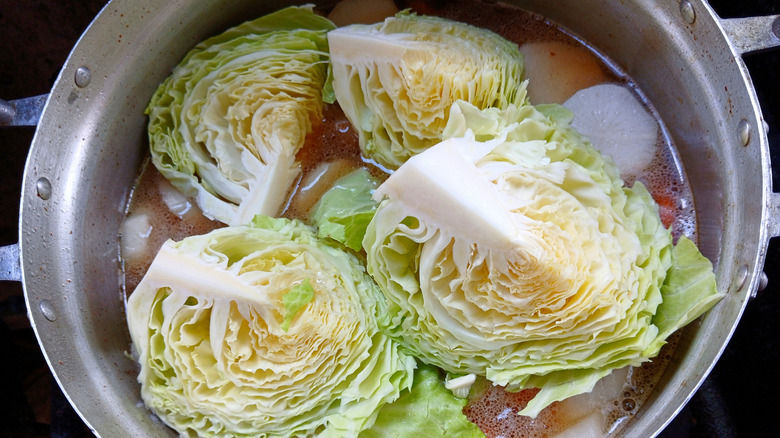
Beans may have a reputation for being the musical fruit, but cabbage and its fellow brassica family members have an equally unfortunate reputation for being smelly veggies. Cabbage comes in many types, which all emit a stinky odor when you cook them due to the presence of sulfur compounds. The longer cabbage cooks, the more sulfuric compounds are released and thus the more intense the stink. Overcooking cabbage is a sure way to stink up your kitchen, but compounds are released during the cooking process even if cooked correctly. Luckily, there are plenty of tricks to mitigate or eliminate the smell of cabbage both during and after the cooking process.
The simplest way to eliminate smells while cooking cabbage is to add either lemon juice or vinegar directly to the cooking liquid. Both of these staples are well-known odor eliminators — lemon can also be used to neutralize odors in your fridge. The acid chemically alters the sulfur compounds, reducing their volume. Bay leaves are another good bet along with lemon juice or a cup of vinegar in the cooking water for an even more foolproof odor barrier. And a spoonful of milk in steaming liquid also helps. If you'd rather not add ingredients directly to the pot, you can place certain starchy staples next to or on top of the covered pot of boiling or steaming cabbage. Douse a piece of bread in vinegar or lemon juice to absorb the odiferous steam emanating from the pot. Placing a halved potato next to the pot will also effectively absorb odors.
More methods for cooking cabbage with less stink

Essentially, the shorter the cooking time, the less you'll have to worry about the smell emanating out of the pot and pervading your house. So, you can switch longer cooking methods for shorter ones. For example, swap boiling for steaming, which is also a gentler method that retains more of the vegetable's nutrients; a win-win situation. Sauteing or stir-frying shredded cabbage is another quick-cooking method with less risk of stinking up the kitchen. Plus, you'll probably use other aromatic ingredients in a stir-fry like garlic, onions, and spices which smell delicious when bloomed in hot oil and will certainly balance or mask the smell of sulfuric compounds. Instead of a long roast for cabbage wedges, you can sear them in hot oil for that same charred crust in a fraction of the time.
If you're set on boiled, braised, or roasted cabbage recipes, don't let the stink deter you. Simply safeguard against the smell that might permeate your kitchen with the help of common ingredients you're likely to have on hand. For example, eliminate lingering cabbage smells by boiling citrus peels, letting the steam from the pot permeate your kitchen. This method is known as a simmer pot, and it's a great way to use up citrus peel scraps. Other simmer pot ingredients include apples, cinnamon, star anise, and rosemary. Alternatively, mist the air with a mixture of vanilla extract and distilled water.