

These Are The Farm-Animal Treatment Standards That Walmart And Sam's Club Demand From Suppliers
We may receive a commission on purchases made from links.
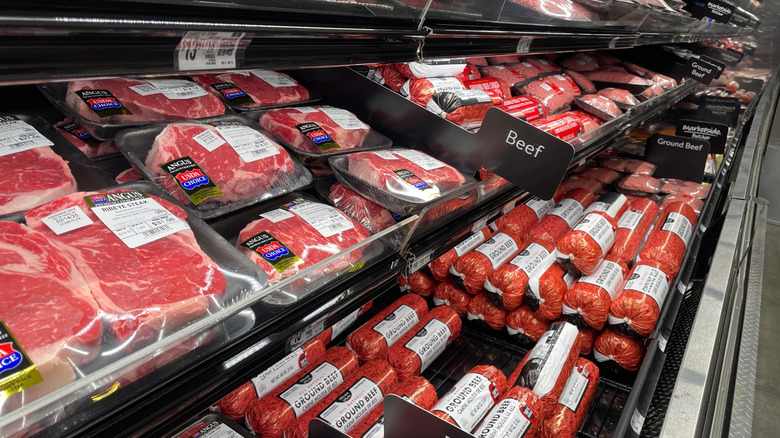
Walk into a Walmart or Sam's Club on any given day and you'll find the meat department packed — courtesy of endless deals that keep customers coming back. But cheap meat raises questions: Where is it actually coming from? How are those rotisserie chickens and Member's Mark steaks raised? The good news is that both have explicit animal welfare policies that lay out supplier expectations in detail.
At the core, both Walmart (and its subsidiary, Sam's Club) share the same guidelines leaning on the "Five Freedoms" — a framework developed by the British Farm Animal Welfare Council that's become the gold standard for animal care globally. These five principles are straightforward: animals should have access to food and water, live free from pain or illness, experience physical comfort, express their natural behaviors, and exist without fear or stress. That's the baseline both retailers commit to — every time you grab a package of any kind of meat.
In practice, suppliers need to flag and fix any abuse incidents, phase out confinement practices like gestation crates and battery cages, and make sure that when they do perform painful procedures (tail docking, dehorning, and so on), they've got proper pain management in place first (Sustainable Brands). Antibiotics mustn't be used as a growth booster, and suppliers are on the hook for writing annual animal welfare reports and submitting to third-party audits from time to time (Walmart, Inc.) That's quite comprehensive as far as policies go ... at least on paper.
How do these standards stack up against the rest of grocery?
According to the ASPCA's annual Supermarket Scorecard — one of the industry's most authoritative independent rankings — Walmart and Sam's Club occupy solid middle ground in the report. Both have implemented complete cage-free egg policies and carry their own cage-free store brands (Arkansas Business). That doesn't sound like much until you find out that it's miles better than some competitors, like Trader Joe's, which, and we quote: "[failed] to make even the most basic commitment to ensure animals in their supply chains are not suffering."
As for whether these companies have put their money where their mouths are... Well, that's where it gets complicated. Walmart ranked dead last on the 2024 Business Benchmark on Farm Animal Welfare — a failing grade that puts it in the company of McDonald's, Nestlé, and Cargill. None of these are known for going all-in on animal welfare. And since Sam's Club is Walmart-owned, it raises some questions about how aggressively those goals are actually pursued.
If you're really concerned about animal welfare, when you shop at either place, pick up packages labelled as "organic". Grass-fed is worth seeking, too, though it speaks more to feed quality than living conditions. All these tend to be a bit more premium, but they're always sourced with higher animal welfare standards than the usual meat.