

The Little Brewery Seal Many Beer Drinkers Miss, And Why It Matters

Beer trends have been in an unpredictable state of flux during the last few decades. Between waves of new and emerging craft breweries, and receding tides from Big Beer's buyouts of smaller breweries, it can sometimes be hard to tell which breweries are in a net or swimming free. To help imbibers, retailers, and venues identify which breweries are still independently owned and operated, the Brewers Association created the Independent Craft Brewer Seal in an effort to "proudly display that independent spirit."
The seal features an upside down beer bottle with the words "Independent Craft" scrawled alongside. According to the Brewers Association's site, its purpose is to give "beer lovers an easy way to identify independent craft beer." Where many breweries have been quietly bought wholly or in part by bigger brewing companies or other liquor brands, it can be hard to find breweries that are exercising the independence and creativity that has typically characterized craft beer. To qualify for the certified mark, a brewery must be small (producing 6 million barrels of beer or less), independent (owned no more than 25% by other alcohol industry entities — excluding craft beer producers), and be classed unequivocally as a brewing company.
Nick Meyer, owner of Eckhart Beer Co. explains the seal's importance as "a way to identify that a brewery is not owned by one of the huge, dominant players in the U.S. beer industry." According to Meyer, "If supporting small brewers over big ones is something that's valuable to [consumers], this helps them make an informed choice."
A seal for your approval
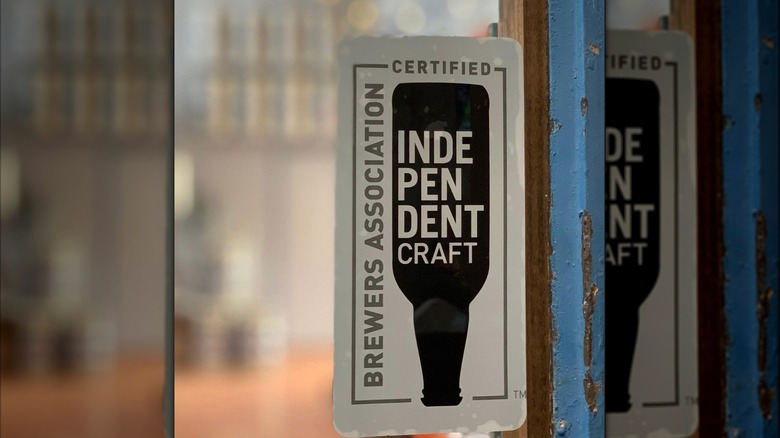
Another perspective on the seal is that it might not be as relevant as it once was. Josh Penney, head brewer at Threes Brewing in Brooklyn offers his view: "My personal opinion is that the symbol doesn't really mean a lot to most consumers anymore. There's been a lot of consolidation and movement within the craft beer space and it tends to get a little murky. I think most people are aware of a lot of the 'big name' owned breweries and people don't usually need to see that symbol to make their decision."
Though some consumers online echo Penney's opinion and question its value, many other beer drinkers support and seek out the symbol, considering it especially helpful when faced with unfamiliar brands.
As interest in craft beer thins over time and the industry shrinks, however, breweries are finding other avenues to gain stability and bolster their businesses outside of the classic, sell-out-to-Big-Beer narrative. Some independent breweries join forces with others in "rollup mergers" that consolidate resources. In other instances, one larger independent brewery acquires another. These breweries remain independent within the stipulations of the seal, but this also means that one brewery is tied up in the finances and control (to varying degrees) of another. This does beg the question of how relevant a seal of independence really is to beer drinkers, as ownership gets — in Penney's words — "murky."
A seal of pride

Ultimately, the Independent Craft Brewer Seal matters because it confirms that a brewery isn't just one of many swallowed up by Big Beer players like AB InBev. For the purists, discerning fans, and those rooting for the underdog, the certified symbol proudly declares independence.
The seal was first introduced in in 2017, at the end of a decade in which AB InBev (then Anheuser-Busch) had acquired 10 smaller independent breweries and independent beer enthusiasts were getting nervous about the future of the industry. The Brewer's Association called their campaign "Take Craft Back," and the immediate buy-in from craft breweries was encouraging. Now, nearly another decade later, over 5,700 breweries use the mark on their labels.
For the breweries that still proudly fly this flag of independence, the seal represents commitment to keeping craft beer autonomous and out of the hands of large corporations, giving craft beer drinkers a unifying emblem to seek out on cans and bottles. This in turn makes it easier for them to support the breweries with this ethos. In the end, whether or not the seal is important is up to whomever cracks open the can.