

Should You Buy A Shiny Watermelon?
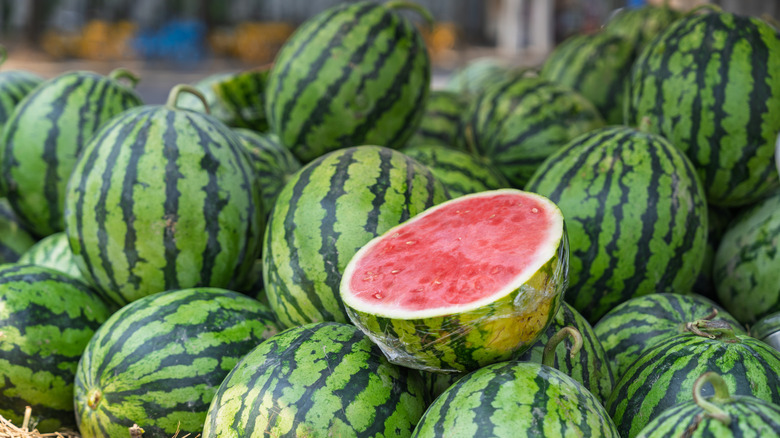
Like any fruit or vegetable, choosing a watermelon has a long list of visual, tactile, and even auditory cues. The way the fruit looks is usually the first test we use to pick out a watermelon. Our eyes tend to be drawn to shiny things. And while a shiny eggplant, apple, or tomato mean the fruit is at peak ripeness, a shiny watermelon is one you should avoid.
Underripe watermelons have a glossy, waxy coating that appears shiny. So, if you chose a watermelon based on shininess alone, you'll be stuck with one that is not ready to eat. Unlike bananas and peaches that continue to ripen after they're picked, harvesting a watermelon effectively stops the ripening process for good. Once you've picked an underripe watermelon, you're stuck with it; there's no way to ripen an underripe watermelon. Look for watermelons that have a dull, green matte coloring. Another visual sign of fruit that's not quite ready to eat is the size of the stem. A large, green stem, like a shiny sheen, is a cue to leave the watermelon in the bin.
Visual green flags on a watermelon are what you might consider eyesores to avoid if you're not in the know. For example, webbing seen as raised brownish streaks or patches along the rind are due to sugar scarring, indicating a sugary sweet interior. Likewise, the large yellow spot that many watermelons have is where the watermelon has sat out in the field before being harvested. A deep yellow spot indicates high sugar content.
More ways to spot the ripest watermelons

Many of the tips and tricks to picking the perfect watermelon involve looking at the fruit, but tactile cues are as plentiful as the visual ones.
Testing a watermelon's firmness is a key trick to ensuring it's ripe and ready to eat. You can start by running your fingernail across the rind to ensure that scratching the rind doesn't pierce it. You can also press your finger into the rind to check firmness, ensuring that your finger makes no indentation. A soft, mushy rind might lead to rotten or mushy watermelon flesh. The weight relative to the size of the watermelon is another indicator of the sweetest, juiciest watermelon. The heavier a watermelon is relative to its size means a high water volume which in turn equates to a super juicy watermelon. You can compare by lifting up two equally sized watermelons. The heavier watermelon is the one you should put in your cart!
One of the most widely used methods for choosing a watermelon is auditory. The tapping method for picking a watermelon assesses its juiciness as much as lifting it does. You'll want to listen for a deep, low-pitched, hollow sound as opposed to a high-pitched, flat ring. If it sounds like you're tapping a drum, this indicates a higher water volume inside, which also means a higher sugar content. The water content allows sound waves to bounce around and vibrate, creating that hollow drum sound.