

Is It Ever Safe To Microwave Metal?
Since becoming mainstream household appliances in the 1970s, microwave ovens have changed a lot. Over time, they have become smaller, cheaper, more efficient, and loaded with all sorts of special settings that you ought to be using. Some things, however, have not changed so much. For one thing, the general rule of thumb is still that metal objects should be kept out of these appliances. As it turns out, however, this rule might not be as strict as we've been told. To explain the matter in detail, we sat down with Kantha Shelke, PhD, founder and principal of food science and research firm Corvus Blue LLC, and a senior lecturer of food safety regulations at Johns Hopkins University.
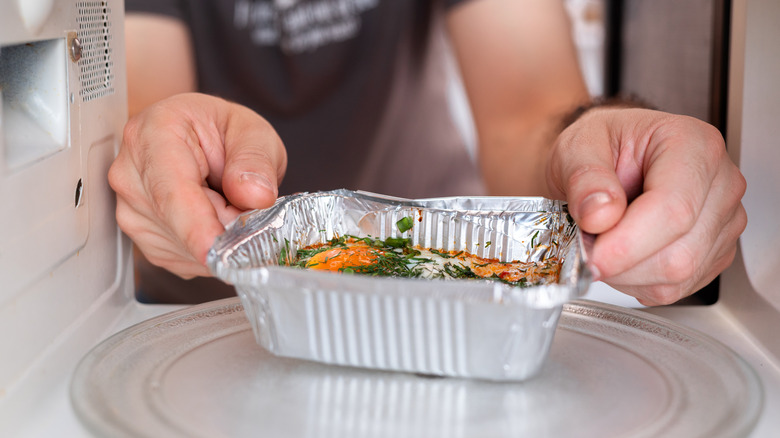
"The rule of thumb most of us grew up with is mostly right," Shelke says, accepting that metal typically tops the list of things to never put in the microwave. She does, however, allow that there are safe exceptions to the rule — though the circumstances can be a bit narrow. "There are legitimate exceptions," Shelke says. "USDA's Food Safety and Inspection Service allows small, smooth pieces of aluminum foil to shield parts of food that overcook quickly (e.g., poultry wing tips) if the foil covers no more than a quarter of the food, stays at least an inch from the oven walls, and is smooth and not wrinkled."
Why exactly does metal cause problems in the microwave?
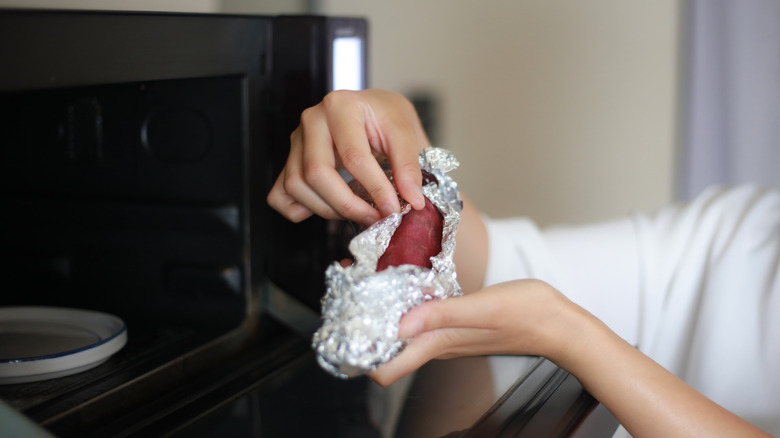
The last piece of that advice is more relevant to the conversation about metal in the microwave than you might realize. "What matters most is the shape, not that it's metal," Shelke explains. "Microwaves do not pass through metal but reflect off it. When that reflected energy concentrates at thin edges, sharp points, or crumpled folds, it can build up enough voltage to leap as a visible spark."
This is why accidentally microwaving a fork can cause real problems, but certain types of metal get by just fine. You might even be familiar with the metallic sleeves on Hot Pockets and other frozen microwaveable foods, which are specifically designed to work with the physics of microwave ovens in order to deliver effects like crispness and browning. Or perhaps you might have seen a microwavable meal in a metal tray, or an oven with its own interior metal components. "Some frozen meals come in shallow aluminum trays engineered specifically for microwave reheating," Shelke says, "and certain ovens ship with manufacturer-tested metal racks."
In truth, you just have to look at the mesh grating on the microwave door itself. Inside the glass on the door is a metal mesh designed to keep the microwave radiation inside the oven while also allowing you to watch your food cooking. Obviously, this mesh, as well as the metal walls of the rest of the microwave oven, do not pose a sparking or fire risk, despite the material they are made from. In fact, that metal is integral to the safe design of the oven.
Microwaveable metal containers may be a growing trend
As a general rule, though, you should be very careful with putting any metal in the microwave. "Check your owner's manual," Shelke says. "If it says no metal, that's the end of the conversation." Even if some metal is permitted, make sure that you follow the instructions carefully and stay by the oven as it cooks. Should you see any sparking at all, stop the microwave immediately and make different plans for heating that food.
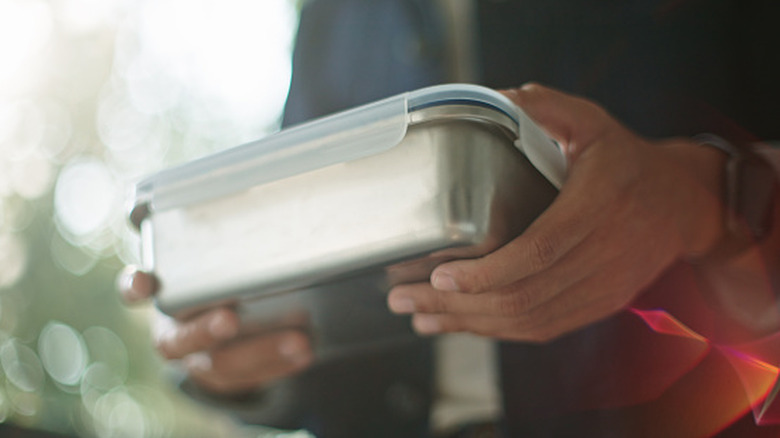
While it might seem unusual to use metal in the microwave at all, it is perhaps something that we should all start getting used to. "People are increasingly moving away from single-use plastics," Shelke explains, with the primary concern being chemicals leaching from the plastic as it's heated. Black plastic containers might be the norm right now for microwaveable meals, but that might change as consumer awareness grows around what happens when you microwave food in plastic dishes, leading to an increasing market for microwaveable metal containers with rounded corners and smooth rims, like this inexpensive stainless steel food storage set from Fecoqi. Then again, glass or ceramic dishes are also great options, and safe operation doesn't require you to read the microwave manual or stand guard over the appliance while warming up your lunch.
The answer to whether or not metal can go in the microwave is not a simple one. But if you don't feel like going to that trouble, just stick to other materials for your microwave cooking.