

This Bourbon Bottle Label Guarantees Quality Without Question

We may receive a commission on purchases made from links.
Pondering the array of bourbon whiskeys at your local liquor store, it's easy to feel a bit lost. You may feel uncertain about investing in a prohibitively expensive bottle without some sign that it will be worth the money, so in lieu of a trusted recommendation, is there any way of assessing the quality of an unfamiliar bourbon? To answer this, Tasting Table got advice from Cody Nicoll — sommelier, mixologist, managing partner of Ottawa's Ember Live Fire Grill, co-owner of Bar Ocelli, and the owner of Hospitable Nicoll — who unpacked the meaning and importance of the words "bottled-in-bond."
Asked precisely what this label means in the context of bourbon, Nicoll explained that "the term bottled-in-bond in the United States stems from the 1897 Bottled In Bond Act, which was meant to serve as a stamp of authenticity and quality of the product. This act stipulates guarantees that the product was distilled by one distiller at a single distillery in one distilling season, aged for at least four years in a federally bonded warehouse, and bottled at exactly 100 proof (50% ABV)." The reason aficionados look out for bottled-in-bond bourbon, Nicoll said, may be because of that proof content.
"Enthusiasts might seek out such products because of the higher proof content, which implies less dilution and, consequently, a greater concentration of flavor and purity," explained Nicoll. Additionally, the four-age statement required in order to attain a bottled-in-bond label is "double the minimum aging requirements of bourbon, thus spending more time in oak, pulling more flavor and terpenes out of the barrel."
Why the Bottled In Bond Act was necessary
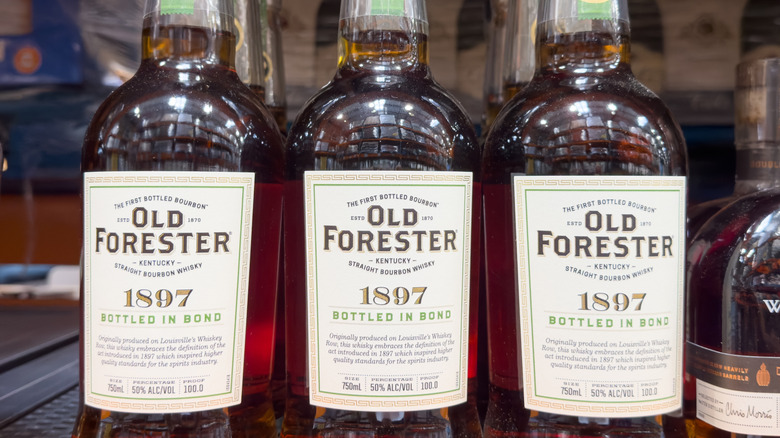
Bourbon whiskey predated the Bottled In Bond Act — but 19th century bourbon tasted much different than the liquor you know today. During the so-called Gilded Age which followed the Civil War, the American whiskey industry was riven with corruption, and many whiskeys that were sold as bourbon were essentially no different from moonshine. The Bottled In Bond Act was an attempt to bring some consistency and quality control to this heretofore unchecked industry, and as a result became what some consider to be the U.S. Government's first federal consumer protection legislation.
Today, U.S. federal law is even more strict on what does and does not constitute bourbon whiskey. If you're wondering which bonded whiskeys might be worth your time, be sure to check out Tasting Table's recommendations of ten bottled-in-bond bourbons you need to buy, such as the stylish, bold 1792 Bottled-in-Bond. The bottled-in-bond designation is not restricted solely to bourbons, however — its mark of quality can also be found on other whiskeys, such as Mellow Corn, a delightful yet budget-friendly straight corn whiskey that thoroughly impressed Tasting Table's taste tester.