

Some Alcohols Do Expire: Don't Leave These Types On The Shelf Too Long
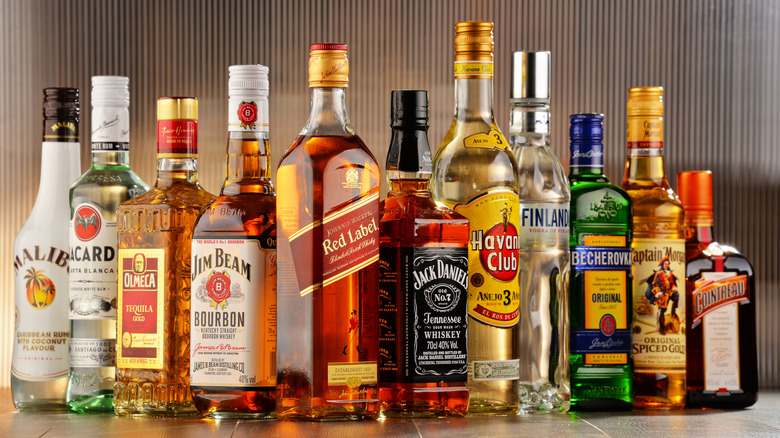
If you're a spirits or cocktail enthusiast, chances are you have a well-stocked home bar. And it's quite possible that, among the essentials, there's a forgotten bottle or two in the very back. Perhaps you bought an unusual liqueur while traveling, or something you needed for a cocktail which you haven't made again. So, if your collection is starting to look like your grandpa's old liquor cabinet, it may be time for a clear-out, because as our expert explains, there are some liqors that won't last the distance.
We asked Molly Horn, chief mixologist and spirits educator at Total Wine & More, for answers to the pressing issue of the lifespan of those bottles sitting in your liquor cupboard. "There is a difference between a spirit-based product going bad, experiencing flavor fallout, and having a limited shelf life with a pre-opening expiration date," she says. "The most common challenges are with products that have perishable ingredients such as cream liqueurs, which should be kept in the fridge after opening and are best within six months of opening."
This makes perfect sense; after all, there is real cream in liqueurs such as Irish cream, Amarula, and RumChata, among many others. Cream is perishable, of course, so while unopened bottles of creamy liqueurs may be stored at room temperature for a certain time (check their expiration dates) they will spoil faster once opened.
But what about other flavored liqueurs? "Spirits that are built around flavors, especially those that are lower-ABV such as liqueurs and amari, don't carry the same challenges as the perishable ones, but very frequently, especially after an extended period of time, will lose flavor and will show as dull compared to a freshly opened bottle," says Horn.
How to store liquor to best preserve its flavor
Horn states that unopened bottles of full-proof or higher spirits kept in favorable conditions — aka something akin to a wine cellar — should be safe to keep for decades. But there is a caveat: "They won't develop in the bottle (excepting Chartreuse, of course)." Green and yellow Chartreuse are unusual in that they keep evolving after bottling, developing stronger and more complex flavors.
So, what about straight spirits such as vodka, whiskey, or tequila? "Opened bottles of full-proof or higher spirits do not degrade swiftly after opening, but a general rule of thumb is once more than half the bottle is empty, oxygen will slowly diminish flavor of the remaining spirit," says Horn.
If you're looking for some signs that a specific spirit may be nearing its expiration date, Horn says, "It's kind of one of those once-you-notice-the-signs-it's-already-too-late things." She explains, "If you observe flavor fallout or you notice that special bottle you've been saving for special occasions doesn't taste quite as good as it once did, it's already experienced oxygenation. So don't wait too long to finish enjoying what's left!" If you suspect something is not tasting as good as you'd like, use it up in a refreshing spring cocktail or incorporate it into your cooking soon.