

The Old-School Ingredient Andrew Zimmern Uses For Richer Steak Flavor
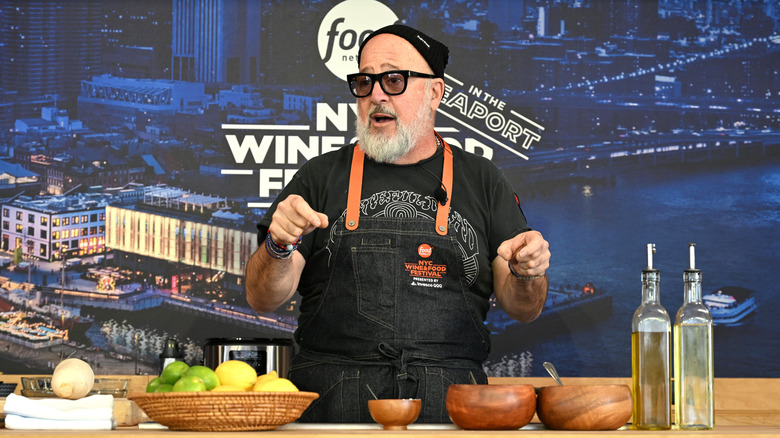
Those unfamiliar with demi-glace may regard it as just one among the many esoteric culinary terms that can make French cooking so intimidating to newcomers. However, those more intimate with its velvety richness, transformative powers, and astonishing versatility know this old school brown sauce is sacred. So it is no surprise that chef, TV personality, and "Cooking From the Heart" author Andrew Zimmern employs demi-glace when preparing a classic steak au poivre.
You can find recipes for steak au poivre that do not make use of demi-glace — traditionally, a combination of equal parts Espagnole sauce and reduced beef or veal stock, which can, in turn, be used as a base for other sauces — but if you have the option, it's hard to imagine going without it. Besides as Zimmern says in a demonstration of the recipe on his YouTube channel, "It's old school, but steak au poivre is an old school dish." It originated in 19th-century Normandy bistros, and Zimmern recalls that the recipe was brought to the United States by emigrating French chefs, where it benefited from the growing, Julia Child-influenced popularity of French cuisine.
After searing seasoned steak in a hot pan using the chef's press, an essential kitchen tool, a bouquet garni of rosemary and thyme is added, along with a dollop of butter. He sweats peppercorns and diced shallots in the pan, before flambéing the steak with cognac and stirring in mustard and homemade demi-glace. As the steak rests, the sauce simmers before cream is poured in then thickened into "steak au poivre heaven." The resulting sauce is a smooth, aromatic, inimitably meaty complement to the crusted, pan-seared steak.
Where did demi-glace come from, and how do you make it?
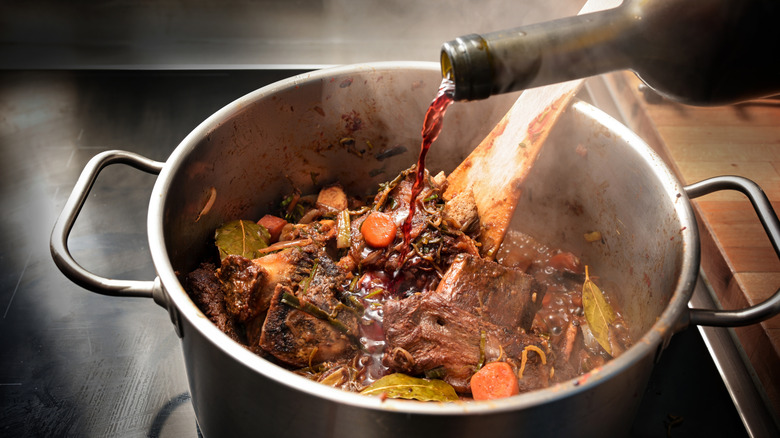
Much like steak au poivre, the origins of demi-glace lie in 19th-century France. It was famous chef Marie-Antoine Carême who reappraised and simultaneously reinvented French cooking by codifying its original four "mother sauces," one of which was Espagnole. Created for the royals and nobles that Carême would cook for, Espagnole (or Spanish sauce) is a savory sauce of meat stock, dark roux, aromatics in the form of mirepoix (a mixture of diced vegetables), and tomato purée. Auguste Escoffier, a French chef influenced by Carême who would go on to become almost as legendary, would later define demi-glace as one part Espagnole and one part brown stock, reduced by half (hence its literal meaning, "half-glaze"), and often supplemented with wine and herbs.
While Zimmern says he makes demi-glace several times a year, he does not share his preferred recipe, but you can easily find plenty of authoritative methods. In his iconic memoir "Kitchen Confidential," purveyor of much cooking wisdom Anthony Bourdain recommended making demi-glace by adding some red wine, shallots, fresh thyme, peppercorns, and a bay leaf to your already-reduced meat stock, then reduce it further until it is thick enough to coat a spoon and strain. "Freeze this stuff in an ice cube tray," Bourdain wrote. "Pop out a cube or two as needed, and you are in business — you can rule the world."