

A Juicy Rotisserie Chicken Might Actually Signal A Major Red Flag — Here's Why
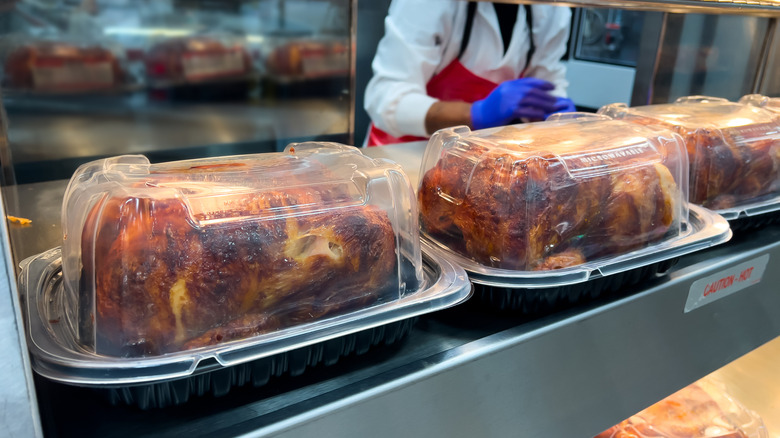
When you look at how chicken is advertised, a few words pop up frequently. "Tender," "succulent," and "juicy" are terms that are used again and again to entice you. And who wouldn't want a tender, succulent, juicy chicken? But as with many things in life, moderation is key, especially with that last one. Some juice is ideal, but too much liquid in your rotisserie chicken is something you want to avoid.
Tasting Table spoke with Mark McShane, chef and food safety expert at Level 3 Food Hygiene Certificate, about red flags you need to watch for when buying rotisserie chicken at the grocery store. Some, like the chicken not being the right temperature or looking overcooked, made sense, but his warning about overly juicy chicken was a surprise.
"A minimal amount of clear or light-golden juices [is] acceptable," McShane told us. You can use that to make a quick pan sauce, or mix it into soup, rice, or sauteed vegetables as Jacques Pépin recommends. "However, an abundance of cloudy, oily liquids or a gelatinous and dark-grayish substance indicates the chicken may have been stored and cooled down for extended periods of time."
You don't want to open the container in the store, but you can gently shake it or look through the packaging window. If you can see or hear liquid sloshing around, consider putting that chicken back. Likewise, if you can see that the color looks off, avoid it.
Juicy is good, swimming is not
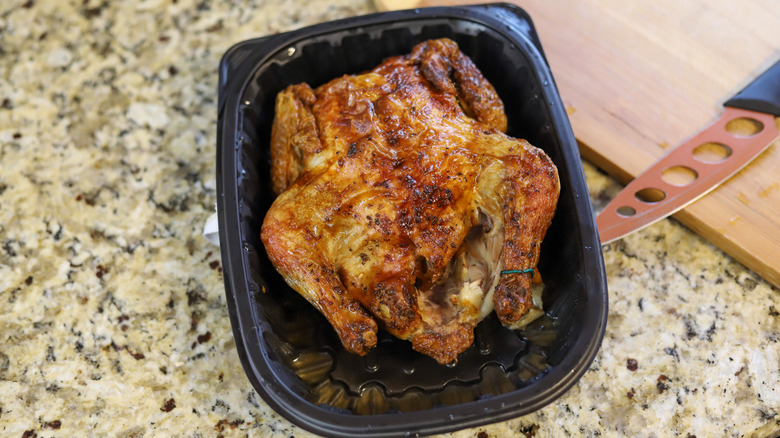
If the liquid at the bottom of the container has begun to congeal, it likely means the rotisserie chicken has been sitting too long, possibly at too low a temperature. Cooked chicken should not sit out for more than two hours at room temperature. Rotisserie chickens should be held at 140 degrees Fahrenheit or above after cooking to prevent bacterial growth. At that temperature, they can be held all day, but the quality will definitely go down as the chicken dries out.
When cooked meat juices cool down to below 104 degrees Fahrenheit, they begin to thicken up thanks to the gelatin content. As the temperature lowers, the gelatin gets even thicker. So if you see rotisserie chicken at the store sitting in a thick, gelatinous liquid, it likely means it was held below a safe temperature and may not be okay to eat. Check to see if there is a time on the package that indicates when it was cooked, and if there isn't one, it's best to avoid that chicken.
Beyond the safety concern here, the quality of the chicken just won't be up to par. Any food kept warm for too long after cooking won't taste as good as something fresh. That's something we've all experienced before. When you get a fresh rotisserie chicken, you want those juices inside it, not outside. Rotisserie chicken is notorious for being dry, so even if the juices don't look cloudy or thick, a large amount of liquid is still a bad sign. It likely won't be the best chicken you've ever eaten. Luckily, there are some ways you can elevate store-bought rotisserie chicken to ensure it's even more delicious than you were expecting.