

I Went Behind The Scenes Of Top Chef's Legendary Restaurant Wars. Here's What Viewers Don't See
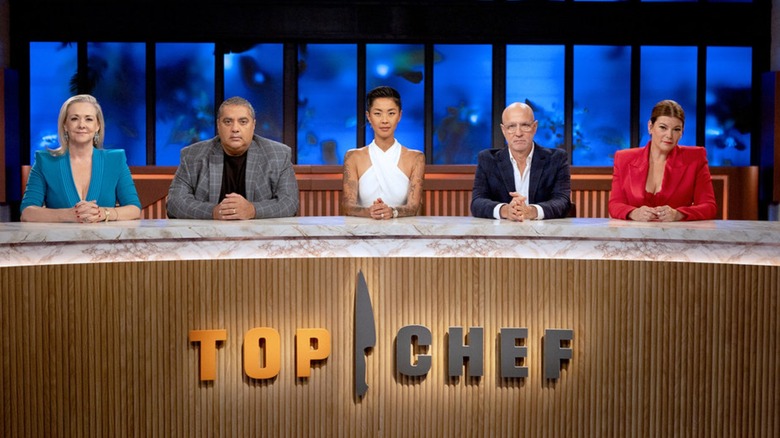
When you work as a food writer, there is always some random opportunity to eat a four-course meal at a buzzy restaurant that may end up disappearing sooner than you think. Rarely does it happen that this restaurant is guaranteed to vanish within 12 hours of your visit. Such was the situation I found myself in last year, when I traveled to Charlotte, North Carolina, to enjoy an experience many of us dream of: being a diner on the famous "Restaurant Wars" episode of Bravo's "Top Chef."
I dined at the Carolina Queen, one of two restaurants constructed, staffed, and served out of a kitchen at The Casey, an event venue in Charlotte's Lockwood residential neighborhood. At the time, I didn't know that the concept I had been booked at would become that night's winning team. What I did have was an understanding of how the episode's format worked, as well as an idea of what to expect as a diner. (Food temperature is rarely hot, ticket times may take a while, and portion sizes will only prime you for a full meal afterward.)
"Restaurant Wars" has been a fixture of "Top Chef" for two decades now. In that time, it has become something close to an institution in food television. To understand how it comes together, I spoke with executive producer Doneen Arquines, judges Tom Colicchio and Gail Simmons, and host Kristen Kish about what goes into building the episode. Behind the scenes, there is legit construction, a crafty crew, the logistics of several cameras, and an editorial instinct to consider. This is as close to a behind-the-scenes look as you can get without an invitation of your own.
This article contains spoilers for "Top Chef" season 23, episode 8, "Restaurant Wars." Interview comments have been edited for length and clarity.
Building a fictional restaurant
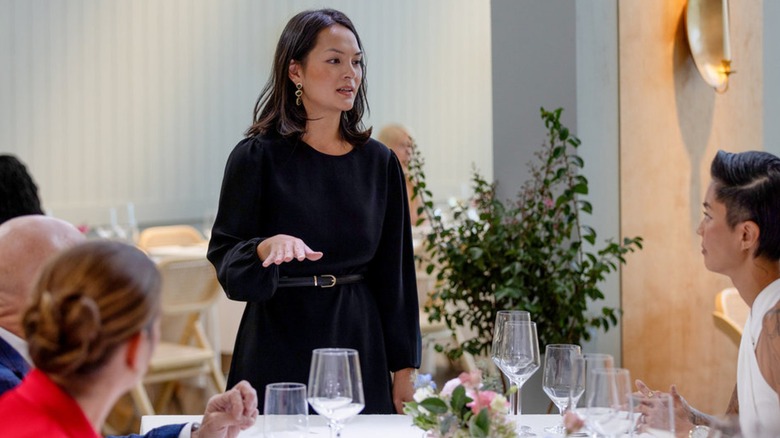
"Restaurant Wars" works as a competition because it's the closest that viewers get to seeing the contestants in their normal element. It also works as a piece of television because the restaurants are fleeting. Guest judge Michael Mina said that, for him, a new restaurant might take 10 months to open. So, how do these concepts come together in under two days?
Per executive producer Doneen Arquines, behind-the-scenes construction begins long before either concept is a shine on the chef's knife. "Our construction lead, Rob Sulit, is building flats weeks before we even start this challenge," Arquines told Tasting Table. "Part of the reason why we do the menu plan the night after elimination [is] because we [can] get their restaurant decor choices, like the wall color and all that stuff, as soon as possible."
Production doesn't have much say in how the back-of-house is built, so the location must provide the best conditions for competition. A venue like The Casey will have a lot of different equipment and enough of the necessary things to support eight chefs. The most challenging part is the space for dining and service. "Each team's got a dozen servers that are coming in and out constantly," reminds Arquines.
A pipeline already exists for building the staff at each restaurant. Production tries to rely on the same servers they've used for previous filming, but they're often "pulling from everywhere," according to Arquines. The fill-ins feed into the biggest challenge that judge Tom Coliccio sees during "Restaurant Wars": making sure the waitstaff is trained. "The servers ... if they got the table off by a number, then the thing's going to go to the wrong table," said Arquines. "I think that's a really tricky part for everybody to do in a short amount of time."
The numbers that go into production
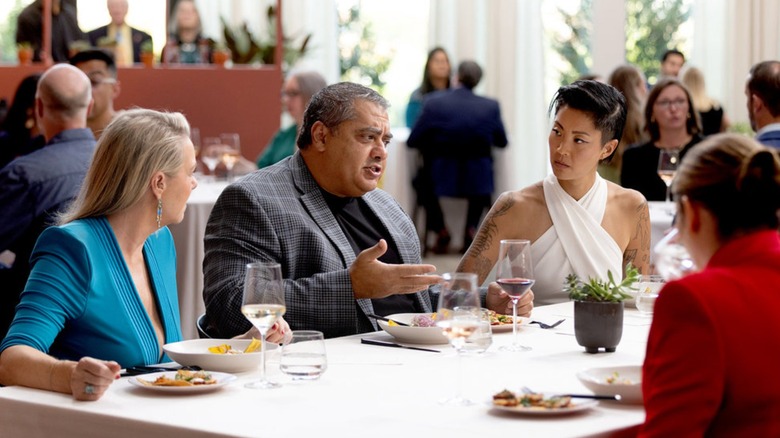
The truncated deadline — 48 hours — is a gobsmackingly short amount of time to conceptualize, raise, and open a new restaurant concept. It's not the only number that tells the story of what's going on behind the scenes of a given "Top Chef" season's "Restaurant Wars." In my experience on shoot day, the set was a veritable beehive of activity, albeit an orderly and organized one.
"There's probably 120 of us running around," executive producer Doneen Arquines said when asked to count the crew working on-site. "Each restaurant was serving 100 diners each ... So throughout the day, there's probably close to 400 people in and out of the space." Some of that staff is cordoned off in an audio and visual room, tracking the capture of raw media from cameras and microphones across a staggering number of screens. Four hours of footage might be condensed down to 12 minutes, and, amazingly, the team captures so much with what seems like so little.
"We normally only have eight cameras," Arquines explained. "We have to have at least three on the judges' tables to cover both sides of the table and a wide shot. Then there's one in the other dining room, and then we've got the other two kitchens working." As for getting candid comments from guest diners, the team uses several unmanned tabletop microphones hidden inside fake planters.
Apart from the camera crew, there's staff coordinating groups of diners and their reservation times; technical supervisors overseeing the equipment; and a small crew secluded behind blackout curtains, shooting glamor shots of the dishes.
How producers spot the story
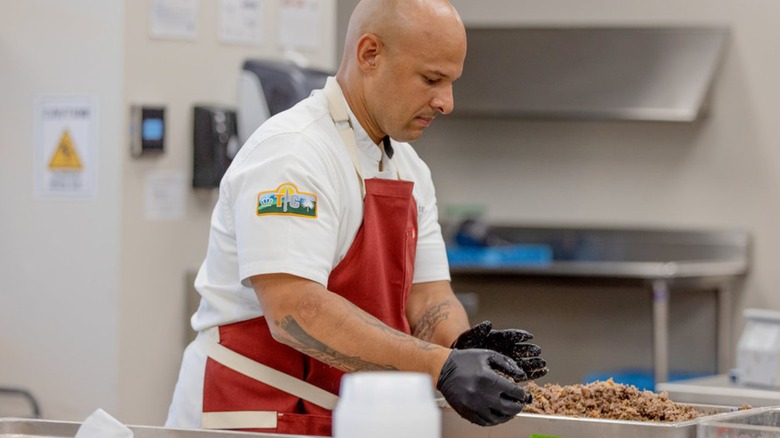
A "Top Chef" filming day can last anywhere from 12 to 16 hours. That is a lot of time for anyone to maintain focus, let alone tie together threads that must form a narrative arc. Of course, the Emmy-winning "Top Chef" team has developed instincts for turning chaotic service into coherent episodes. The cameras and crew, the microphones, and even the hand-written tickets delivered to the cheftestants by "Restaurant Wars" servers can be bits of infrastructure that help producers sniff out the story wafting from the kitchen.
"We have really smart people and camera operators who are used to seeing when something looks like it might be happening," said Doneen Arquines. The audio team also plays a crucial part. If there is even a whisper in the kitchen, someone is flagging it. "Audio's listening in and telling us ... 'Oh, they said they were going to do this with this dish, and now they're doing something different, so let's find out why they're changing it.'"
Consider, for example, how this week's installment put subtle attention on the yet-to-be-eliminated chef, Brandon Dearden. Before viewers had any confirmation of his fate, the cameras were showing Dearden asking the opposing team for a single can of Cheerwine to use as the finishing touch of his dessert. Then, there was the contestant interview in which Dearden acknowledged how choosing to cook only a single dessert course was a "high-risk" move. Taken separately, these moments — one of them being a 15-section interaction in and of itself — might be worth passing over. But as the judge's commentary crescendoed, the production began to see the connection between how these seemingly insignificant moments would play into the day's final verdict.
This season's Restaurant Wars twist required some DIY
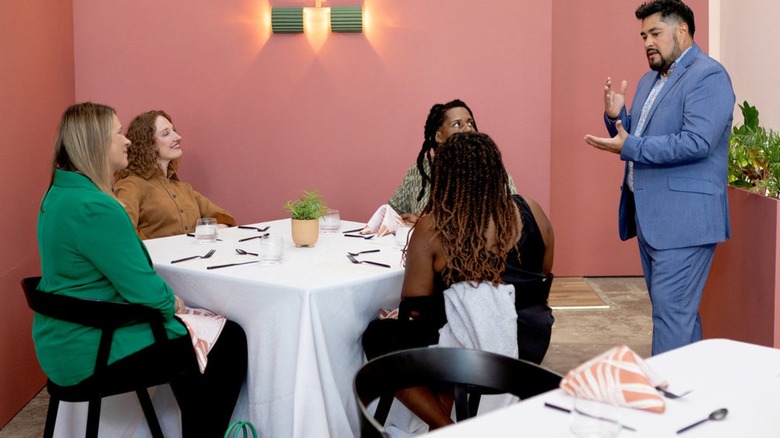
One thing that keeps "Restaurant Wars" fresh is the occasional operational twist. Sometimes this is circumstantial. In the past, venue size has required teams to operate their restaurants on separate schedules rather than simultaneously. During the pandemic, the restaurants were chef's table concepts rather than full of diners. This year's twist was a new wrench for the episode's mechanics, but an old hat for service industry folk. Carry-out was introduced.
"We've talked about [takeout] many times, but we finally were like, 'Let's just do it,'" Doneen Arquines told us. As it turned out, the ring-ring-ring of telephone orders wasn't just a challenge for the chefs, but also introduced a catch behind the scenes. "The hardest part about 'Restaurant Wars' is camera coverage because we're covering so many different things happening at the exact same time," Arquines said. Production couldn't just send customers out of the restaurant with their food and no camera crew, so they turned to a DIY approach. Some carry-out customers were asked to film themselves eating at home.
"There were a couple of people that we knew would be able to handle the self-recording," Arquines revealed. "We had invited them to 'Restaurant Wars' ... but then asked, 'Oh, do you guys mind actually being takeout diners?' We asked them to self-record when they went home, their reactions to the food, unpacking the food, what they ordered, what they thought of the food."
As for the chefs, production felt confident that this twist was within their wheelhouse. They were briefed on the maximum number of orders they might expect, but nothing else. How each team handled operations was up to them. Chef Anthony Jones' strategy of taking calls directly, for example, was a personal choice.
The city sets the backdrop, but that's not always the case

Because of the formulaic nature of "Restaurant Wars," the episode risks feeling removed from the host city in a way that other installments don't. "I wouldn't say that we change 'Restaurant Wars' necessarily to the city," Doneen Arquines said. In the best cases, though, the cheftestants' experience in prior challenges influences or motivates them to lean into the destination's offerings. "Both teams were really inspired by Charlotte," said Arquines. "They really embraced that in their menus."
The chefs gravitated towards ingredients that spoke to Charlotte's abundance: North Carolina snapper and Carolina ruby potato appeared in team Tierra Riena's aguachile appetizer; gold rice, benne crackers, and Cheerwine in their dessert. Across the wall at the Carolina Queen, the crab and the Reaper pepper and the pimento cheese I tasted all spoke to the city's culinary history and rich agricultural offerings.
You might expect the judges and hosts of "Top Chef" to be boldly exploring the city while on location. Host Kristen Kish said that for her, the destination comes more into focus when she watches the finished show than it does during filming. All the same, a small bit of behind-the-scenes exploration did seem to inspire the judges' vision.
"The only concept that I require for excitement is just delicious food and great hospitality," Kish told Tasting Table. She reportedly experienced great hospitality during successive trips to Charlotte staple Lang Van, where her drink order and preferred table were remembered by the staff. "And that's not specifically for me," she said. "That's happening with everybody." When that experience is front of mind, then small service touches during competition — like team Carolina Queen's pre-meal fizzy tea, for example — don't just feel front of mind, but like an extension of Charlotte's dining scene.
What the judges are actually looking for
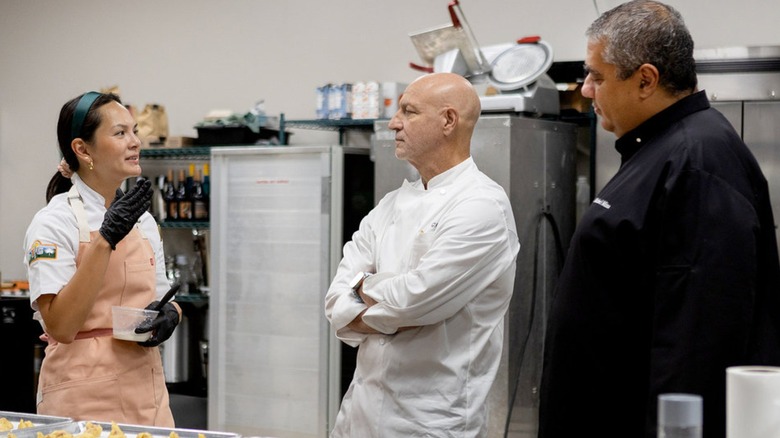
Behind the scenes, "Restaurant Wars" is harder on the judges than viewers might think. Evaluating a single dish in a Quickfire or Elimination challenge is straightforward. Evaluating an entire restaurant, built in two days, means the judges' eyes have to be in many more places.
There is the front-of-house question, which, behind the scenes, Tom Colicchio seemed less-than-thrilled to have to consider. "I personally hate that we make one of them do the front-of-house," Colicchio said. His reasoning is well understood by anyone who's ever been hungry while waiting for a long ticket time. When service is slow, the instinct is to blame the person running the dining room. They're more visible than the chef.
For judge Gail Simmons, the scope of judgment changes drastically during "Restaurant Wars." "The biggest thing is that there's leadership and team management involved," she said. "You're managing a team of chefs, everyone who's also your competitor." Even if a chef has done it before, they haven't done it like this before. "You're also doing it in 36 hours," Simmons reminded.
Even when the cameras aren't focused elsewhere, the judges are watching to see whether the concept holds up under pressure. Said Tom Colicchio of the most common failure, "You need to make sure that the food you're doing lines up with the concept ... because often we get a sense that they want to make good dishes and they don't care about the concept."
It's the reason why two of three judges separately told Tasting Table that broad choices like "global seafood" no longer fly. (In retrospect, it was good instincts on the part of chef Laurence Louie to tell chef Sherry Cardoso early on in the episode that a global concept wouldn't be specific enough.)