

Why More Flavored KitKats Aren't Made In The US
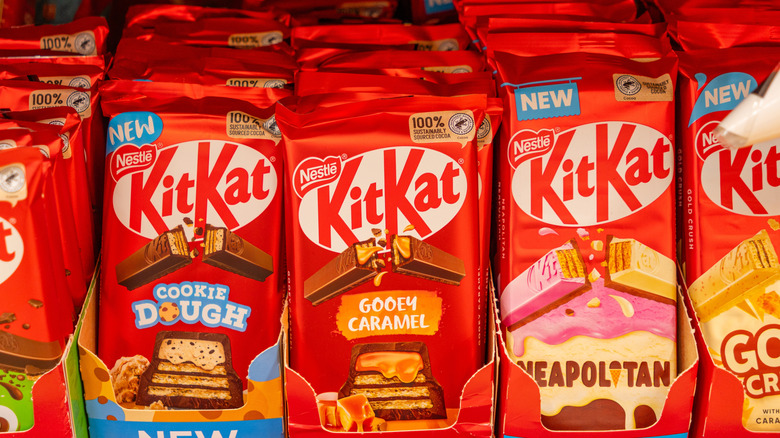
There is some news that is so breathtakingly sad, you just need a moment to take it all in. (And no, we're not just talking about the massive KitKat heist in Europe.) For us, it was when we learned that in other parts of the world besides the United States, there are dozens, nay, hundreds, of KitKat flavors. In Japan alone, there have been nearly 400 varieties introduced. Surely, we must have angered the Candy Gods over here to explain our dearth of flavors. But actually, it all boils down to different distributors and marketing.
The famous wafer bar KitKat is actually made by two different companies, and that split shapes how the candy is developed and marketed. KitKat was originally created by an English candy company, Rowntree's, in 1935. After enjoying decades of success, the company was purchased by the Swiss candy conglomerate Nestlé in 1988, which now produces and sells the iconic candy everywhere but here. And therein lies our problem. In the boring ol' U.S. of A., KitKat bars are manufactured and sold by Hershey under a licensing agreement that goes all the way back to 1970.
Because Nestlé and Hershey are obviously two different companies, they go about product development and marketing very differently. You can certainly order some Japanese flavors, as we did for our KitKat flavor ranking test a few years ago. But as far as getting to try exquisite, luxury flavors like this one-of-a-kind Gateau Mignon KitKat, you'd have to head straight to Tokyo.
Hershey sticks to tried-and-true flavors
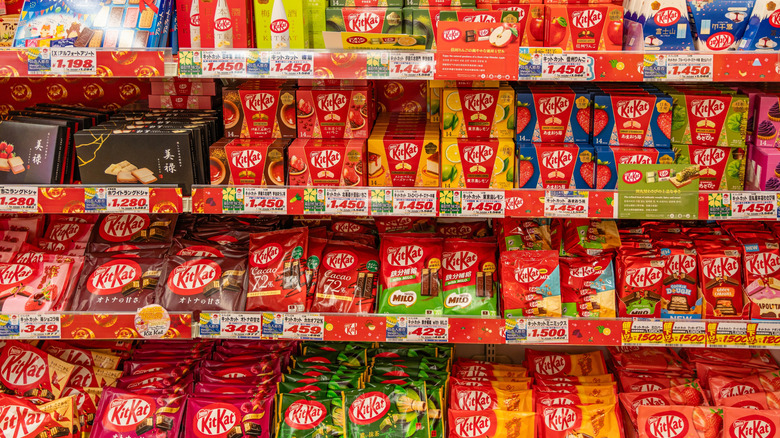
The U.K. deserves credit for being the first to introduce an entirely new KitKat flavor, orange, in 1996. But it was Nestlé Japan that really took it to the next level. Even though the country didn't start experimenting with KitKat flavors until 2000, kicking it off with classic strawberry, they've clearly taken the lead in imaginative flavors since then. Lemon vinegar, wasabi, pumpkin pudding, and purple sweet potato are just a few of the funky flavors to try over there. Interestingly, the last flavor isn't based on the popular Murasaki sweet potato, but on another type of purple sweet potato called Okinawan (beni omi).
So why does Japan get to have all the fun? Many credit Japan's marketing team's clever work and research on making the foreign treat feel homegrown. There's also some very lucky wordplay involved; the candy name sounds similar to the Japanese phrase "kitto katsu," which roughly translates to "you will surely win." It's become a cultural practice to gift these "good luck charms" to students before big exams — so why not make it a unique flavor, too?
However, things are looking up stateside. Though Hershey's has historically stuck to more traditional flavors, they're beginning to branch out. We've seen some seasonal offerings come out, like raspberry creme for Valentine's Day and a limited-time churro flavor for the summer. Hopefully, if U.S. consumers cooperate and keep buying these special offerings, we'll be seeing way weirder flavors in the near future.