

How Molasses Caused One Of History's Strangest Disasters In A Boston Neighborhood

Usually food-related disasters take the form of viral diseases, but over a hundred years ago in Boston, molasses was the source of one of the most legendary disasters in American history. It's the kind of thing that sounds so ridiculous it might make you laugh, until you learn that 21 people died, but on January 15, 1919, a massive flood of molasses overran Boston's North End neighborhood. Now known as the Great Molasses Flood, it actually had ramifications far beyond the tragic deaths, but the details are rather strange.
The source of the flood was a massive five-story metal tank, containing 2.3 million gallons of molasses, which stood in the North End neighborhood. Molasses has been part of Boston's, and New England's, culture since the colonial era, when it was part of the triangle trade with the Caribbean. Molasses was shipped up from the tropics, where it was distilled into rum in New England, a major industry at the time. It was also used as a sweetener, especially because it didn't spoil as quickly as refined sugar. Those uses became part of the region's culinary legacy, making molasses popular as an ingredient to this day in dishes like baked beans. However this tank was not holding molasses for eating and cooking, it was holding a type of molasses called "blackstrap," which was used for the production of ethanol at the time.
Then early in the afternoon on January 15, the tank holding all that molasses burst. The syrupy liquid rushed forth and overwhelmed the neighborhood, killing 21 people and injuring 150 more.
Boston's Great Molasses Flood was the result of shoddy construction for a massive molasses tank
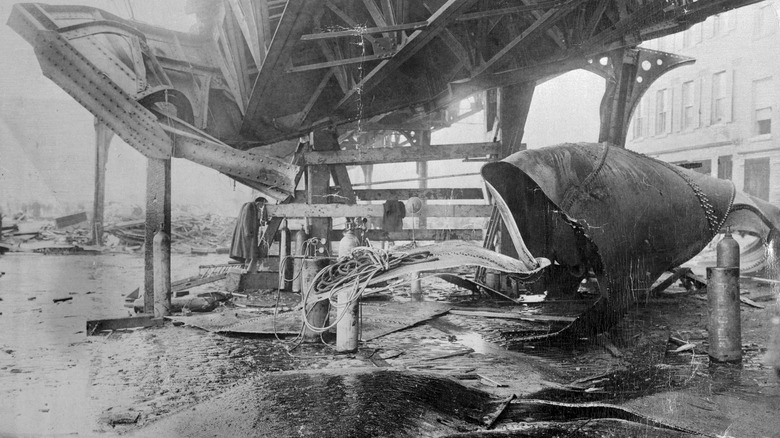
It's easy to understand the devastation when you realize just how staggering an amount of molasses this was. The wave of molasses was reportedly anywhere from two-stories to 40 feet high, 160 feet wide, and traveling at 35 miles per hour. It crushed entire buildings, lifted others off their foundations, and even tore down an elevated train track. The explosion itself was also deadly, as the metal from the tank became shrapnel, and bolts were said to have been shot from the side like bullets.
But it wasn't the force of the explosion that made the molasses so deadly. It was able to move that quickly because of its weight. Molasses is 50% denser than water, and the physics of it crashing down on itself created the force that propelled a thick, viscous liquid like that at such speeds. Then, being winter, the other side of sticky syrup quickly took over. The molasses thickened in the cold, and trapped many people, while also making rescue more difficult.
In typical fashion, the disaster was first pinned on political scapegoats. The company that owned the tank blamed Italian anarchists, while other common targets like Bolsheviks were also blamed. Of course, surprise, surprise, the company that had tried to pin the blame on an immigrant group was found to have actually cheaped out and built a tank that wasn't strong enough to hold the molasses. It was so shoddy that children in the Boston North End neighborhood would even take buckets to collect the sweet molasses leaking out of the tank. When the company found out the tank leaked, it just painted the container brown to cover up the molasses oozing out.
The Great Molasses Flood in Boston led to new regulatory protections for construction

The cleanup up the molasses flood was difficult. It took around 87,000 man hours to finish the job, and only got done that fast because workers eventually realized they could break down the goop by spraying it with saltwater from the harbor. It was reported that the area of the disaster remained sticky, and even smelled like molasses, for years to come. Beyond a tragic and amazing historical story, the disaster produced tons of litigation, which eventually affected national building standards. More than 100 lawsuits were filed against the United States Industrial Alcohol Company, whose subsidiary owned the molasses tank. There was a six-year investigation involving thousands of witnesses, and in 1925 the company was finally found liable for the disaster, being forced to pay settlements.
The Great Molasses Flood ended up inspiring a wave of legislation around the country. Because the company has been found liable, for reasons like using steel that was too thin among others, states started requiring major infrastructure projects to verify the sound engineering principles behind the constructions. This included things like having engineers sign and seal all plans, and allowing building inspectors to investigate projects.
Today a small plaque stands at the corner of Boston's Commercial Street and Copps Hill Terrace commemorating the site. Despite the wild details, scale of the tragedy, and changes it inspired, it is not as well known as other similar industrial disasters. Molasses may still have its uses, but it doesn't hold the same importance in the American imagination as the oil or factories behind so many better-known disasters. Instead, like the Great Molasses Flood itself, is a small link to a past many Americans have forgotten about.