

Jamie Oliver's Foolproof Trick To Removing Tricky Eggshell Pieces From Your Dish

Few kitchen mishaps are as familiar, small, or irritating as a shard of eggshell slipping into your bowl of freshly cracked eggs. Fortunately, chef Jamie Oliver has a foolproof solution. In his YouTube series, "Jamie's 1 Minute Tips," he demonstrates "the quickest and easiest way" to go about removing eggshell fragments, using something you definitely have on hand already: the shell you just cracked.
Oliver explains, and bluntly demonstrates, that the impulse to fish out the fragment with your fingertips, just does not work. "The natural instinct is to get in there with your fingers," he says, "but if you try and get it, it always runs away, and it's kind of annoying." We've all been there! Instead of chasing the slippery bit around the bowl, he suggests returning to what he jokingly calls, "our friend, Mr. Shell," and using half of the cracked eggshell as a scoop.
The technique is remarkably effective because the shell's thin, rigid edge cuts cleanly through the egg white, like a hot knife through butter, allowing it to capture the fragments that fingers (and even spoons) cannot. As Oliver says, "You can mop it up easily, and get those annoying bits of shell every single time. Happy days!" It's a satisfying and easy solution to a problem that every egg cook will experience at some point in their lives.
You have to break a few ...
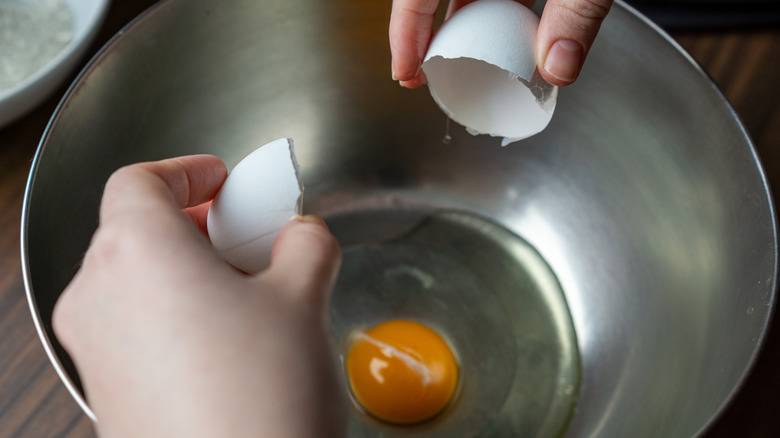
The success of Oliver's trick comes down to simple food science. Egg whites are composed of about 90% water and 10% proteins, primarily albumin, which gives them their viscous texture. This structure creates surface tension that allows small, sharp objects to slip in, and then away from blunt tools like fingertips. A broken shell, however, has a firm, sharp edge that can slice through and penetrate the surface, allowing it to separate so you can scoop up and shovel the fragments away.
If you don't want to go to all that trouble, a few preventative techniques can help avoid the problem in the first place. Cracking eggs on a flat surface, rather than the rim of a bow, reduces the likelihood of shattered shells. You can also try the egg drop method, which you probably never thought of. Using a separate bowl before adding eggs to a recipe (instead of cracking them straight into the pan) also ensures that shells don't end up in your would-be perfect, classic French herb omelet.
Eggshells can prove useful after their primary task is done, and there are many creative ways to use them in the kitchen. They can be dried and ground into a calcium-rich powder, which can be used for gardening as a soil amendment or even for scouring your pans, minimizing waste and extending their usefulness. Paired with Oliver's approach, these ideas reinforce the age-old wisdom that sometimes, the best solutions are hiding in plain sight. Happy days!