

Laminate Vs Solid Surface: Which Affordable Countertops Are The Better Buy?
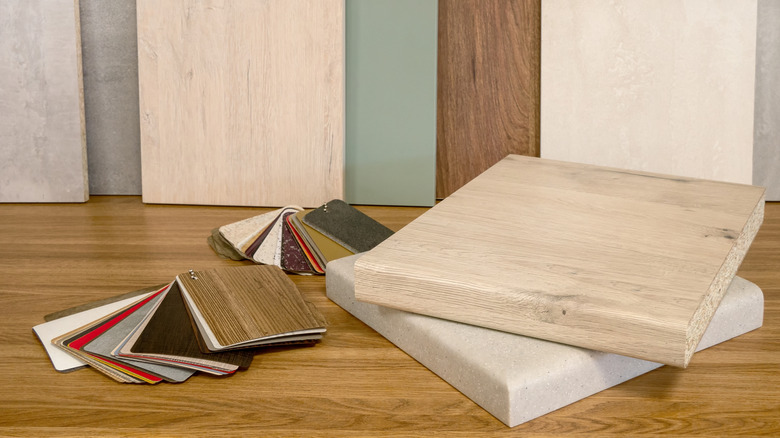
When it comes to kitchen countertops, if you are looking to buy on a budget, those options dwindle quite a bit. Granite, quartz, butcher block — they all sound wonderful until you get a look at the estimate, narrowing your choices down to two more common and affordable options: laminate and solid surface. However, saving money on kitchen countertops doesn't mean low quality, as both surfaces have real advantages. To sort which option is the best buy for you, we asked Brandy Rinehart, the owner and designer at Rinehart Design Group, for her take on both laminate and solid surface kitchen countertops.
Laminate countertops are almost always your cheapest option, and they are made with layers of plastic resins and brown craft paper, topped by a protective transparent melamine resin, which helps make them more resistant to heat and scratches. Despite being a less durable material, Rinehart adds, "Advancements in printing and texture technology have elevated laminate into a viable contender against higher-end materials." Laminate is also easy to clean due to the resin surface, and those advancements that have been made in texture mean there are many more options for laminate designs than there used to be.
But Rinehart also offers words of caution with laminate. "Laminate is not a natural material, and when damage occurs — such as chipping or deep scratching," she explains. "Repair is rarely seamless, often requiring full replacement." So, while laminate may be affordable up front, it could end up costing you more in the long run.
Solid surface countertops offer superior durability, but at a higher price
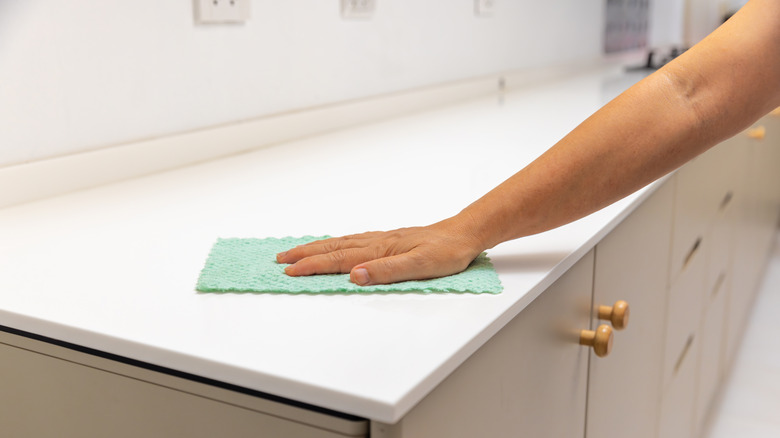
Rinehart notes that solid surface countertops — which are non-porous — are a step closer to luxury compared to laminate. "These surfaces combine natural stone particles with advanced resins to create countertops that are both durable and design-flexible," she adds. This is similar to how quartz countertops are made, offering similar benefits at a lower price point. "They are also known for their resilience — resistant to stains, scratches, and daily wear," Rinehart says, "making them an ideal choice for high-use kitchens seeking both longevity and aesthetic control."
However, while heat resistant, hot pans should not come in direct contact with them, nor should you chop or cut directly on them. Like laminate, solid surface counters allow manufacturers to customize a lot of different styles without the limits imposed by nature. "Their appeal lies in versatility," Rhinehart adds. "Whether you prefer the organic look of veined stone or the minimalism of a uniform, matte surface, engineered materials offer a wide spectrum of styles."
In the end, which countertop is better for you comes down to what you expect from your kitchen. Both offer a wide variety of visual styles, so from a design standpoint there isn't much difference. It mostly comes down to how much you value solid surfaces' extra durability versus laminates' affordability. While solid surfaces are cheaper than other kitchen countertop materials, they can still be far more expensive per square foot than laminate. But if you make heavy use of your kitchen, that added expense might be worth the longevity and protection.