

Why Store-Bought Kimchi Is Generally Still Safe To Eat After Its Best-By Date
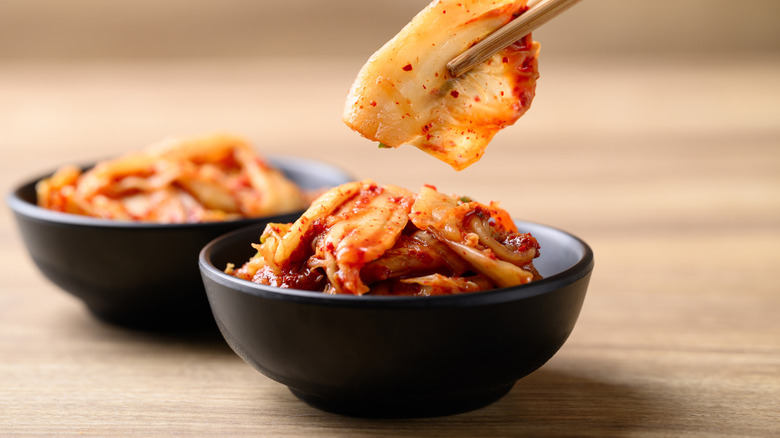
Before the invention of refrigeration, people had to find a way to make fresh food last. Along with drying, curing, and smoking meat and vegetables, people also learned how to ferment foods. In Korea, this resulted in kimchi, a way of preserving cabbage to eat all through the long winters. This method has been used safely for thousands of years, and the advent of refrigeration and modern processing have only made things safer.
Fermented food as preservation might seem counterintuitive, as it involves encouraging bacteria to grow. However these are helpful bacteria, which raise the acidity of the food to a point where harmful bacteria — the ones responsible for spoilage — cannot thrive. When you purchase a jar of kimchi, the fermentation process has already created an environment that is microbiologically safe, and this fermentation continues even after the kimchi is opened and refrigerated.
The longer kimchi ferments, the more sour it gets. This isn't necessarily a sign it's gone bad, but some might find the flavor too strong. It can be mellowed by cooking and added to dishes like Korean tofu stew. It's also important to know that "best-by" food labels don't actually refer to when the food expires, but how long it remains at the best quality. With store-bought kimchi this is usually around 8 to 12 months, but it's generally still safe past this time. Still, there are signs to look out for.
Signs your kimchi has gone bad
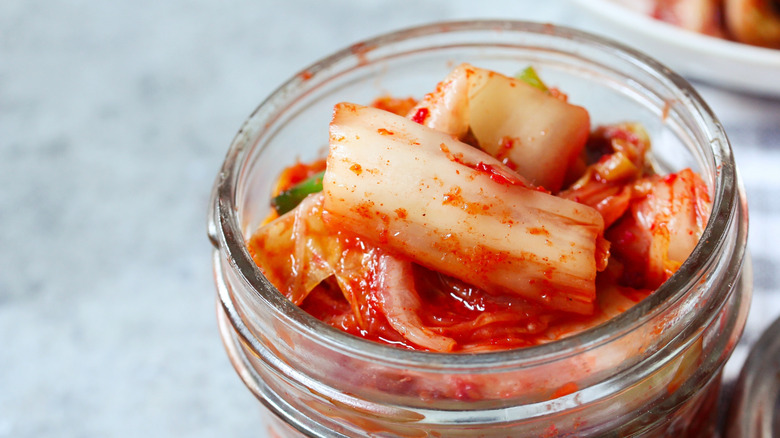
Once your jar of kimchi has outlasted its best-by date, you'll want to rely on your senses to tell you if it's still good to eat. Due to the nature of fermentation, kimchi does have a naturally strong smell, but a smell of alcohol can be a sign that harmful bacteria has developed. Also, if you see any visible signs of mold such as dark spots or fuzzy patches, the kimchi should be tossed. Another indicator of spoilage is a slimy, mushy texture. While the vegetables will become less crunchy as the kimchi ages, they should still have some firmness.
Ensuring store-bought kimchi is safe to eat is all about storing and using it correctly. Even before opening it needs to be stored in the fridge, in order to keep the fermentation at a safe level. Once opened, you need to protect it from the wrong kind of bacteria, which can even enter by exposure to air. While you might be tempted to siphon off the brine for flavoring soup, ensure that there is always enough liquid to cover the vegetables. It should also go without saying that you need to use clean utensils, which means no double dipping with the chopsticks — even if you live alone.