

Thousands Of NYC Restaurants Rely On This 200-Year-Old Business For Their Fish
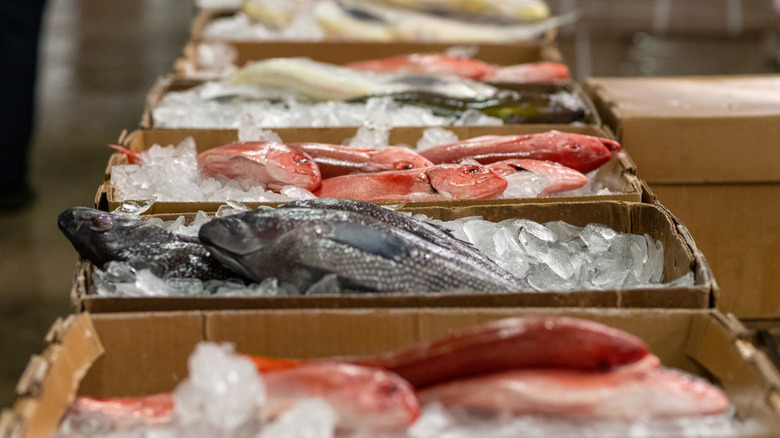
Before dawn cracks open like an oyster over New York City, the Fulton Fish Market is already wide awake and teeming with trade. The smell is pervasive, fishily permeating your soul from a good half mile away. Inside the refrigerated warehouse in Hunts Point, the meltwater-wet concrete floors glitter with fish scales as precariously piled forklifts weave between pallets. Knives flash as rubber-booted workers break down massive, motorcycle-sized tuna into clean, blood-red loins. Steely-eyed buyers — chefs preparing dinner service, fishmongers stocking neighborhood seafood counters, and the occasional late-night looky-loos — prowl the aisles, hunting for the best catch.
The Fulton Fish Cooperative Market is the oldest (and largest) seafood market in the United States, and the second largest in the world. "While the rest of the city sleeps, there's a small city of people working here, moving millions of pounds of seafood to keep New York fed," notes Fulton Fish Co-Op CEO Nicole Ackerina, highlighting "the scale and overnight hustle" of the operation. Every day, the market moves between one and two million pounds of fish, a disorientingly massive number that only makes sense when Ackerina explains that the frigid, fragrant night market supplies most of the seafood served in the city's nearly 30,000 restaurants.
The market serves the range of dining rooms and raw bars, from the dim sum halls of Chinatown to the fine dining rooms of Grand Central Oyster Bar and Eleven Madison Park. The Fulton Fish Cooperative Market — located in the Bronx — connects global trade routes, Indigenous waterways, organized crime, Wall Street, city infrastructure, labor, and restaurants. While cities are often celebrated for their skylines, they are defined by their supply chains — and the Fulton Fish Market feeds one of the greatest cities in the world.
Fulton Fish Market's net results
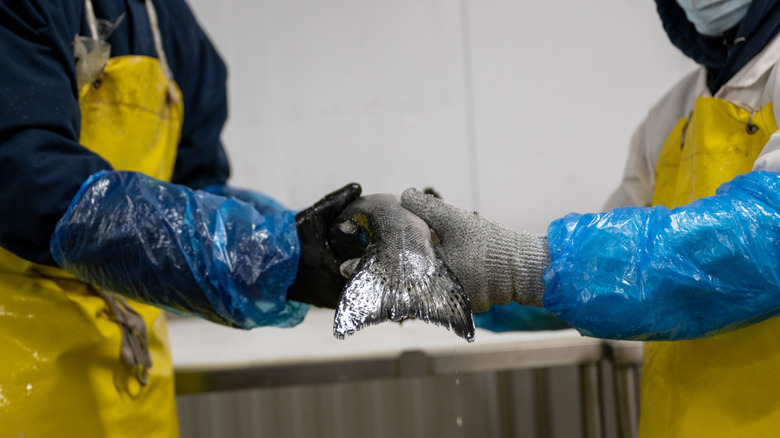
Seafood arrives packed in boxes of ice and labeled with certifications, species, origin and weight. "If it swims in the sea, you can find it at the market," Robert DiGregorio, the director of seafood quality at Fulton Fish Market E-Commerce, jokes, adding that seafood arrives "from every continent on earth, even the waters off Antarctica!" Once it's here, the product must go from the net to the plate as quickly as possible. "You're handling thousands of dollars' worth of very perishable merchandise that, if handled wrong, can spell disaster," DiGregorio explains, "but if handled right, can support generations of thriving businesses, fishermen, and bring great seafood to restaurants and consumers."
Improved refrigeration, air freight, and globalized distribution have dramatically changed what seafood Americans eat — and the Fulton Fish Market has played a major role. "Much of the fish in the market today would not have been available just a few years ago," DiGregorio adds. "Fish like branzino, which was a newcomer in the U.S. as recently as the 1990s, and Chilean sea bass, which was virtually unheard of before the 1980s, are good examples. Imported farmed salmon is another."
The quality expert notes that as methods of transportation improved, different seafoods "became available to U.S. customers through the Fulton Fish Market." That influence is perhaps most visible in the city's restaurant industry. The year-round availability of fresh tuna alone "helps keep nearly 2,000 Japanese restaurants in business," DiGregorio notes. No wonder the daily market is one of the most important starting points for New York's world-class restaurant industry.
Manhattan's historic seafood trade route
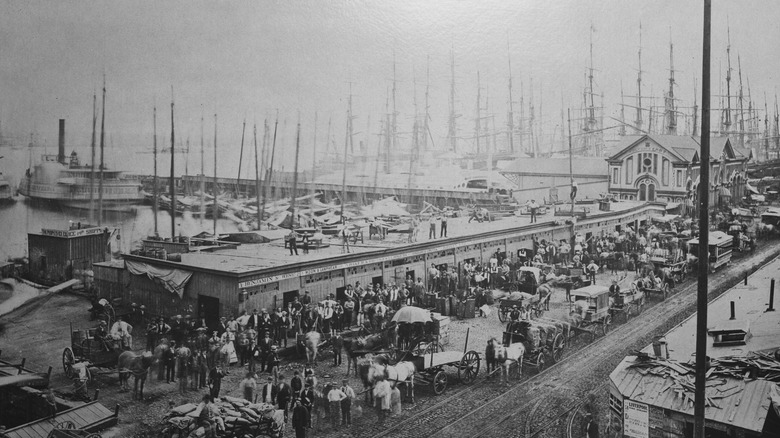
Before the refrigerated warehouse in the Bronx, the Fulton Fish Market lived along the East River in Lower Manhattan, just upstream from Ellis Island. When it opened in 1822, fish came the low-tech way. "In the early days of the market, all of the fish arrived by boat," DiGregorio says. It was unloaded by hand, soon after it was caught from nearby waters, onto wet wooden docks. Markets like this appear where geography allows them; cities grow where trade routes converge; and New York City, positioned at the mouth of the Hudson River with access to the open ocean and the interior, was a trading city long before it became the financial capital of the American empire.
Manhattan's waterways had been thriving trade routes for thousands of years before Europeans arrived, with Indigenous Lenape communities navigating and utilizing the brackish rivers and harbors for transportation and food. After the Erie Canal was completed in 1825, connecting the Hudson River to the Great Lakes, the city's role as a major trade hub was amplified. This brought in more people, and the vast quantity of food they ate. The market only grew.
Over time, New York became the primary trade gateway between the rest of the country and everything within (and across) the Atlantic Ocean. Fish, grain, timber, immigrants, money — it all passed through the same waters, docks, and markets. The Fulton Fish Market was one essential knot in the net holding it all together. "From 1822 to 2005, the market operated in the same location along the East River," DiGregorio adds, "and was largely limited by its physical surroundings."
Sleeping with the fishes
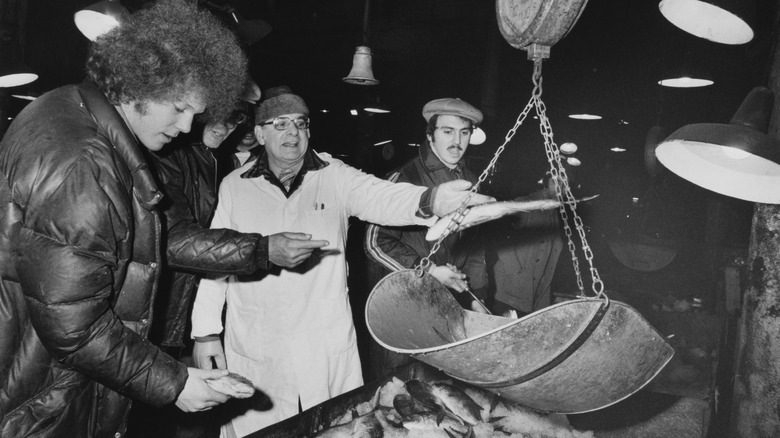
For most of its history, the Fulton Fish Market was one of the busiest, smelliest, and most notorious markets in New York. Yet, throughout much of the 20th century, it was controlled by members and associates of the Genovese crime family. This mafia used prepotency over deliveries and unloading crews to influence prices and decide which businesses could operate in the market. Because of the product's high perishability, even small delays could add up to major losses. Control over labor and transport meant control over the market and its profits.
The market was visceral — loud, physical, and occasionally dangerous, as fortunes were made or lost on something that would rot within two days. A few blocks away, as the fishmongers wrapped up their pre-dawn deals, a different, equally notorious and influential market opened every morning on Wall Street, trading something less tangible but still brutal and cut-throat. In the late 1980s, federal prosecutors filed racketeering charges against the Genoveses and seized control of the fish market to break up organized crime, part of a broader effort to clean up corruption in New York's wholesale markets and waterfront industries.
For much of the 19th and 20th centuries, Lower Manhattan was lined with the wholesale markets that fed the hungry, churning city. Over its extended tenure, the market held fast through many sea-changes, but gradually, the economic tide went out, and the shipping industry left Manhattan. The old working waterfront developed into office towers and tourist districts. As shipping declined, most of those markets disappeared or relocated. The Fulton Fish Market was the last of its kind in that location.
History moves the market to the Bronx
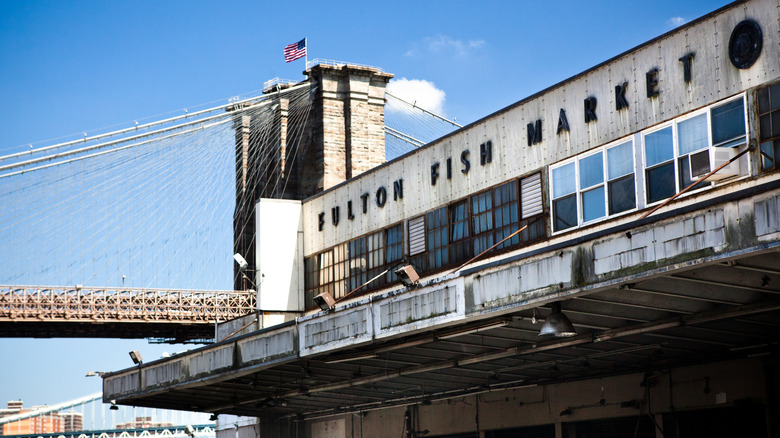
Operating over two centuries, the Fulton Fish Market survived major cultural and historical upheavals: the Civil War economy, the Great Depression, major fires, World War II rationing, shipping changes, and the 1970's NYC fiscal crisis. After the terrorist attacks on September 11th, 2001, the Fulton Fish Market was temporarily relocated to the Bronx, where vendors operated awkwardly out of a hodgepodge of refrigerated trailers in an empty lot. The period was memorialized in a makeshift mural as the ”Hell in the Bronx 9/17/01-10/12/01," according to The New York Times.
While everyone eventually migrated back to the rickety Manhattan market, 2005 marked the year that, after nearly two centuries, the market permanently relocated to the Bronx. However, this time, the New Fulton Fish Market was hosted in a sprawling state-of-the-art industrial complex within the Hunts Point Food Distribution Center, neighboring the city's large-scale, meat and produce cooperatives. Today, that complex functions as one of the primary perishable food channels in the area. As Ackerina notes, "Over one-third of NYC's fresh food passes through these markets!" Trucks move through Hunts Point all night long, carrying countless pounds of fresh food to be sold in grocery stores, restaurants and neighborhood markets across the five boroughs.
A significant, but waning, portion of the current population of market workers experienced both locations. "I personally worked for years out of a building that opened in 1817," DiGregorio reveals. "Two of the newer structures along the river included the Tin Building, which opened in 1907, and what we called 'the new market,' built in 1939 after the building it replaced collapsed into the river in 1937."
United we stand, divided we flounder
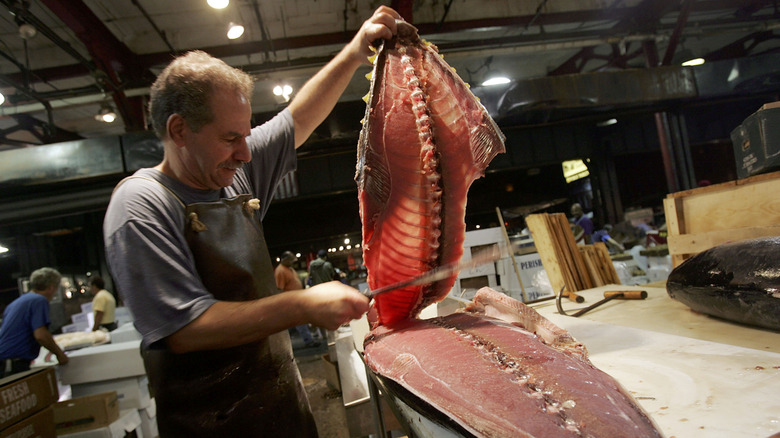
One of the reasons the Fulton Fish Market has survived more than two centuries is that it operates structurally as a cooperative rather than as a single company. The vendors collectively share the infrastructure and machinery of the market, the cold rooms and loading docks, the floor space and forklifts, and the steady stream of buyers. Much like a school of fish, individual sellers run their own businesses, but the strength is in their group formation.
The shared ownership model allows small operations to survive and even make big waves in a business that would otherwise be dominated by a handful of big corporations. The modern Fulton Fish Cooperative Market is part of a long tradition of workers coming together to build their own infrastructure in an economy that isn't designed to tip in their favor. And an online presence hasn't hurt the brand either. "We're thrilled to bring world-class seafood to customers across the country and give them the resources to feel more comfortable preparing a variety of seafood at home," adds Fulton Fish Market E-Commerce CEO Mike Tonetti.
With the rising sun, the market winds down. The ice melts into the drains in the floor, and the trucks are loaded with seafood, fanning out across the city in every direction. A few hours later, chefs will plate oysters in fine dining rooms, fishmongers will arrange fillets in neat rows over crushed ice, and diners will order sea bass or grilled branzino without knowing where it really came from — or all the labor that went into getting it on the plate.