

8 Types Of Carrots And How To Cook With Them
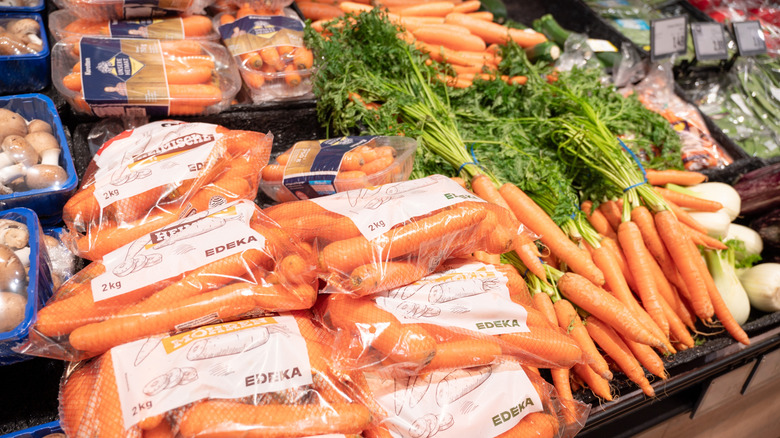
Carrots aren't exactly the most glamorous vegetable. They usually just kind of sit there on the side of your plate, providing a cheerful, golden-orange contrast to other vegetables. We eat a lot of them, though. According to the USDA, Americans eat more than 8 pounds of carrots a year per capita. And why not? They're affordable year-round, and you can use them in all kinds of sweet and savory recipes.
But unless you're a home gardener, you might not have realized that there are lots of different kinds of carrots, and it's occasionally worthwhile to match a carrot type to a recipe, or vice versa. Sure, you won't often see a lot of variety at the grocery store, but you'll find alternative carrot types at farmers markets and upscale grocers, or you can grow them yourself at home.
As an avid home gardener, I grow multiple types of carrots every year, and as a trained chef and former restaurateur, I've put a lot of time and thought into showcasing their flavors. As a result, I'm pretty well versed in the subject of carrots, so here's a breakdown of a few different types that you can buy or grow, how they differ from each other, and suggestions for how best to cook them.
Imperator
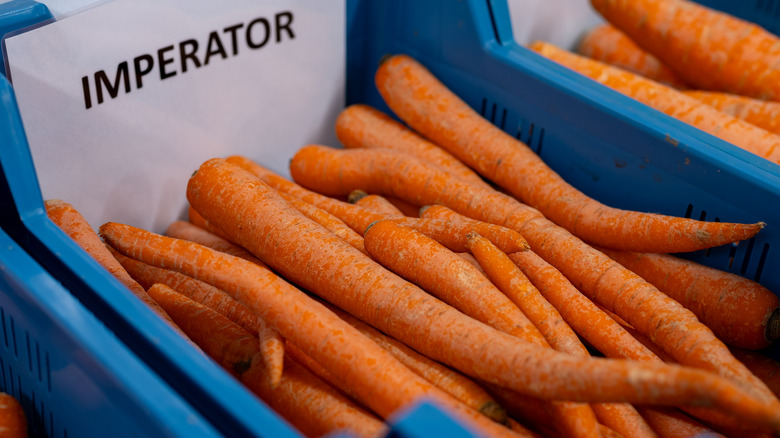
We're going to start with a type of carrot called Imperator, because this is the default "supermarket carrot" variety that you'll see everywhere in North America. They're an excellent carrot for commercial growers because in good soil they'll produce long, nicely shaped roots – typically at least nine or ten inches in length – that taper gently to a pointed tip. When you picture a carrot in your mind, it's almost certainly an Imperator.
Imperators are also long-storage carrots, which translates into good year-round availability — one of the main reasons they're the default supermarket carrot. They vary a bit in terms of flavor and sweetness depending on where they're grown and how long they've been in storage, but they're generally a great all-purpose carrot. Garden tip: If you leave Imperators in the ground until after the first couple of frosts, the chill will boost their natural sugar content.
Imperators are likely the carrots you've eaten all your life, so you know that they're versatile enough to work with any cooking method. They're fine for boiling or roasting, and they'll hold their shape and texture when slow-cooked in a braise or a stew. Plus, they're usually still sweet enough to serve raw on a crudités tray or grated in a salad. If you've got some Imperators that aren't especially tasty, you should try the viral roasted-and-braised "melting carrots" side dish recipe.
Nantes
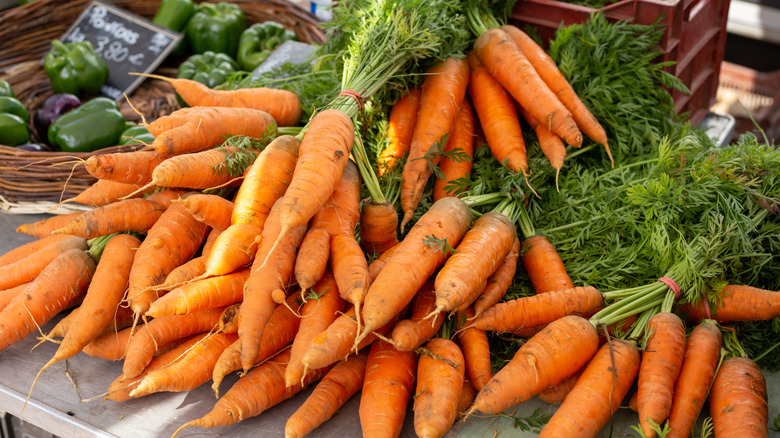
Nantes carrots are easier to find at a grocery store than some of the others on this list, so it's worthwhile keeping an eye out for them, especially in summer. You'll know them at a glance from Imperator carrots because they're a bit shorter, usually topping out at six or seven inches in length. Instead of tapering to a thin tip, they're almost cylindrical and have a rounded tip.
Nantes varieties come to maturity in mid-summer, and some cultivars can be ready even earlier than that. If you live in a short-season climate like I do, you'll see a lot of farmers market vendors selling them. They sometimes appear in supermarkets during their season. I grow at least one bed of Nantes carrots every year because I find they cope better with my stony soil than Imperators do. Nantes' signature characteristics are their beautiful crunch and their extra-sweet, juicy flesh — you could think of them as the Honeycrisps of carrots.
That beautiful texture and flavor is worth showcasing, so Nantes carrots a good option for simple steaming or adding to stir-fries where they'll be minimally cooked. That said, I also like them grilled. First, slice the carrots lengthwise and par-cook them by boiling, steaming, or using the slow side of your grill. Then, coat them in oil and cook them on the hot side of the grill to char, caramelize, and develop grill marks.
Chantenay
Chantenay is a type of carrot that you'll usually only find at farmers markets or in your own garden. They're relatively short – typically less than five inches long – but they make up for it by being very thick at the base. As a result, they're sharply tapered and cone-shaped.
Their size and shape come down to the fact that they're bred for growers with "problem" soil. If you have shallow growing beds or you garden in an area where the soil is stony or heavy with clay, you should still have consistent success with Chantenays. I find their texture to be a bit coarser than other varieties, but they have a good carrot flavor, and the red-cored varieties are visually striking.
Overall, I consider Chantenays to be perfectly acceptable all-purpose carrots, so I plant a bed of them every year. You can use them in any dish where you'd ordinarily use a supermarket Imperator, but I especially like to roast them. Roasting helps to bring out their deep carrot flavor, and many spices, herbs, or spice mixtures — such as garlic, cumin, and garam masala — complement them beautifully. They're also really juicy, making them a prime candidate for blending into juices or smoothies.
Danvers
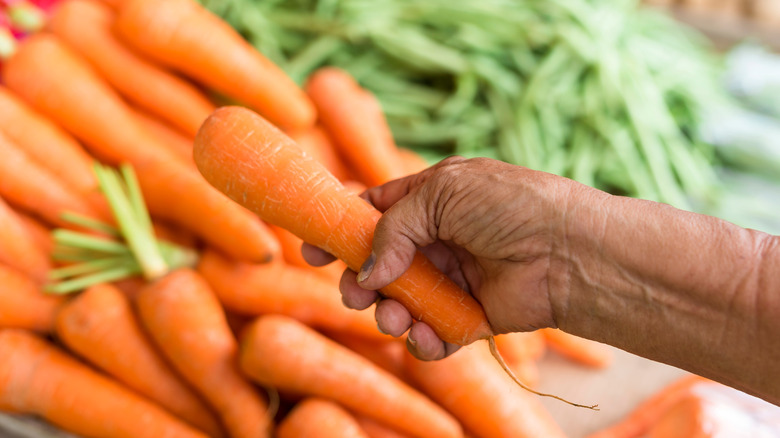
Danvers carrots look like a cross between Imperators and Chantenays. Averaging between six and seven inches long, they're shorter than Imperators but longer and less conical than Chantenays, and they have a rounded tip, rather than a pointed one. Their name comes from the town in Massachusetts where they were first grown and marketed.
As you'd expect from a New England breed, Danvers carrots are cold-hardy and can grow in stony or substandard soils while still producing a decent root that stores well for winter. Like Imperators, they're a good all-purpose carrot, with a flavor that's reasonably sweet but — as always — variable depending on growing conditions and the specific cultivar.
Danvers carrots aren't exceptional in terms of flavor or texture, so they're a versatile carrot for boiling, steaming, roasting, and shredding for salads. I've also used them in Indian-style pakoras, which make for an interesting alternative to conventional recipes. Like Imperators, Danvers carrots are also excellent when glazed, which is a good technique to have in your pocket for when you find yourself with long-storage carrots that aren't especially sweet. Try pairing them with Tasting Table's maple pecan carrot glaze – you'll thank me later.
Baby carrots
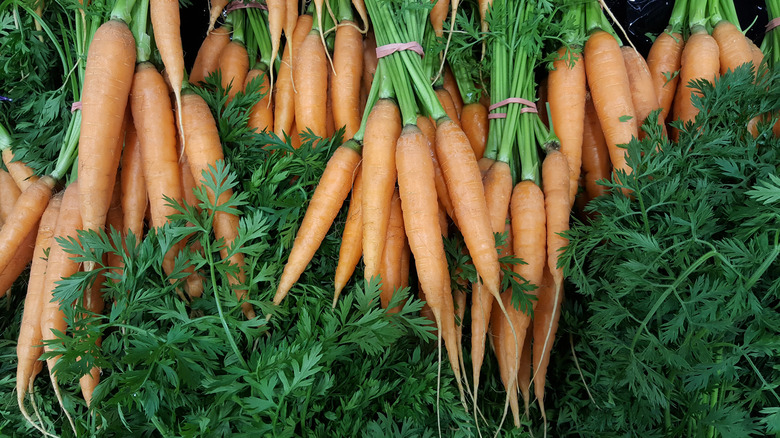
Until the 1980s, the term "baby carrots" didn't refer to those bags of suspiciously uniform, peeled carrots you see in the supermarket. Those are just ordinary supermarket carrots, cut to length and shaved down to a smaller size.
Genuine baby carrots are a lot rarer, and while they'll crop up occasionally at the supermarket when they're in season, you're more likely to find them at a farmers market. They aren't cut to shape, they're a specific variety of carrot which — like baby or fingerling potatoes — are designed to mature quickly into a small but harvestable size. They're unusually sweet and tender, and you'll sometimes see them served at high-end restaurants with a bit of their leaf stem attached as a visual symbol of farm-freshness.
Baby carrots taste excellent raw, but if you must cook them, do so minimally to make the most of their delicately sweet flavor. Steaming until they're just tender-crisp is a good option, or you can slow-cook them at low temperatures in a bit of butter. If you have a sous vide setup, cooking baby carrots with it really concentrates their sweetness.
Globe carrots
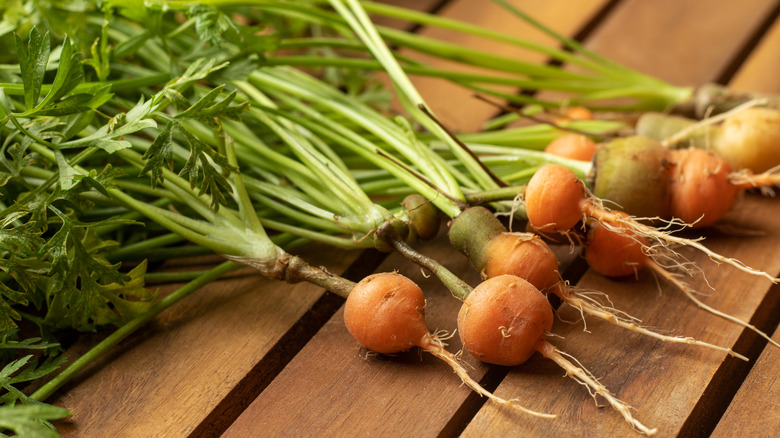
Globe carrots are an appealing novelty — something you'll seldom see at a supermarket but will find occasionally at farmers markets. They're exactly what the name implies: carrots that have been selectively bred to grow into a ball shape, like a radish or small beet, rather than the conventional long, tapered root.
If you're a home gardener, globe carrots are a great option for planting in the kind of dense or stony soil that makes a gnarly mess of regular carrots. Most varieties are quite sweet, especially when eaten fresh, and you'll find that kids are fascinated by their unusual shape — if you struggle with getting your little ones to eat their vegetables, this is the variety to grow. I mostly treat these like sweet Nantes or baby carrots, but their unusual shape opens up extra possibilities. Small globe carrots — or larger ones, halved — make an interesting addition to a tray of roasted vegetables, for example. I like to thinly slice larger ones for use in salads using my mandoline, but if you use one of these handy kitchen tools, remember to wear a protective safety glove.
Steaming globe carrots preserves their flavor nicely, and I like matching them with other small, round vegetables, such as white turnips, pale-green kohlrabi, and striped "candy cane" beets. Cut the vegetables into wedges and serve them cold with a vinaigrette for a light and summery side dish.
Rainbow and colored carrots
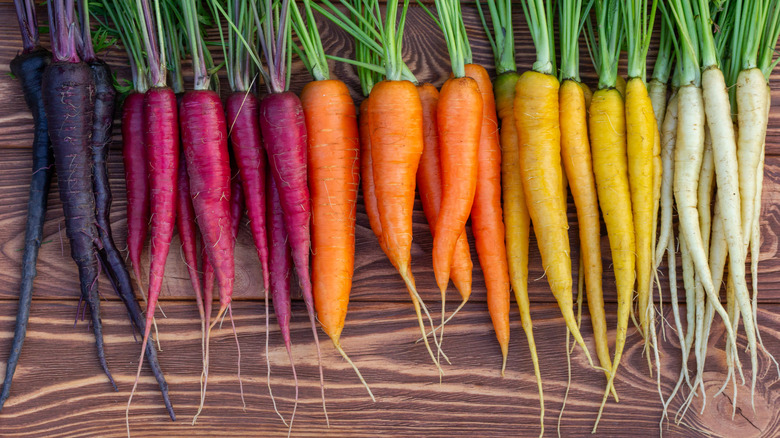
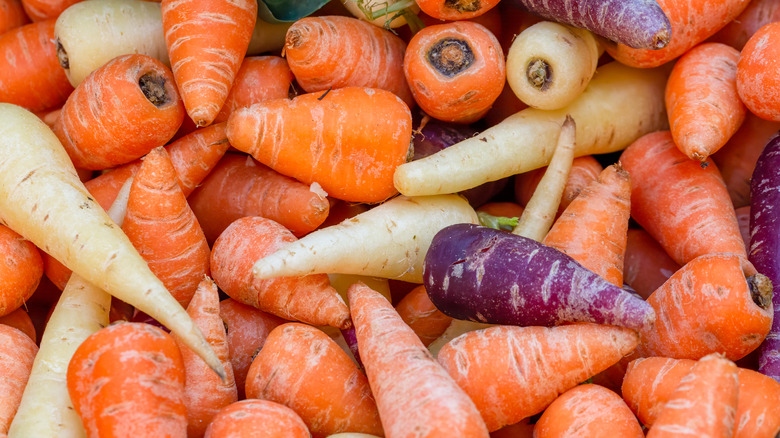
I'm going to lump rainbow and colored carrots together, even though they aren't all the same. Rainbow carrots are actually a specific hybrid, which results in varying color combinations of white, yellow, and orange. The various red, purple, and "black" (actually a very dark purple) carrots are different cultivars.
Except for their color, rainbow carrots are very much like Danvers or Imperator carrots in terms of their general-purpose versatility. Purple and red carrots are variable, with some having distinct earthy or even bitter notes, and occasionally having an almost spicy quality. Some red and purple carrots are orange on the inside, giving them a vivid two-tone effect on the plate.
Rainbow carrots can be boiled, steamed, roasted, or served raw, and their varying colors will lend visual appeal to your meal. I always try to cut them into long pieces to maximize the effect. The same holds true for red and purple carrots. Bear in mind that red carrots' color comes from lycopene, which isn't water-soluble, while purple carrots' color is caused by anthocyanins, which very much are. To retain their color, avoid boiling, steaming, or braising them. Instead, they're best roasted, stir-fried, grilled, or served raw. I especially like colorful carrots for roasting, as they're less likely to break during cooking, and you can season them with compatible flavors like ginger and orange.
Asian carrots
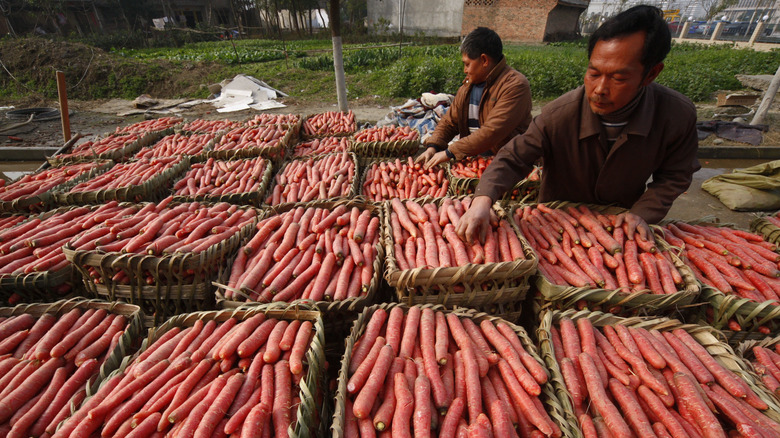
If you're paying attention, you may have noticed that all of the varieties we've described so far have Western (cough) roots. Yet carrots are thought to have originated in modern-day Afghanistan or Iran, and they're grown all over the world, meaning there are many notable varieties from Asian countries.
I'm admittedly selling Asian carrots short by lumping them all together, but unless you grow them yourself, you're unlikely to find them outside of an Asian grocery store or food market. So, rather than getting into the metaphorical weeds with carrots you're unlikely to encounter, I'll stick with a few notable examples. There are the tender and sweet, Nantes-like Japanese Kurodas, which are typically seven to nine inches long. There are various Kintoki-type cultivars, which are red carrots from the Kyoto region of Japan. There are also some Chinese carrots worth mentioning, including the big white "daikon carrot," the colorful Shanghai Pink, and the small, flavorful "red stone tail."
Many Asian varieties resemble Nantes carrots or are straight-up Nantes hybrids, and they can be cooked the same way. They also feature prominently in pickle-making across the various cuisines of China, Japan, Korea, and Southeast Asia – homemade kimchi might be the easiest recipe to try if you're new to pickling. They're also excellent in the cold noodle salads that are so popular throughout the region. These varieties are different enough from each other that I want to avoid generalizing them any further, so I suggest tasting them and choosing a cooking method based on the Western-style carrots they most resemble.