

Think Twice About Ogee Countertop Edges If You Have A Smaller Kitchen — Here's Why

There are many ways to make a small kitchen feel more spacious — and just as many kitchen renovation mistakes to avoid because they could actually make it look even smaller. Before you embark on a small kitchen renovation, consider how each design element will fit in the space at hand. For instance, you should think twice about using ogee countertop edges in a small kitchen.
Though decorative countertop edges are a popular kitchen design trend for 2026, they aren't necessarily the right choice for every kitchen. An ogee countertop edge features a two-part curve. The upper is a concave arch, which extends into a convex arch at the bottom. That means that this decorative, S-shaped profile extends out from the natural endpoint of the countertop, and requires a little more clearance than a traditional flat edge. So, not only do ogee countertops look more dramatic and impressive, they take up more space. In small kitchens, even that little extra bit of clearance can make a huge difference in how easy it is to maneuver around a kitchen island or fit in all of the appliances you need to install.
The swooping, prominent design of this countertop edge can also seem a little too busy for a confined space, especially if other elements of your kitchen's design or architecture are similarly ornate. If you prioritize minimalism in your kitchen design or are trying to make a small kitchen appear larger, an ogee countertop might overpower the space and make it feel oppressive.
Best countertop styles and edge designs for small kitchens
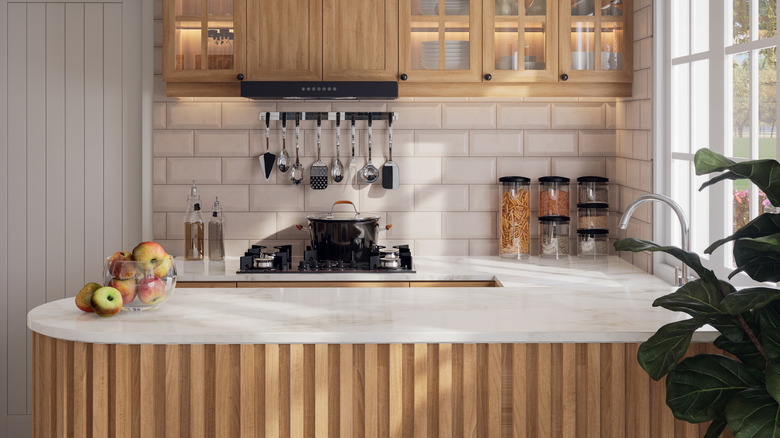
The best countertop styles for small kitchens are ones that are low-profile and simple. You can make the space feel brighter and airier by opting for light colors, simple patterns, and sleek countertop edge profiles. Choosing countertops that echo the colors used for your kitchen backsplash, cabinets, flooring, and wall and ceiling paint can draw the eyes up and around the room, essentially tricking you into perceiving it as larger than it is. Conversely, creating clearly delineated areas using dark or contrasting colors may draw attention to small, cramped spaces.
Because small kitchens may be harder to navigate due to tight corners and awkward spaces, you'll also want to weigh the pros and cons of curved vs sharp edges for your kitchen island and countertops. A straight countertop edge is a classic, traditional choice and can complement any architectural style or décor. Its clean, minimalist design allows you to maximize usable space without highlighting tight confines, but its sharp edges may increase the chances of bruises and scrapes, especially in a small kitchen.
If you have kids or elderly parents in your home, a bullnose edge is a great choice. Because its edge is fully rounded, it won't pose a risk of injury. As a bonus, its smooth, sleek curves can complement both modern and vintage kitchen aesthetics, balancing out more extreme or harsh elements in a harmonious way. An eased countertop edge is a nice compromise between straight and bullnose. It offers a clean, modern look that doesn't add unnecessary bulk. It also has a nicely rounded corner that minimizes the risk of injury as you navigate tight spots in your kitchen.