

Servers Notice This Clear Difference Between Boomer And Gen Z Diners
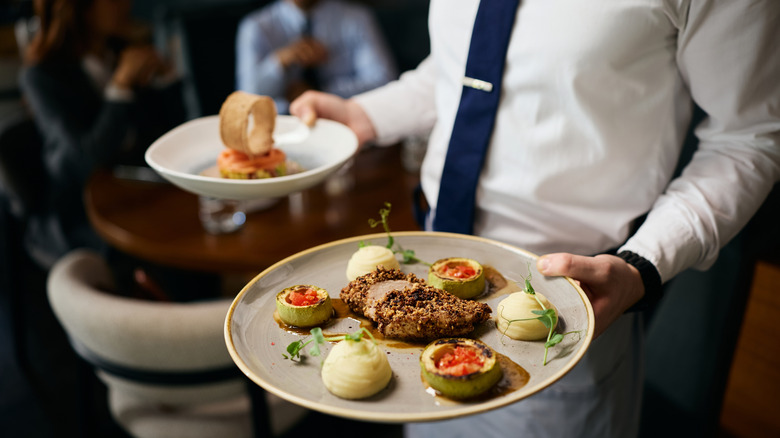
You've probably heard about the "Waiter Rule." It's the ultimate personality test, which basically argues that how someone treats restaurant staff says a lot about whether they treat people decently. It essentially places the server at a certain vantage point, from where they aren't just witnessing social behavior but experiencing it first-hand. And from this vantage point, servers notice a clear difference between Boomer and Gen Z diners — the former talks a lot, and the latter too little.
Now, it should come as no surprise that Boomer and Gen Z diners are a study in contrasts. After all, the gap between the two generations is a minimum of 33 years, going up to 57 years. For the older lot, a good bar is one with a familiar face and a quiet corner. For the young ones, the non-negotiables are good lighting and a photogenic cocktail. Boomers will have a litany of complaints about today's restaurants, from the cost of food and drinks to menus accessible only by QR Codes. Meanwhile, Gen Z's finest will complain about Boomers.
From the servers' point of view, the one thing that stands out is how, and how much, Boomers engage with them. They'll start with small talk, ask about their day, drop a compliment, and overall try and make a personal connection before moving on to questions about the menu. The line between familiarity and over-familiarity is thin, though, as is the one between building a relationship with the waitstaff and expecting the moon from them. Going by posts on Reddit, it's clear that many Boomers don't know where that line is.
When trying to be nice causes disruption
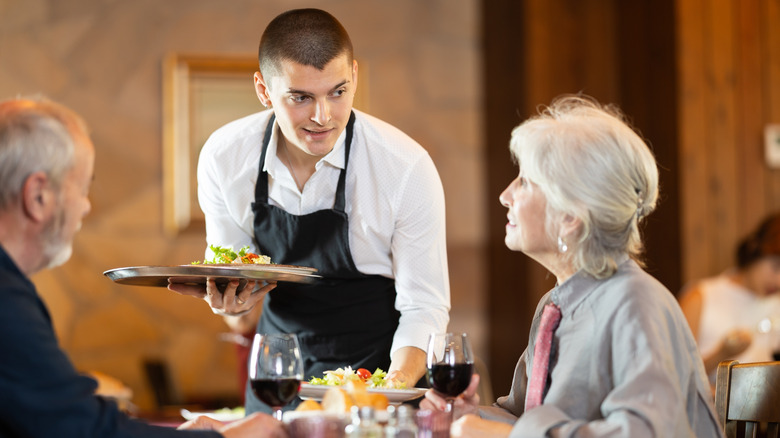
Trying to engage can come at a cost, as one Redditor proved in a post about a meal at "an excellent restaurant" with his "super friendly" father. They wrote, "My dad wanted to compliment someone on the food, and for some reason decided to tell that to the host rather than our waiter." The father didn't care that the host was busy doing his job — he just wanted to pay them a compliment. "He proceeded to get up and interrupt the host (who was talking with two guests before seating them) by putting his hand on the guy's shoulder and reaching out with the other to shake his hand with a big smile." The host, taken aback, tried to turn away, but the dad was having none of it, smiling and shaking the host's hand while telling him what a great experience he'd had. "Meanwhile, I died inside."
Here's another example of over-familiarity from the same Reddit thread on dining with Boomers: "A relative we regularly went out to eat with would get up from the table, and go into the kitchen to chat with the chef," wrote one commenter. This might seem friendly enough until the punchline: "I'm pretty sure it was to give advice."
This tendency towards over-familiarity could stem from older generations knowing exactly what they want. Having said that, while Boomers get a lot of flak about their behavior in restaurants, it's not like dealing with Gen Z is a walk in the park for servers.
Dealing with the Gen Z stare

The problem for servers dealing with Gen Z customers is that they very often say nothing. This phenomenon has been called the "Gen Z stare" — where the person stares blankly at you, with dead eyes, creating extremely long, awkward silences. "I do this when I don't want to be having a conversation with somebody but am forced to be there," admitted one person on Reddit. "It's the 'yes, I'm listening but I'm not engaged' stare."
Understandably, restaurant staff really can't stand this Gen Z habit. "I noticed the gen z stare the most when I was working as a server," an ex-waiter wrote on Reddit. "Half the time I greeted 20-somethings, it was an awkward experience. Like I'd greet them and smile and be met with four blank stares ... the stares were often disruptive to the tasks being completed as quickly as possible."
While Gen Z customers might be happy eating chicken dinners on repeat, it's clear that restaurants need their patronage. This can be gauged from the fact that restaurant brands are trying to reel in Gen Z customers using Amazon ads, trying to distract them momentarily from shopping to consider stepping out for a meal — even if that means having to interact with a server.