

How Much An Average Steakhouse Dinner Would Run You In The 1970s
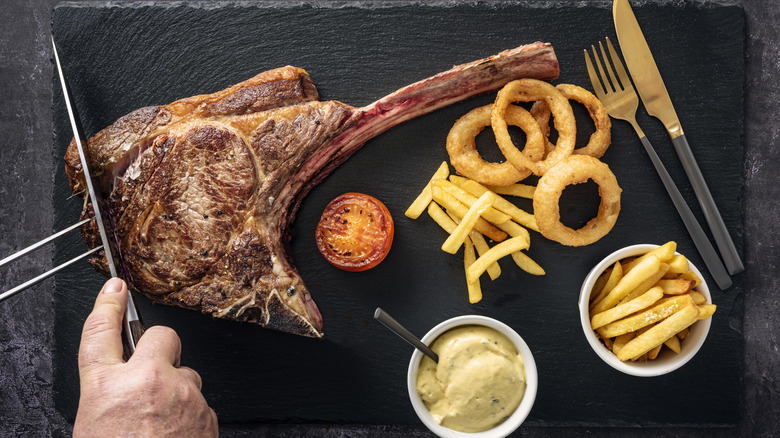
Steak dinners have never really been cheap, but if you wanted one in the '70s, you weren't always breaking the bank. These days, however, it seems like a weekend steak dinner is slipping more and more out of reach for most diners. Beef prices have surged over the past six years, even more so than other food products, with the average price of steak or ground beef increasing more than 50% since early 2020. That even makes steaks from the grocery store pricey, and forget about eating out unless you are heading to Texas Roadhouse or the few other chain restaurants that have managed to use their scale to keep costs a little more reasonable. But in the '70s? You had plenty of options.
The internet is full of old menus, and the steakhouse ones are a wonder to behold. Take Ponderosa, for example. It was the Texas Roadhouse of its day, with Ponderosa Steakhouse once having over 700 locations serving discount beef. This menu, found on Reddit, from the '70s (roughly early '70s based on other Ponderosa menus), has sirloin steak dinner listed for only $1.79, and a T-Bone for only $2.49. Unlike many modern menus, it doesn't list the portion sizes, so it's hard to tell exactly how good a deal it was, but those prices equate to roughly $14.17 and $19.71 today when you factor in inflation. And those old prices included a full meal with baked potato, salad, and a roll. The current prices for those items at Texas Roadhouse are $17 for an 8-ounce sirloin and $35 for the T-bone. And Ponderosa wasn't the only place you could find those steak prices in the '70s.
The days when New York strip steaks and sirloins were less than $3
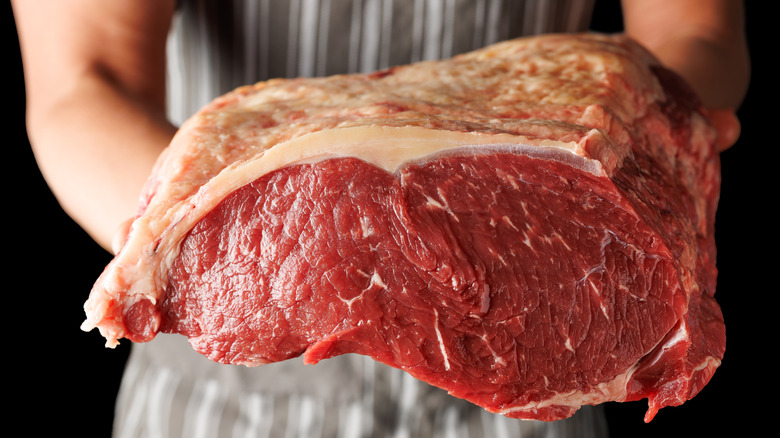
While Ponderosa was on the affordable side, it wasn't that unusual. At Ranch House, a chain that has a dozen locations up and down the East Coast, a New York Strip steak would run you $2.75, and top sirloin was $2.15 in 1971. Salad bar staple Sizzler was also at the top of its game, and you could stop there for a $2.99 New York Strip, or $2.69 top sirloin. Seems like at a steakhouse chain, $2.10 ($16.60 today) was the going price for sirloin in the early '70s, while higher-end cuts would run you closer to $3. However, that's still only about $23 dollars in today's money, a price a lot of diners would be happy to see on the menu in 2026.
However, the '70s weren't without their own problems. In fact, inflation was one of the biggest stories of the decade back then, too. The overall inflation rate topped 12% in both the mid and late '70s, a rate that was more than twice the inflation we dealt with from 2022 to 2023. And beef prices were hit hard, as the average cost per pound more than doubled from 1970 to 1980.
Cattle herd sizes cause jumps in steak and beef prices
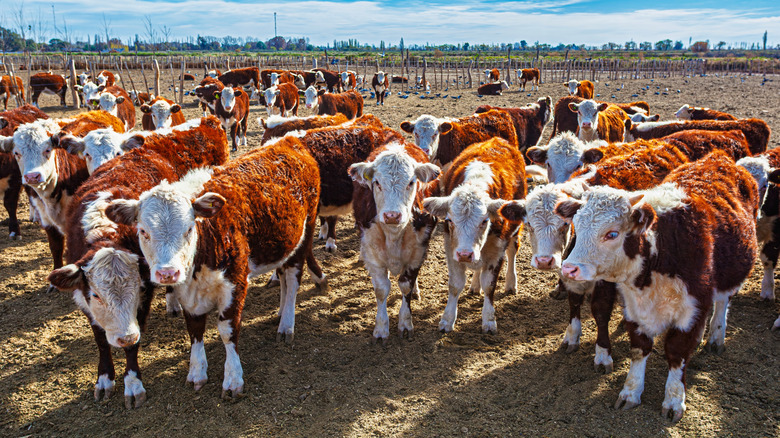
The high beef inflation of the '70s was caused by a drop in cattle supplies, which came about because of the unusually low price of beef in the early part of the decade. And that inflation shows up on old menus too. By the mid-1970s, some other mid-priced chain steakhouses, Steak & Ale, Steak & Brew, and Western Sizzlin', had sirloin steak prices that averaged $4.46 between the three chains, and New York strips prices that averaged $5.63. That means the average price of a sirloin at these chains had risen to around $28 in today's money, and the equivalent of $35 for the strip steak. In fact, beef prices were considered so outrageous in the mid '70s that they inspired consumer boycotts.
And we are facing a similar situation with high beef prices today. While the pandemic saw jumps in the price of almost all food, beef is also under pressure from drought. A multi-year lack of rain in cattle country has meant that American ranchers have had to cut down on the size of their herds, and also supplement feeding with grain, which adds to the cost of raising their cattle. And while beef imports can sometimes help paper over a lack of supply from American producers and keep prices down, the current administration has hit major beef exporters like Brazil with huge tariffs to the opposite effect. It has gotten to the point where the American cattle supply is the smallest it's been in 75 years, and we have nowhere else to go to buy. But just like prices have risen and fallen in the past, those '70s prices show us that you never know when relief might be coming.