

This Mexican Staple Gets Its Flavor From A Confit-Style Technique
Confit is a French word which, in truth, refers to any type of preserved food. It can be fruits cooked in a sugar syrup, or it can refer to meats and vegetables cooked in fat. In the realm of general culinary terminology, however, confit typically refers to a technique by which meat is salted and cooked in plenty of fat, creating a shelf-stable product that could be stored for long periods of time. Duck confit, or confit de canard, is likely the best-known dish utilizing this method, a plate of succulent, fall-off-the-bone duck legs slowly cooked in its own fat and then, ideally, seared in a pan to crisp the skin. But while this cooking style seems distinctly French — at least when you use the word "confit" — it's also the key to truly excellent Mexican carnitas.
Carnitas, which translates to "little meats," is a dish that is widely credited to have first been developed in the town of Quiroga, in the state of Michoacán, west of the capital, Mexico City. In this original style, small chunks of salted pork are simmered in copper pots filled with large quantities of lard, aka pork fat, which is sometimes flavored with ingredients like garlic, onions, bay leaves, and even orange juice or cola. The resulting dish, if you've never had true Michoacán-style carnitas, is a beautiful combination of flavors and textures. Each chunk of meat is tender and juicy in the center, but with a crisp, browned exterior, just like good duck confit. There is a magic to this style of cooking, and while it isn't the easiest technique to bring home, there's nothing preventing you from making excellent carnitas in your own kitchen.
How to make the best carnitas at home
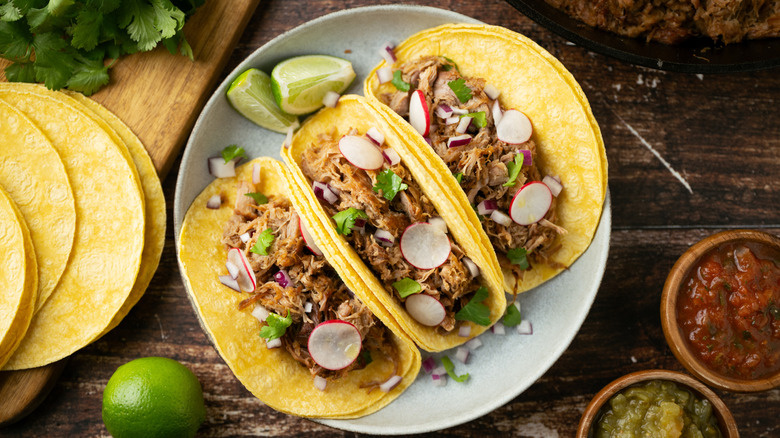
These days, there are countless carnitas recipes out there, many of which differ significantly from the confit-style, lard-simmering technique of Michoacán tradition. While a slow-cooker carnitas recipe can be delicious, these recipes are often more like pulled pork than the Mexican classic. For restaurant-worthy carnitas at home you don't necessarily need a big vat of lard, but you do need to make sure you're cooking with plenty of fat.
Traditional carnitas make use of the entire pig, but for the home cook this is not exactly feasible. The best cut of pork for carnitas in your kitchen is going to be pork shoulder. You may want some extra lard to get the searing done and start the process, but then tone things down to a low simmer and allow the fat to render out, creating that confit effect and maximizing the flavor of the carnitas. As far as enhancing the flavors, you'll also probably want to add some fruits, vegetables, and spices to the oil. Oranges are a common addition — juice and peel — as well as alliums like onion and garlic. You can also add herbs and spices like bay leaves, oregano, cumin, black pepper, and cloves. One unusual addition that many swear by is adding condensed or evaporated milk to carnitas. The sugars latch onto the meat and caramelize, adding another layer of richness to the crust.
Carnitas may not be the simplest preparation, but once you taste that delicious confit-style interplay of crisp crust and meltingly tender center, you'll know there is no other way to do it. Plus, once the meat is cooked, all you need are corn tortillas, onion, cilantro, and a squeeze of lime, and dinner is served.