

If Your Fried Eggs Aren't Picture-Perfect, It's The Heat
We may receive a commission on purchases made from links.
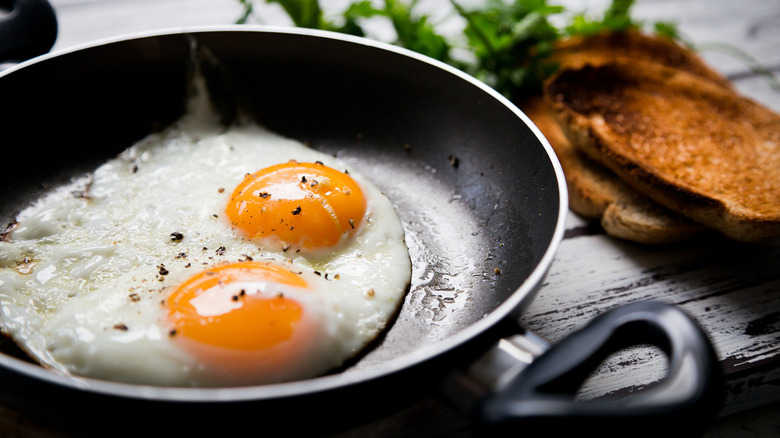
Whether you're topping your next rice bowl or simply enjoying an easy, protein-rich breakfast, fried eggs are a great recipe to master. However, if your fried eggs don't assume their iconic, picture-perfect appearance, it's probably related to temperature. We interviewed Lisa Steele, host of the "Welcome to My Farm" American Public Television series, and cookbook author whose forthcoming title — "In Season" — debuts in May 2026, who said that temperature plays a huge role in the success of a fried egg.
"It's important to fry eggs at a fairly low temperature," she shared. "Egg whites cook much faster than the yolk, so frying an egg at too high a temperature will result in rubbery, overcooked whites with burnt edges before the yolk sets." So, if you're not a fan of runny yolks, it's especially important to fry your eggs at a low temperature so that you don't end up with completely dried out yolks while you wait for the yolk to cook. You can heat oil or butter in a pan over medium heat to receive the eggs, but you might want to turn it down to medium-low once they hit the pan. "I don't think there's a temperature that's too low," explains Steele, "it will just take longer for the eggs to cook!" Better to err on the side of caution than end up with rubbery, burnt eggs. According to Steele, "if the edges of your eggs start to brown and curl up, the temperature is too high."
More tips for mastering picture-perfect fired eggs
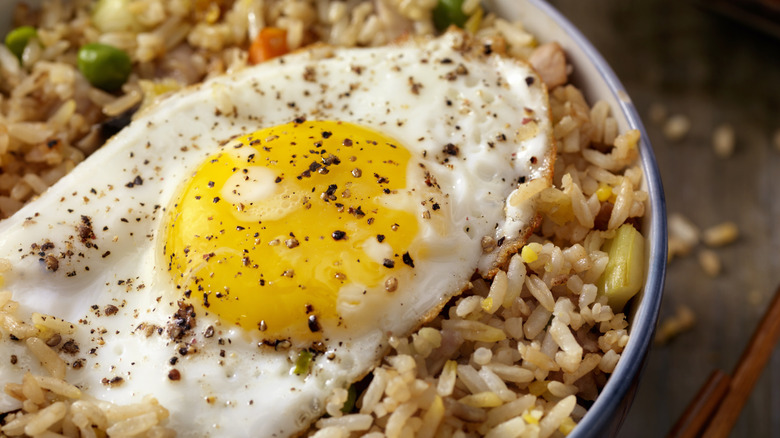
One of the key tips for a successful fried egg is using fresh eggs because, said Steele, "as an egg ages, the whites thin considerably and will spread out in the pan. The membrane on the yolk also thins as an egg ages, so the yolk is more likely to break if you fry an old egg." If you only have old eggs on hand, an easy method to keep fried eggs from spreading is to use a silicone ring to contain them. Don't have a silicone ring? Try using a bell pepper ring or a slice of bread, a la egg in a hole. If the egg whites end up spreading, it may work out in your favor. Another expert we interviewed recommends breaking the egg white membrane so that the egg white spreads. This, he said, would promote more even cooking of the egg white.
While some of us enjoy the crispy brown edges that fried eggs often incur in sizzling oil and butter, others do not. Consequently, Steele told us that "adding some heavy cream to the pan when you're frying eggs instead of using oil or butter will result in creamy, soft whites." Once you've mastered the low and slow method of frying eggs, you could try J Kenji Lopez's approach. According to Lopez, you can make a fried egg in under two minutes by using a high-heat method in a thick, high-quality cast-iron pan.