

What To Look For In Store-Bought Pie Crust, According To Jeff Mauro
We may receive a commission on purchases made from links.
We indulge in some desserts only for flavor-related reasons, but others carry sentimental notes as well. Pies are so very often at the center of traditional holiday celebrations that they always come with hints of nostalgia and familial comfort. Making pie from scratch is not overly complicated, though it does take some time. That's why many of us reach for store-bought crusts to shorten the process.
We caught up with chef Jeff Mauro, who recently partnered with Bayer Aspirin to promote heart health, and asked him for tips on picking out the best pie crust at the store. "The cleanest label, just flour, butter, salt, sugar," Mauro told us, pointing out that a short, simple label is "often an indication of quality." Some commercial pie crusts come with a laundry list of ingredients because they're predominantly focusing on being shelf-stable, so they have to include certain preservatives. But in Mauro's view, the crust you get at the store shouldn't be that different from one that's made from scratch. "If you're not going to make it, you might as well have it as close to the same ingredients as if you would have made it," he said.
While Mauro doesn't recommend any specific brand, in our ranking of 9 store-bought pie crusts, we found Wholly Wholesome Pie Shells as the best of the bunch, and indeed, they have a very short ingredient list, containing just organic wheat flour, organic palm oil, organic cane sugar, salt, and water.
Even a cracked store-bought pie crust can be fixed
As average consumers, we usually laser-focus on the visual appearance of the pie crust, checking for any possible cracks on the surface before even thinking about turning it over and reading the ingredients. According to Mauro, people can take the crack-checking a little bit too far sometimes. "It's kind of like popping the little nub off the avocado to see if it's ripe. You're kind of breaking before you buy, so I don't want to advocate opening the box and peeking inside," he said. However, he does acknowledge that checking for cracks is still important — and it's up to the brand to make the packaging clear enough for the customers to check without jumping through hoops. "It's almost like eggs. It's like, it should be in clear packaging, shouldn't it?"
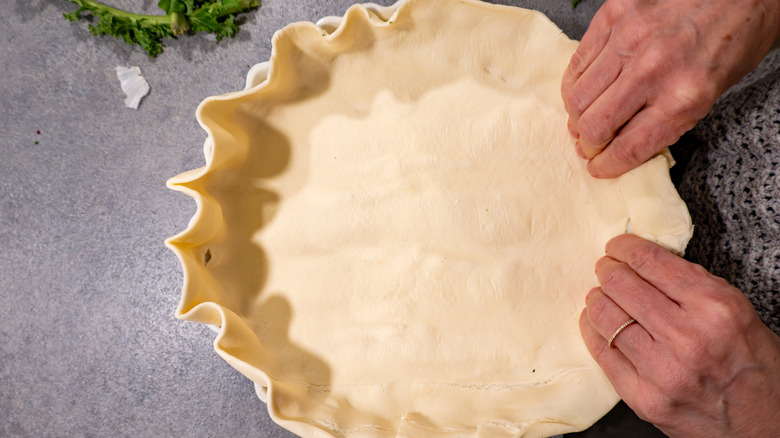
Sometimes we can still end up with a cracked crust, though, despite taking all the precautions. It happens, but it's not the end of the world because it's easier than you think to fix a broken pie crust. "Just let it come to room temp and you could patch it up with a little water," Mauro told us. If the crack is bigger, you could also opt for the spackle method, which mixes together a little bit of flour and butter until a pliable dough is formed, which you can then place over the crack to patch it up.