

The FDA Has Issued The Highest-Level Recall For Frozen Blueberries In 4 States
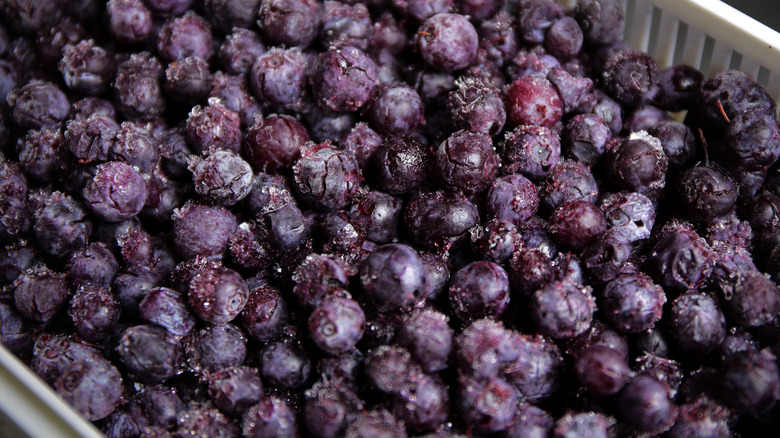
The U.S. Food and Drug Administration (FDA) has issued a major recall of frozen blueberries across four states due to a potentially lethal bacteria. A total of 55,689 pounds of frozen blueberries may be contaminated with Listeria monocytogenes. The recall was actually issued back on February 12, 2026. However, since that time, the FDA has upgraded the severity to a Class I recall. This is the highest and most serious level of recall the FDA issues, and indicates what the agency calls "a situation in which there is a reasonable probability that the use of or exposure to a violative product will cause serious adverse health consequences or death."
The IQF, or individually quick frozen, blueberries were not sold directly to consumers, so you don't need to worry about having bought them at a grocery store by accident. However, they were sold in 30-pound cases and 1,400-pound totes commercially in Michigan, Oregon, Washington, Wisconsin, and Canada. The lot codes for the 30-pound cases are 2055 B2 with an expiration date of July 23, 2027. Also affected are lot codes 2065 B1 and 2065 B3, which have July 24, 2027, expiration dates. The affected 1,400-pound totes have lot codes 3305 A1 and 3305 B1. Both feature expiration dates of November 25, 2027.
Oregon Potato Company, which operates Willamette Valley Fruit Company, issued the recall voluntarily, but the FDA has not published where the blueberries were sold or to whom. That means it's unclear at this time when or where consumers may have come into contact with them. Past frozen food Listeria recalls have followed very serious consequences, including deaths.
Where the blueberries went
The FDA did not issue a press release about the recall. For that reason, there is no further information about where the blueberries actually went. In containers of that size, the blueberries were clearly intended for commercial use. That means they could have been supplied to restaurants or food manufacturers. If so, those businesses would have to notify customers in the event of a health risk, which might lead to a press release.
According to the FDA's own guidelines, they typically issue a press release, especially in the case of a Class 1 recall, unless they don't feel that it would be beneficial to the public. According to the agency, one such case is when "the product is limited to a small number of consignees that are easily identified and can be rapidly reached through targeted contact." Given that these are large, commercial portions of blueberries in a relatively small geographical area, that may be the case with this recall. The Oregon Potato Company could have reached out to the companies that purchased the blueberries before they were used in any way that would affect the public.
Fruit can easily get contaminated with Listeria. If you do have any concerns, you could contact the Oregon Potato Company based in Salem, Oregon, to ask questions. Listeria outbreaks can be serious, especially in newborns, pregnant people, the elderly, and those with weakened immune systems. Symptoms of Listeria infection (also called listeriosis) may include fever, headache, nausea, abdominal pain, and diarrhea. Contact a health professional right away if you experience these symptoms and suspect Listeria to be the cause. If you are in one of the affected states, keep your eyes open for the news regarding blueberries if you are concerned over the next few days.