

Blended Whiskey Isn't Always Basic — This Award-Winning Scotch Is Proof
The general mindset among Scotch whisky drinkers has been that single malts are the way to go. Simply adding those words — "single malt" — to the description of a bottle is enough to pique the interest of many would-be consumers. And while there are certainly plenty of wonderful single malt whiskies out there, an enthusiast who chooses to eschew blends is foolishly limiting their tasting experiences. A single sip of Dewar's Double Double 21 Year, however, may be enough to make this clear.
The biggest difference between a single malt and a blended whisky is that blended whiskies can be made with product from many different distilleries, whereas everything that goes into a single malt must come from just one producer. Beyond that, single malts must be produced using only barley, while blends can make use of other grains. Because of these restrictions, single malts provide a clear picture of both regional variations and the styles of specific distilleries. While the broader freedom of blended whisky affords producers the opportunity to selectively draw upon specific elements of different styles to produce something altogether unique.
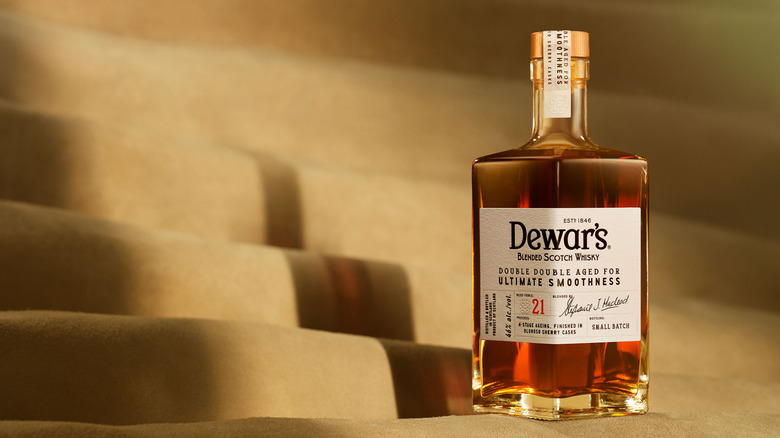
With Dewar's 21-Year Double Double series, the beauty of blended whisky is on full display. This exceptionally smooth whisky undergoes a unique four-stage aging process developed by the brand's master distiller in which single malt and single grain whiskies are double aged in parallel before being expertly mixed. This allows the creation of a perfectly balanced whisky that is mellow yet complex, with notes ranging from honeyed almonds and dark chocolate to cherry blossoms and a touch of brine. The Double Double series also includes several different final cask finishes, with options like Oloroso sherry casks and Japanese mizunara oak casks each adding unique elements.
Blended whisky used to be the top choice
While single malts have an air of luxury to them, blended whiskies deserve a place in your collection as well. Many of the most popular Scotch whiskies are blends, and they absolutely dominate the market in terms of sales. Johnnie Walker, for example, has been the best-selling whisky in the world for decades and all its offerings are blends. In fact, there was a time not so long ago when many saw blended whisky as the better option.
Scotch whisky has been in production since at least the 15th century, and for much of that time the whisky produced and consumed was single malt or single barrel. Things changed in the 1800s, when whisky makers discovered that by blending different whiskies they could create new products with broader appeal. These blends became the norm by the 1920s, spreading around the world to define Scotch whisky for global consumers.
It wasn't until the 1960s that single malt Scotch began a revival. For whisky connoisseurs, the milder flavor of blends never carried the same appeal. The strong flavors and the ties to specific places and histories brought single malt Scotch back to a place of honor, but the broad appeal of blended whisky remained.
The rise of blends is actually said to be one of the top whisky trends to watch in 2026, with producers blending not just for mass appeal, but also to create unique products like the Dewar's 21-Year Double Double series. Blending can be a means to make something simple and palatable, but it can also provide a path to whisky that is distinctive and fresh.