

Judges Couldn't Stop Awarding This Rare Scotch, And You Deserve To Taste Why

Scotches command a great deal of respect in the world of hard liquors for a reason: A quality bottle tastes like nothing else. But if you've ever wondered what's the best bottle of Scotch that your money can get you today, virtually all of the judges at the 2025 Top Shelf Awards and the San Francisco World Spirits Competition will give you a single answer: Rosebank 31 Year Old.
This Scotch has been winning absolutely everything — and no, we aren't exaggerating. At the 2025 Top Shelf Awards, it took home four of the biggest prizes: Best Single Malt Scotch 20 Years and Over, Best Single Malt Scotch, Best Overall Scotch, and even the Best in Show Whisky (the top award). Then it went on to rack up gold awards at the International Spirits Challenge, as well.
So, what's so great about this whisky that people lost their minds over it? Well, this particular Scotch spent — you guessed it — 31 years aging in sherry and bourbon casks before being bottled at 48.1% ABV. The reviews for these bottlings are filled with praise. Unlike many Scotches, rather than peaty, the Rosebank 31 is citrusy and floral right out of the gate. It's been said that the thick, near-creamy liquor tastes like chamomile and berry on the palate and, on its way down, gives a beautiful finish of peach and oak. It's extremely approachable as far as premium Scotches go, meaning most people can enjoy this Scotch even if they aren't a professional whisky-taster. But there's one thing even more interesting than the unusually light and vibrant characteristics of the Rosebank 31, which is its backstory: Did you know that the liquor outlasted the very distillery that made it?
The origin of Rosebank 31 Scotch is quite a story
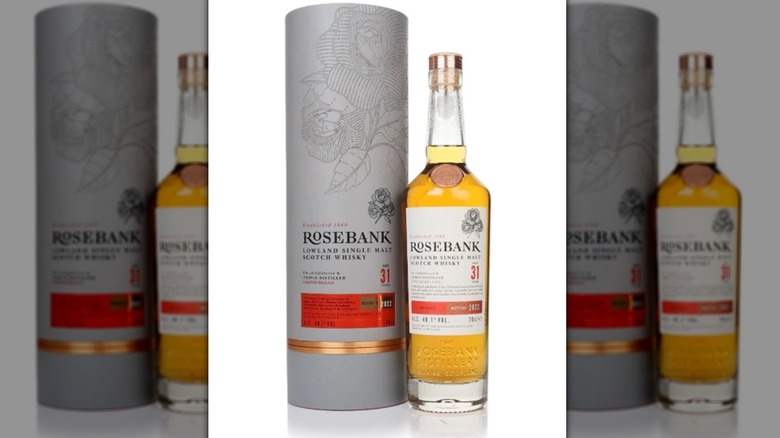
Rosebank's story started in 1840 when James Rankin, a local wine merchant in Falkirk, Scotland, built a distillery in nearby Camelon, along the banks of the Forth and Clyde Canal. An inexhaustible supply of water that's perfect for running stills aside, on either side of the canal were wild rose bushes which, as legend told it, were the origin for the name Rosebank.
Over the decades, Rosebank grew into a serious operation. At first, its stills were mostly used to make blended whiskies under other brand names until, eventually, the distillery started producing single-malts under its own name. By the early 1900s, the distillery was churning out around 170,000 gallons annually and earned the nickname King of the Lowlands (one of the major Scotch-producing regions).
Then the market shifted hard. Like plenty of distilleries in that era, Rosebank couldn't weather the economic downturn of the late 20th century, and in 1993 it shut down after running for more than 150 years. Here's where it gets interesting: When Rosebank closed in 1993, management didn't liquidate the inventory. Six massive warehouses with a maximum capacity of 9,000 barrels remained stocked and untouched for over two decades. In 2017, Ian Macleod Distillers acquired the property and have rebuilt the distillery with the Rosebank name. They decided to crack open those stored barrels and bottle them as part of a Legacy Series under the revived Rosebank label. Rosebank 31 came from one of those barrels, and apparently, time had only made it better — King Charles III actually tasted it at the Palace of Holyrood in January 2026. If the king approved, it definitely didn't get all those rewards by luck or chance.
Is this Scotch more like an Irish whisky?

Experienced tasters will immediately find Rosebank to be very similar to the profile of Irish whiskies — and sure enough, the fruit-and-floral forwardness as well as the smoothness is a match. At first glance, Rosebank's Lowland distillation method looks Irish — unpeated, triple-distilled. The devil is in the details, though. Irish distillers combine malted and unmalted barley in the mash — it's this mixed blend that produces the drink's signature creaminess. Rosebank, by contrast — and similar to a lot of Lowland-style distillers like Auchentoshan – relies entirely on malted barley, which gives a more richly-flavored spirit than a comparable Irish whiskey.
If you so happen to get your hands on one of 4,000 bottles produced (assuming you have the $3000 or so to buy the bottle), other than drinking it neat — hugely recommended for your first sip! — there are plenty of ways that you can put its unique character to good use. In a Scotch whisky coffee, for instance — basically a boozy Irish coffee, but with a splash of Scotch instead. The fruitiness of Rosebank 31 will also shine especially bright in something like a raspberry Scotch sour. Our recipe uses a peated Scotch, but swap it for some of this, and it should accentuate the raspberry preserve and liqueur beautifully with its berry notes. Pair with dark chocolate, aged cheese, or a quiet moment, and you'll get why this rare Scotch is so beloved.