

When Raising Cane's Was Short On Fry Cooks, Corporate Employees Traded Ties For Aprons To Fill In
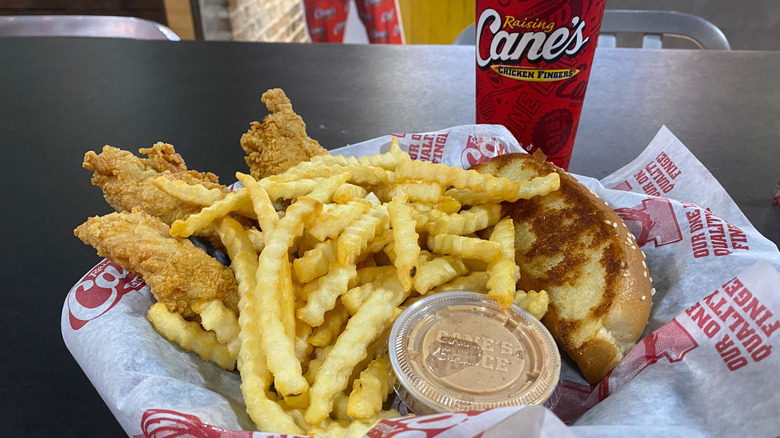
The link between the kitchen and the corporate boardroom is usually restricted to language. You might put a failing project on the "back burner", or search for the "sweet spot" between stretch goals and feasibility. You could even "trim the fat" when a plan starts to feel bloated. And you do all of this without ever stepping in front of an oven. A few years ago though, corporate employees at Raising Cane's Chicken Fingers found themselves shuttling between the frying pan and the fire, and this time it was literal, not figurative.
In 2021, companies across America faced major labor shortages — one of the many cascading effects of the lockdown triggered by COVID-19. Thousands of businesses shut down, leading to 22 million job losses. However, as companies adapted and reopened within 12 months, the number of job openings exceeded the number of available workers, especially in the hospitality sector. According to CNN, 71% of restaurants were running understaffed at the time.
For Raising Cane's Chicken Fingers, addressing this shortage was a huge priority, given that they needed to hire 50,000 people in 50 days to fuel their growth plans. As a short-term fix, they took a creative decision, getting corporate staff to double up as line cooks and cashiers at understaffed stores. "It's obviously unprecedented times, there's no playbook on how to get through it," the company's co-CEO AJ Kumaran said at the time, as reported by CNN. "It's all hands on deck." That they didn't lay-off any employees during the pandemic and got corporate employees to double up as fry cooks are among the facts that make the Raising Cane's story so interesting.
How the Raising Cane's operation played out
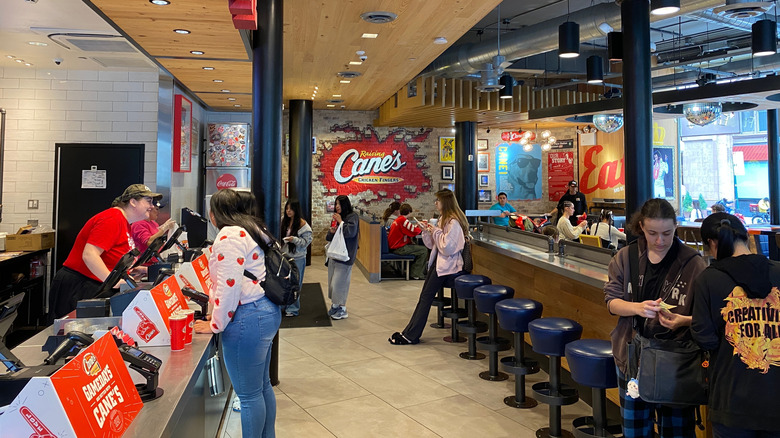
Considering Raising Cane's was projected to fail from Day 1 (because of its too-simple menu), the company is used to beating the odds. To deal with the staff shortage, over 50% of the 500 corporate employees based in Dallas were reassigned to either restaurants or one of more than 500 drive-thrus. A similar number of marketers and trainers were also shifted to front-line restaurant jobs or temporary recruiting roles.
The employees seemed to take it in their stride, too. "I absolutely love it," said Heather Teroy, who went from corporate recruiting to the kitchen. "It breaks up the monotony of my day-to-day work and I get to be out with this awesome crew. So much fun," she was quoted as saying in a Denver 7 article. Incidentally, even before this temporary reallocation of roles, every member of the Raising Cane's staff had "fry cook and cashier" in their job title. "Because that's what we do," Raising Cane's founder Todd Graves told Forbes in 2020. "We're supporting those frontline cooks and cashiers who are supporting our customers right now." All new employees start their career with restaurant training, so each of them knows the Raising Cane's 24-hour method for perfect fried chicken.
The move was as much about showing the whole workforce that everyone at the company was pulling in the same direction. As Kumaran himself pointed out, when your total workforce was over 40,000 people, pushing 750 corporate employees to the frontline wasn't going to move the needle in practical terms. "But it's the thought that counts, it's the idea that everyone steps in, it boosts the culture and that's what we're working on right now," said Kumaran, according to Denver 7.