

9 BBQ Restaurant Red Flags You Should Never Ignore
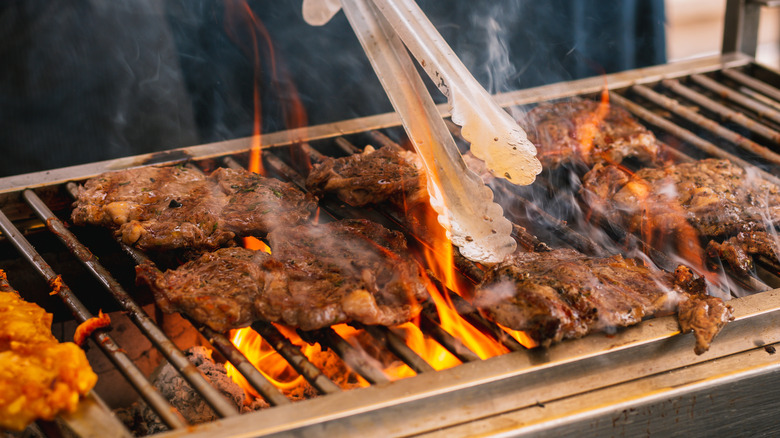
When you're craving umami meat and smoky side dishes, a barbecue restaurant is undoubtedly the place to go. These types of restaurants may not feature white tablecloths and extensive wine lists, but they often boast some of the most delicious food in town. But since BBQ restaurants tend to be pretty casual, how can you really tell if you're going to a good one? After all, just because the atmosphere is humble doesn't mean you're not going to get an incredible meal.
We talked to BBQ experts Jim Carroll, owner of Meat and Greet BBQ Catering LLC, and Chip Carter, CEO, producer, and host of Where the Food Comes From, to learn more about how to spot red flags at BBQ restaurants. Some of these red flags may be fairly obvious, while others can be easy to ignore if you don't know what you're looking for. By being on the lookout for these red flags, you have a better chance of ensuring that the BBQ restaurant you visit actually delivers on the food front, no matter what the space looks like. Let's take a closer look before you plan your next BBQ restaurant visit.
There's no visible smoker
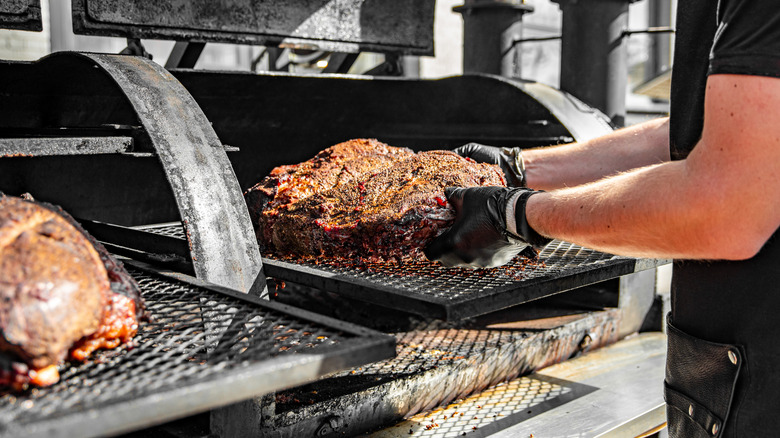
When you go to a barbecue restaurant, you want to make absolutely sure that the chef there is cooking everything on site. After all, if the meat isn't fresh, you might as well just get some sort of BBQ-inspired prepared meal from the grocery store instead of paying a premium for restaurant-quality food. That's why Chip Carter and Jim Carroll both say that if there's no visible smoker at a BBQ restaurant, it's a red flag that you're not going to get a quality meal. "Do they have a barbecue pit or big smokers? If not, they're opening up plastic bags of precooked items in the back," Carter warns.
"Authentic barbecue requires hours of low-and-slow cooking over wood or charcoal," Carroll explains. "Without a visible pit or stack, and absent that distinctive smoke scent upon arrival, meats are likely reheated, oven-finished, or enhanced with liquid smoke."
There are so many creative ways to use liquid smoke in your cooking at home, but you certainly don't want your BBQ to get its smokiness from this shortcut product when you're at a real BBQ joint. According to Carroll, you should actually be able to smell that cooking meat before you even enter the door of a real BBQ restaurant.
The sauces aren't very good
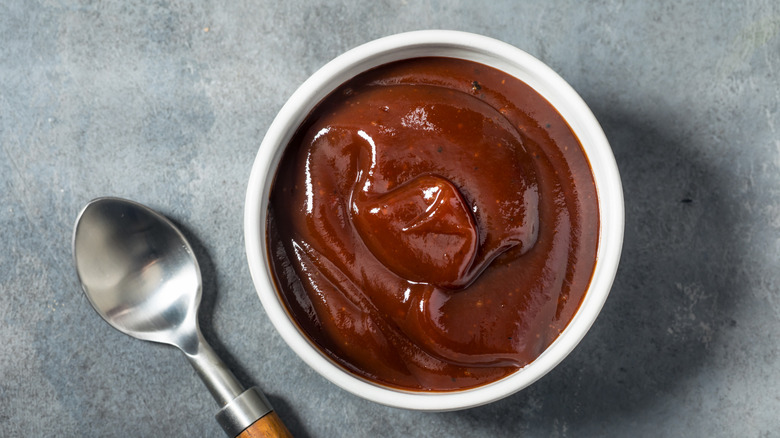
Of course, the most important aspect of a good barbecue restaurant is the meat itself. This is the centerpiece of your meal, and you want to make sure that the meat is cooked well, rendering the ideal flavor and texture in every bite. But the meat isn't the only aspect of a meal at a BBQ restaurant that determines the final flavor you taste when you take a bite. Sauce also plays an incredibly important role in this kind of restaurant, which is why it's a red flag if a BBQ restaurant's sauces aren't very good.
Most good BBQ restaurants, according to Chip Carter, will serve their meat without sauce and allow you to select the variety you want to put on your plate. And if the team is paying attention to sauce quality, you can safely assume that they're doing the same with the meat itself. According to Carter, one shortcut you can use is to "ask to taste the sauce before you order." It's not a good sign if they don't let you taste any, but if they do and you like the sauce, you're probably dodging BBQ restaurant red flags. "You're not going to get bad sauce at a good place, and you're not going to get good sauce at a bad place," he explains. If you're making your own BBQ at home, you should invest in a solid BBQ sauce brand.
Too much variety on the menu
It's always nice to have lots of options to choose from when you go out to eat, but there's a limit. Too many options on any menu can be a bad sign, and the same holds true for barbecue restaurants specifically. That's why, says Jim Carroll, a particularly large menu with a lot of variety is a BBQ restaurant red flag.
"Strong BBQ establishments focus on executing a few proteins exceptionally — brisket, ribs, sausage, chicken, perhaps pulled pork," Carroll explains. "When menus span burgers, fried items, tacos, pasta, and barbecue simultaneously, quality typically deteriorates. True pitmasters build reputations on mastery, not breadth." Not only will you want to look for some focus when it comes to the specific types of dishes and meats a restaurant is choosing to work with, but you can also search for BBQ restaurants that hone in on one specific style of regional BBQ, like Memphis- or East Texas-style BBQ.
Sauce masking dry meat
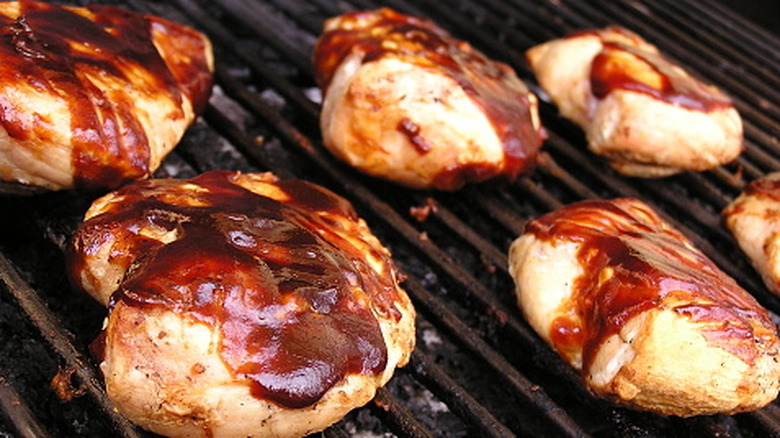
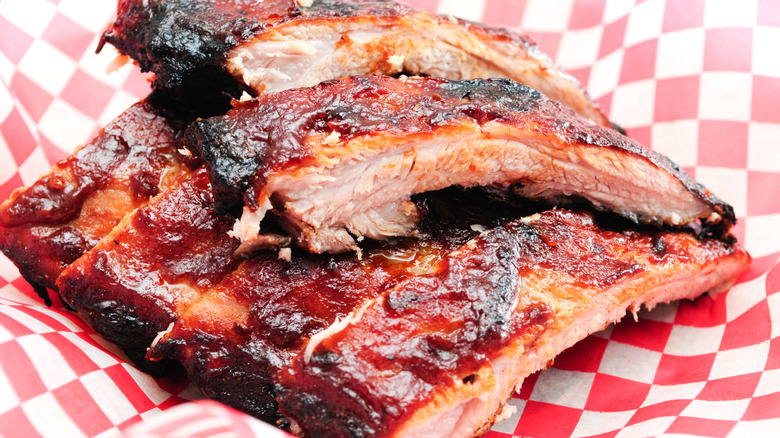
We've already discussed how important it is to go to a barbecue restaurant that offers solid sauces, but that doesn't mean that you should allow a particularly good sauce to completely override the other flavors on your plate. According to Jim Carroll, one common red flag that customers may encounter at BBQ joints is dry meat that's masked with too much sauce. "Sauce should enhance smoked meat, not conceal it," he advises.
In some cases, you might get a dish that's served with the sauce already applied. Burnt ends, for example, often come covered in sauce. However, too much sauce, particularly on some specific dishes, can be a bad sign. "When brisket or ribs arrive dry with heavy sauce application, that indicates rushed cooking or reheated product," says Carroll. "Properly smoked meat delivers moisture and flavor independently." And some types of BBQ don't come with the sauce already applied at all — Texas-style BBQ is one of them. That doesn't mean you can't use a sauce on the side, but it certainly shouldn't be the star of the show.
Brisket that disintegrates like pot roast or that looks grey
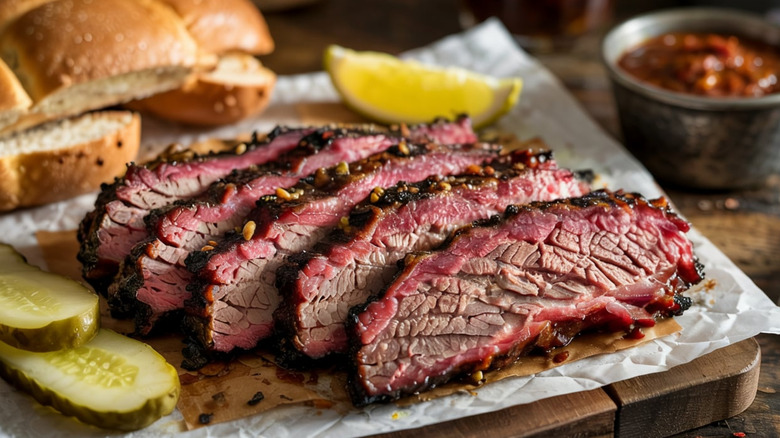
Brisket is one of the most delicious barbecue dishes out there. It just so happens that how a restaurant serves its brisket can tell you a lot about its quality as a whole. According to Jim Carroll, one major BBQ red flag you may encounter is brisket that disintegrates just like pot roast or has a gray, sickly color to it.
"Proper Texas-style brisket displays smoke ring, bark, and clean slicing while maintaining tenderness," Carroll says. You do want your brisket to be somewhat soft, of course, but there's a limit. When you stick a toothpick in it, for example, you shouldn't be met with much resistance. At the same time, it shouldn't be absolutely falling apart when you gently shake the bone either.
Color is another important factor to consider when determining brisket (and, by extension, BBQ restaurant) quality. "Gray meat lacking bark typically indicates steaming, boiling, or oven cooking. That's slow-cooked roast, not barbecue," says Carroll.
Never selling out of anything

It's always a bummer when you make it to a barbecue joint only to realize that the menu item you wanted to order is no longer available because it's sold out. As unfortunate as those moments are, though, it's a sign that you're actually at a really solid spot. Per Jim Carroll, it's actually a red flag if the restaurant you're going to never sells out of anything, especially near the end of the day. "Top BBQ operations frequently deplete brisket or ribs — actually a positive indicator," says Carroll.
Why is it such a green flag if your favorite BBQ place sells out of the best dishes on the menu? "It confirms daily fresh cooking rather than overnight holding," says Carroll. "Establishments maintaining full inventory until closing may reheat leftovers." That's not to say that a restaurant is definitely bad if it doesn't sell out of food at the end of the day, but if you've been to an establishment several times near the end of service and every menu item is still available, it could indicate less-than-fresh food.
Not getting consistently good food every time you go
Sometimes, it takes more than one visit to truly get a sense of how good a barbecue place is. This is because inconsistent quality is a red flag that could indicate other underlying problems at a restaurant. Therefore, you should ideally visit a spot a few times to get a better sense of the consistency of the food quality there. "Quality BBQ demands [a] disciplined process," says Jim Carroll. "When one visit delivers excellence, and the next produces dry, oversalted, or overcooked results, it reveals inadequate pit management and compromised quality control."
There can be several reasons why a BBQ restaurant may offer inconsistent quality in its menu items. High turnover rate, poorly trained employees, and inconsistent sourcing of ingredients can all lead to food that's great during one visit but not so delicious at the next. The only problem? You can't really get a good sense of a BBQ restaurant's consistency until you visit multiple times.
The space doesn't look clean

Most barbecue restaurants aren't particularly fancy places. They may have worn concrete floors or bare bones decorations that don't lend themselves to a particularly aesthetically pleasing environment. However, that's not necessarily a bad thing. The problem is when appearance and cleaning standards venture from humble territory into downright dirty and unkempt. Therefore, you'll want to pay close attention to how clean the space is before ordering at a BBQ restaurant.
"Spaces lacking upkeep typically reflect compromised food safety and cooking standards," says Jim Carroll. If the dining room is particularly messy or unorganized, chances are that it's not much better in the kitchen, where employees are actually handling your food. According to Carroll, "Clean pits, organized prep areas, and presentation pride matter in BBQ as in any kitchen."
If silverware is dirty, if the bathroom is left a mess, or if the floors, menus, or basically anything else you touch is greasy, you should assume that you're at a restaurant that doesn't pay close enough attention to hygiene — a huge red flag in any establishment, BBQ place or not. "I literally inspect with my eyes first — including going to the restroom and looking for anything unhygienic," Chip Carter advises. "A little grime and smoke is one thing, but nasty is another."
Staff members who aren't knowledgeable about BBQ
When you're at any type of restaurant that focuses on a specific type of food, you want the employees to have some knowledge about the food they're serving. Therefore, it's generally a red flag if you ask a staff member at a barbecue restaurant a question and they can't answer adequately. "When asking about brisket timing, wood selection, or freshest offerings yields blank responses, BBQ likely isn't the primary focus," says Jim Carroll. This doesn't necessarily mean the restaurant is bad, but it does indicate that BBQ quality isn't the highest priority at the establishment you're visiting.
Of course, this isn't a cut-and-dried indicator. For example, you might be talking to a new hire who's still learning about the business. But if you ask someone who otherwise seems to know what they're doing about the BBQ offerings on the menu and you get responses that don't seem very knowledgeable, you may not be getting the highest-quality BBQ around.