

The One-Pot Meal From The Depression Era That Turns Beef Into A Hearty Dinner
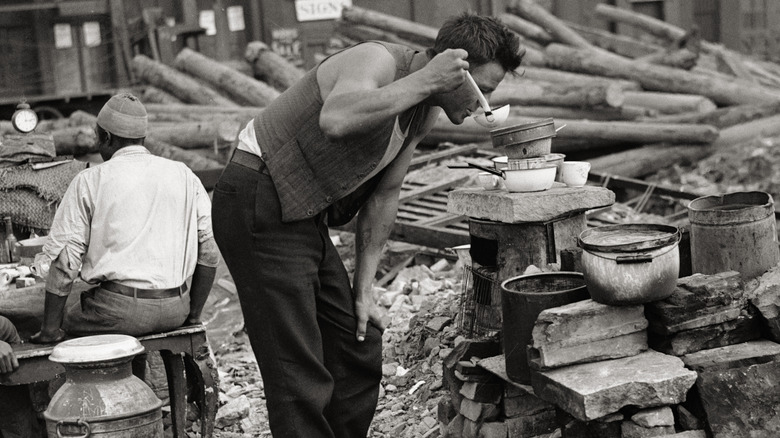
Don't get it twisted — hobos, tramps, and bums are not the same. A "hobo" travels in search of gig work, while a "tramp" simply travels (not seeking work), and a "bum" neither travels nor works. Today, we're giving reprise to a beefy, vintage one-pot meal that deserves a comeback: Mulligan stew, a dish that largely emerged from the Depression Era's "hobo" culture.
Historically, hobos were a wave of migrant workers across America between the Civil War and the Great Depression. Per the lore, the stew's name comes from the outdated Irish slang term "Mulligan" (a common Irish surname), which colloquially refers to any regular man. Even before the Depression officially hit in 1929, Mulligan stew (aka "community stew") found its origins in the American hobo camps of the early 20th century. A 1900 newspaper (via Reference.org) outlines the egalitarian division-of-labor process of "making a Mulligan" in a "hobo jungle" campsite — one person builds the fire, while another person is tasked with finding meat, and another finds potatoes, and on and on: "If a chicken can be stolen, so much the better. The whole outfit is placed in [a large can] and boiled until it is done. If one of the men is successful in procuring 'Java,' an oyster can is used for a coffee tank, and this is also put on the fire to boil." Other iterations coat the beef chunks in flour for richer browning and added thickness.
Mulligan stew was designed for warmth and adaptability in America's hobo jungles
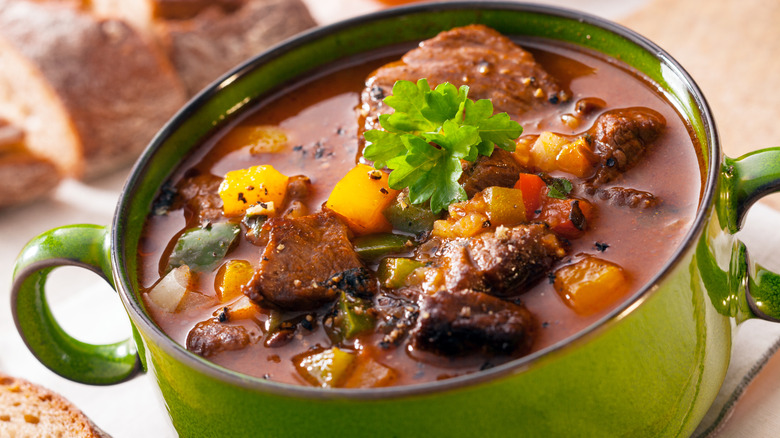
In the pages of a cookbook, Mulligan stew might sound similar to Hoover stew, another Depression-era classic. But, whereas Hoover Stew had its own recipe (macaroni, hot dogs, tomatoes, and corn or canned beans), Mulligan stew is more of a concept than a dish: Meat and vegetables, stewed together. That's it. Nonetheless, it has kept Americans of all walks of life well fed for nearly a century.
Perhaps Mulligan stew's most defining tasting note is its generous amount of ketchup. A recipe for Mulligan stew appears in a 1940 issue of The Brookshire Times (via Tasting History), calling for a can of corned beef, a can of peas (with liquid), onion, water, salt, and pepper, and an entire "medium-sized" bottle of ketchup. Quoth the recipe, "Put all ingredients in saucepan and simmer gently over low flame for about one hour. The flavor improves with the length of cooking time." Subsistence-centric iterations of Mulligan stew were straightforward (with a pop of sweet-tangy acidity), but modern home cooks can get a little "fancier" with their Mulligan mock-ups.
The rustic dish is rooted in resourcefulness and adaptability, a hearty one-pot meal designed to stick to your ribs as warming fuel between train rides. But, for today's home cooks, "making a Mulligan" can provide a thrifty, zero-waste opportunity for using up leftover veggie scraps. All it takes are toothy chunks of beef and vegetables, and canned ingredients are fair game.
Any meat or veggie scraps can be stewed together into something greater than the sum of the parts
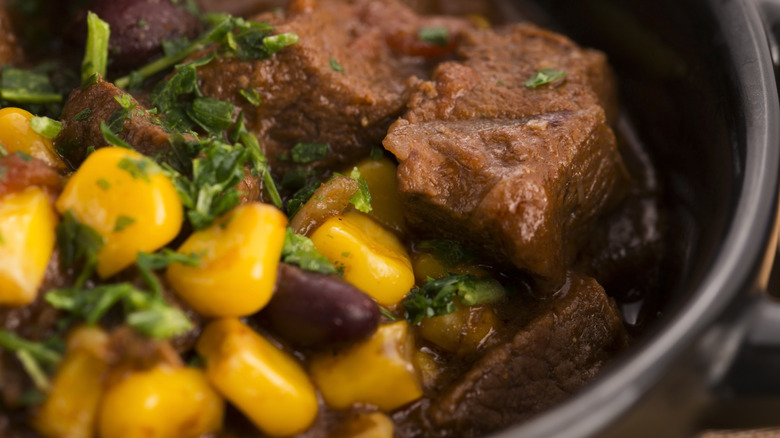
Depending on your available odds and ends, your Mulligan stew might lean beefier or more tomato-forward. A good jumping-off point is some combination of beef broth, carrots, potatoes, celery, onion, lima beans, green beans, peas, corn, and any desired seasonings like Worcestershire, Tabasco sauce, tomato paste, or piney bay leaves, all slow-cooked until tender in the same vessel. Need to clean out the freezer? Economical, versatile Mulligan stew can transform budget-friendly cuts of tougher stew meat like chuck roast or brisket.
Many Depression-era meals are becoming popular again with budget-conscious home cooks – and, while "Mulligan stew deserves its own moment" feels like one of the viral "recession indicator" memes that have been taking social media by storm in recent months, we invite foodies to laugh away the pain and dig into a comforting bowlful. Bonus points if Roger Miller's hobo anthem "King of the Road" plays in the background to accompany your meal — and, ultimately, as Jack Kerouac (tramp, not hobo) observed in "On the Road," "[B]ecause he had no place he could stay in without getting tired of it and because there was nowhere to go but everywhere, keep rolling under the stars," fuelled by a belly full of Mulligan in this brave new world 100 years later.