

Why Tequila Tastes (And Hits) Different In The US Than In Mexico
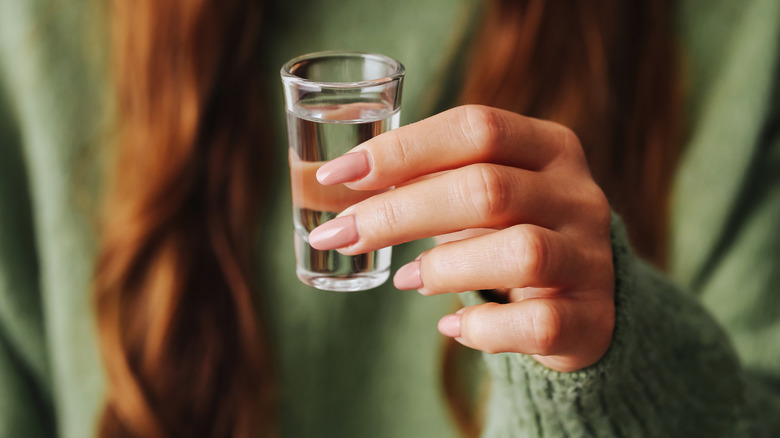
Maybe two margaritas is normally your limit. But Americans taking a trip to Mexico might find themselves craving a third marg. Why? Tequila fans may circle the globe, but the spirit's regulations differ from one national legislature to another. In the United States, federal regulations dictate that full-proof spirits must clock in at an ABV of at least 40%. In Mexico, however, liquor can sit as low as 35% ABV and still be legally categorized as tequila. These changes in ABV affect the tequila's potency as well as taste.
In Mexico, the official standards governing tequila production are set by the Norma Oficial Mexicana (NOM) and certified by the Consejo Regulador del Tequila (CRT), an agency of the Mexican federal government. Per the NOM, tequila sold in Mexico must fall between 35% and 55% ABV. In fact, the same tequila brand may sell a 35% tequila in Mexico and export a 40% version to the U.S. This is also prompted by the fact that lower-ABV spirits are subjected to lower taxation rates in Mexico.
Beyond potency, the NOM also dictates other strict specifications that affect the international tequila market at large. All aged tequilas, for instance, must be aged in direct contact with the wood of oak or Encino oak containers. There are limits on added sugars, the origin of the agave plant, and "100% agave" labelling, among many others.
How differences in ABV affect tequila's taste
In an Instagram post by Lucas Assis, a Los Angeles and Mexico-based bartender specializing in tequila, mezcal, and craft spirits, the mixologist explains that if you're not feeling drunk while drinking tequila in Mexico, "chances are you're not drinking the best-quality tequila Mexico has to offer." According to Assis, a lower ABV is often indicative of more water added to the liquor per batch, with producers making stronger batches of tequila, then diluting them during the distillation process. So, what does this mean, beyond how quickly you'll catch a buzz?
Lower-ABV tequila tends to be smoother on the palate. With its lessened intensity and diminished tasting profile, it's largely better for ripping shots than for crafting tequila cocktails. Although for imbibers, it's worth noting that some lower-quality tequilas with a lot of additives might wreak just as gnarly a hangover at 35% ABV as a higher-quality spirit at 40%.
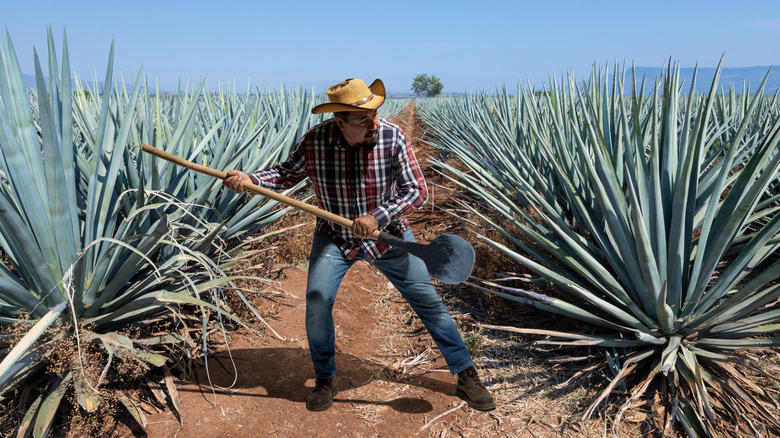
Conversely, higher-ABV tequila delivers an alcohol-forward sharpness on the mouthfeel, which can be rougher going down, but offers a bolder, more pronounced grassy, vegetal flavor from the blue weber plant. As Assis shares, an ABV over 40% is "where you get most of the complexity and the beautiful notes of a bold tequila," including more dimension. Regardless of exact potency, geography further affects tequila's flavor. In order for liquor to be legally labeled "tequila" anywhere, it must be produced in one of five designated Mexican growing regions — Jalisco, Michoacán, Tamaulipas, Nayarit, and Guanajuato — each of which produces a spirit with a unique, distinctive terroir.