

The Clever Way Fast Food Chains Trick Our Brains Into Thinking We've Saved Money
How susceptible would you say you are to psychological trickery? The clever ploys marketers might use to influence you into paying more money for products. Many of us might think we could see through such tactics. However, evidence suggests otherwise. The decoy effect has proven effective in convincing customers to pay more for a product than they otherwise would, especially in the fast food world.
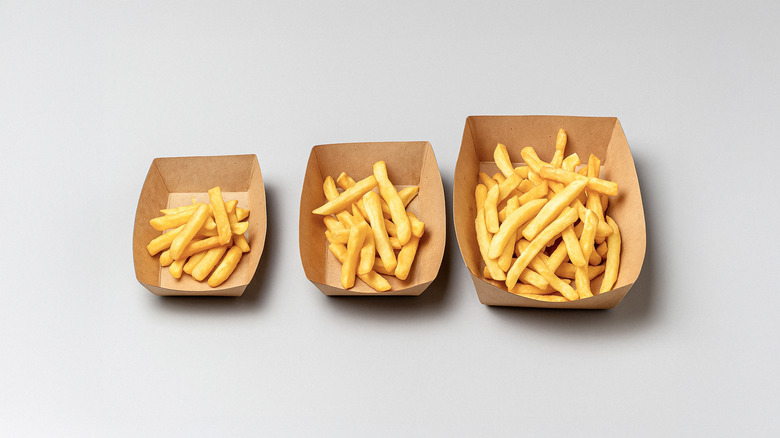
When given the choice between two similar products, people often choose the cheaper option. The decoy effect makes use of a third option to get you to pay more money. It can do this in one of two ways. The first method tricks you into buying a mid-priced option. Let's say a restaurant sells french fries. Small costs $1, medium costs $2, and large costs $3. Most people will choose medium in this situation, avoiding the one perceived as being too low value and the one that is too expensive. If there was only small and large, more people would probably buy the small. By comparison, with three options, the medium seems better. We've talked before about how restaurants might do this to get you to buy more expensive wine.
An alternate method, called asymmetric dominance, could price the fries at $1, $3.50, and $4. Now the small fries seem like they must have very low value, while the most expensive fries look like a deal. They're only $0.50 more than the medium, which seems like a small difference. The effect tricks you into thinking the large is now the best value. This method is even effective with only two options priced close together.
Decoy is de key
Movie theaters use decoy pricing very effectively. Just look at popcorn. AMC Theaters charge $9.79 for a regular popcorn and $10.79 for a large. It's just one dollar more, why not buy it? Especially if you get that free refill. A combo at Wendy's works the same way. The medium is a dollar more than the small, but the large is only $0.50 more. Starbucks sells a Tall Americano for $4.15. The Grande acts as the decoy at $4.55, making the $4.75 Venti seem like a better value for just $0.20 more.
Restaurants have plenty of tricks to get you to spend more. You may think you don't ever fall for most, and that's very possible. Research from NPJ Science of Learning shows that, in real world scenarios, the decoy effect had influence over just 1% of 3.6 million wine purchases in the United Kingdom. But that's still 36,000 purchases. If the decoy effect caused consumers to spend an extra $10, then it led to $360,000 that would not have been spent otherwise.
The CDC says 36.6% of adults consume fast food daily. If over a third of Americans eat fast food daily, that could amount to about 125 million transactions. If just 1% of those transactions involved spending even $0.50 extra because of the decoy effect, that adds up to $625,000 per day and over $228 million per year. It's clear to see why restaurants might want to employ this tactic to get you to upsize your fries, even if you can't get a Biggie Size at Wendy's anymore.